
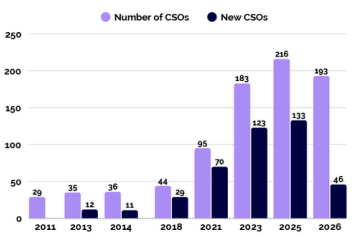
For the first time in 15 years, the number of Chief Sustainability Officers (CSOs) at publicly listed U.S. companies has experienced a notable decline. According to the latest data from the Weinreb Group—a leading executive search firm specializing in the sustainability sector—the count of these C-suite leaders dropped 10 percent, falling from 216 in 2025 to 193 as of July 1, 2026.
This contraction marks a significant inflection point for corporate ESG (Environmental, Social, and Governance) strategy. After a decade of steady growth, followed by a meteoric surge in appointments during the first half of the 2020s, the role of the CSO is undergoing a complex transformation. While some observers interpret this as a cooling of corporate climate ambition, industry experts suggest a more nuanced reality: the role is not necessarily disappearing, but rather evolving, integrating, and in some cases, becoming a casualty of shifting political and economic tides.
A Chronology of the CSO Rise and Stall
To understand the current retraction, one must look at the meteoric rise of the position over the last decade and a half. Following the 2008 financial crisis, the CSO role emerged as a niche, often philanthropic-leaning function. Throughout the 2010s, the position transitioned into a strategic pillar as investors began demanding more rigorous disclosure regarding climate risk and carbon footprints.
By 2020, the momentum was undeniable. The pandemic, coupled with heightened social justice awareness and the solidification of the "Net Zero" movement, saw a massive influx of executive appointments. Companies rushed to formalize their sustainability offices to appease institutional investors and satisfy a new generation of climate-conscious consumers.
The growth remained robust until the 2024–2025 period, when the political landscape in the United States began to shift. The rise of "anti-ESG" rhetoric from various GOP leaders, combined with a more skeptical stance from the current U.S. administration, created a chilling effect in corporate boardrooms. The data provided by the Weinreb Group highlights that the current decline is largely attributed to attrition; when a CSO departs, firms are increasingly opting not to initiate a backfill, effectively shuttering the role at the highest level.
Supporting Data: The "Sustainability Recession"
The term "sustainability recession" has gained traction in industry circles, describing a downturn in corporate commitment triggered by a mixture of political pressure and economic caution. Ellen Weinreb, founder of the Weinreb Group, notes that the decline is not a uniform abandonment of sustainability but a strategic pruning.

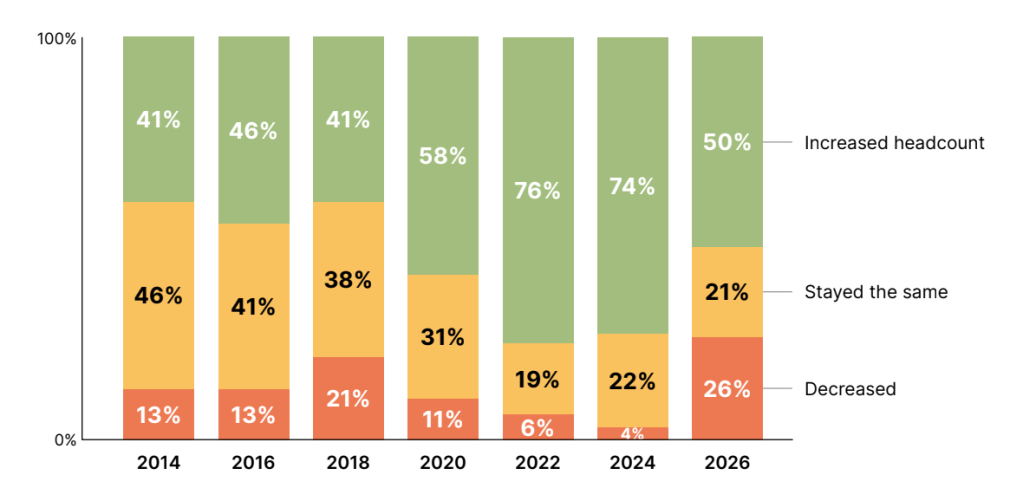
However, the contraction is not universal. Data from the 2026 State of the Sustainability Profession report, which surveyed over 500 sustainability professionals at companies with at least $1 billion in revenue, presents a more complex picture. While the number of CSO titles is dropping, the actual headcount of sustainability practitioners remains resilient.
In 2024, 74 percent of surveyed companies reported increasing their sustainability staff. By 2026, the growth has slowed: 50 percent of companies added staff, while 26 percent reported a reduction. This indicates that while the "Chief" title may be falling out of favor in some C-suites, the underlying operational teams are often being maintained or re-allocated rather than liquidated. The "recession," therefore, appears more targeted at executive-level optics than at the functional departments tasked with decarbonization and regulatory compliance.
The Integration Hypothesis: Moving Beyond the "Optics"
One of the most compelling arguments for the decline of the CSO title is the concept of operational integration. In the early 2020s, many companies appointed CSOs as a reactive measure—a way to manage external brand reputation. As these companies matured, they realized that sustainability cannot be siloed in a corner office if it is to succeed.
"We are seeing a trend where sustainability is being baked into the P&L," says an industry analyst. "When you integrate sustainability into the core business, you don’t necessarily need a CSO to act as a bridge. You need a Chief Operating Officer or a Chief Financial Officer who understands carbon accounting as well as they understand cost accounting."
A prime example cited by the Weinreb Group is the transition of Tara Hemmer. In May 2026, Hemmer transitioned from the CSO position to the Chief Operating Officer role at the environmental services firm WM. This move illustrates a growing preference for operationalizing sustainability rather than treating it as a corporate communications exercise. When a firm moves sustainability responsibilities into the roles of existing COOs or CFOs, the CSO title effectively disappears, but the remit remains, often with more authority and direct impact on the company’s bottom line.
Implications for Corporate Strategy
The decline in CSO ranks brings several critical implications for the future of the corporate sector:
1. The Death of the "Silo"
The era of the "siloed" sustainability department is coming to an end. Companies that treat sustainability as an add-on are likely to struggle in an environment of increasing regulation (such as the SEC’s climate disclosure rules). Future-proof companies are embedding sustainability metrics directly into the KPIs of business unit leaders.
2. The Rise of "Quiet Sustainability"
Political polarization has made public commitment to ESG a potential liability for some firms. By removing the "Chief Sustainability Officer" title, companies may be attempting to lower their profile in the "culture wars" while continuing to pursue energy efficiency and waste reduction under different, less politically charged nomenclature, such as "Operational Excellence" or "Resource Efficiency."
3. Regulatory Pressure as a Counterweight
Despite the decline in CSO titles, the pressure to report on environmental impact has never been higher. Regulatory requirements across the EU and the U.S. necessitate sophisticated reporting structures. While the title may be disappearing, the need for deep, technical expertise in carbon accounting and environmental law is growing. This is likely to lead to a bifurcation of the profession: a reduction in "strategy-focused" C-suite roles and an increase in "technical-focused" middle-management roles.
Challenges to the Current Narrative
Critics of the "sustainability recession" narrative argue that looking at the CSO count is a flawed metric. They suggest that the role was always meant to be transient. In a truly sustainable economy, every C-suite executive should be a sustainability executive. Therefore, the decline of the CSO is not a sign of failure, but a sign of success—a sign that the function has been fully absorbed by the enterprise.
However, this "full absorption" theory is challenged by the 26 percent of companies that reported headcount reductions in the 2026 Trellis survey. For these firms, the shift is clearly motivated by cost-cutting and a reprioritization of capital toward short-term returns. In these instances, the loss of the CSO is a genuine setback for long-term climate targets.
The Path Forward: Professionalization Over Promotion
As the industry moves into the latter half of the decade, the focus is shifting from "promotion" to "professionalization." The early years of the CSO role were characterized by visionary leadership and brand-building. The coming years will be defined by rigorous compliance, supply chain transparency, and engineering-led efficiency.
The decline in the number of CSOs is, in many ways, a normalization of the market. The roles that survive will likely be those that are deeply embedded in the financial and operational reality of the business. For the next generation of sustainability leaders, the goal is no longer to be the loudest voice in the boardroom advocating for change, but to be the most effective architect of the company’s transition to a low-carbon, resource-efficient model.
Conclusion
The 10 percent drop in Chief Sustainability Officers at U.S. public companies is a complex signal. It is a mixture of political anxiety, the integration of sustainability into core operations, and a necessary correction after years of rapid, sometimes superficial, expansion. While the title itself may be in retreat, the underlying mandate—to align corporate activity with the constraints of a finite planet—remains the most significant challenge facing the modern executive.
The companies that thrive in the coming years will not necessarily be those with the most prominent sustainability titles, but those that have successfully woven the principles of sustainability into the very fabric of their operational DNA. The "sustainability recession" may be a temporary hurdle, but the transition toward a more sustainable economy is an enduring, albeit evolving, corporate imperative.