By Pablo Valerio
The landscape of semiconductor design has undergone a tectonic shift. Last month, in the historic halls of Bologna, Italy, the RISC-V Summit Europe 2026 served as more than a mere gathering of engineers; it acted as the official declaration that the RISC-V open-standard instruction set architecture (ISA) has moved decisively from the fringes of academia into the heart of global high-performance computing. From the high-stakes world of enterprise data centers to the harsh, vacuum-sealed environment of deep space, RISC-V is no longer an "emerging" technology—it is the new foundation for the future of hardware.

Main Facts: The "RISC-V is Now" Era
Andrea Gallo, CEO of RISC-V International, opened the summit with a bold, uncompromising message: "RISC-V is now." This wasn’t merely marketing rhetoric; it was a reflection of the architecture’s maturity. The summit highlighted the ratification of the RISC-V Server Platform Specification 1.0, built upon the RVA23 profile.
This milestone represents a critical turning point. By introducing industry-standard boot systems and runtime services—specifically UEFI and ACPI 6.6—to the RISC-V ecosystem, the specification ensures that system software functions seamlessly across a diverse array of server hardware. For multinational corporations and sovereign governments, this is a liberation from the "vendor lock-in" that has defined the x86 and Arm landscapes for decades. By decoupling hardware innovation from proprietary software barriers, RISC-V is providing the technical sovereignty that modern global markets increasingly demand.

Chronology of a Paradigm Shift
The journey of RISC-V from a Berkeley research project to an industrial titan has been marked by several key phases:
- 2010–2015: The Academic Genesis. RISC-V began as an experimental architecture designed for efficiency and transparency. Its modular nature allowed researchers to explore computer architecture without the prohibitive licensing costs of proprietary ISAs.
- 2016–2020: The Industrial Awakening. Early adopters began integrating RISC-V into low-power embedded controllers. Companies realized that the lack of licensing fees combined with extreme modularity allowed for rapid prototyping of custom silicon.
- 2021–2024: Scaling Up. Major players like Google, Meta, and Alibaba began contributing to the ecosystem, moving RISC-V into the realms of IoT and edge computing.
- 2025–2026: The Enterprise Breakthrough. The finalization of the RVA23 profile and the Server Platform Specification 1.0 signaled that RISC-V was ready for the data center. The Bologna summit served as the formal celebration of this transition, showcasing high-performance 128-core processors and space-hardened computing solutions.
Supporting Data: The Ecosystem’s Momentum
The evidence of RISC-V’s rapid adoption is reflected in the sold-out developer workshops at the summit, where 120 engineers engaged in intensive debugging and advanced hardware design. This is not merely a hobbyist trend; it is a professional shift.

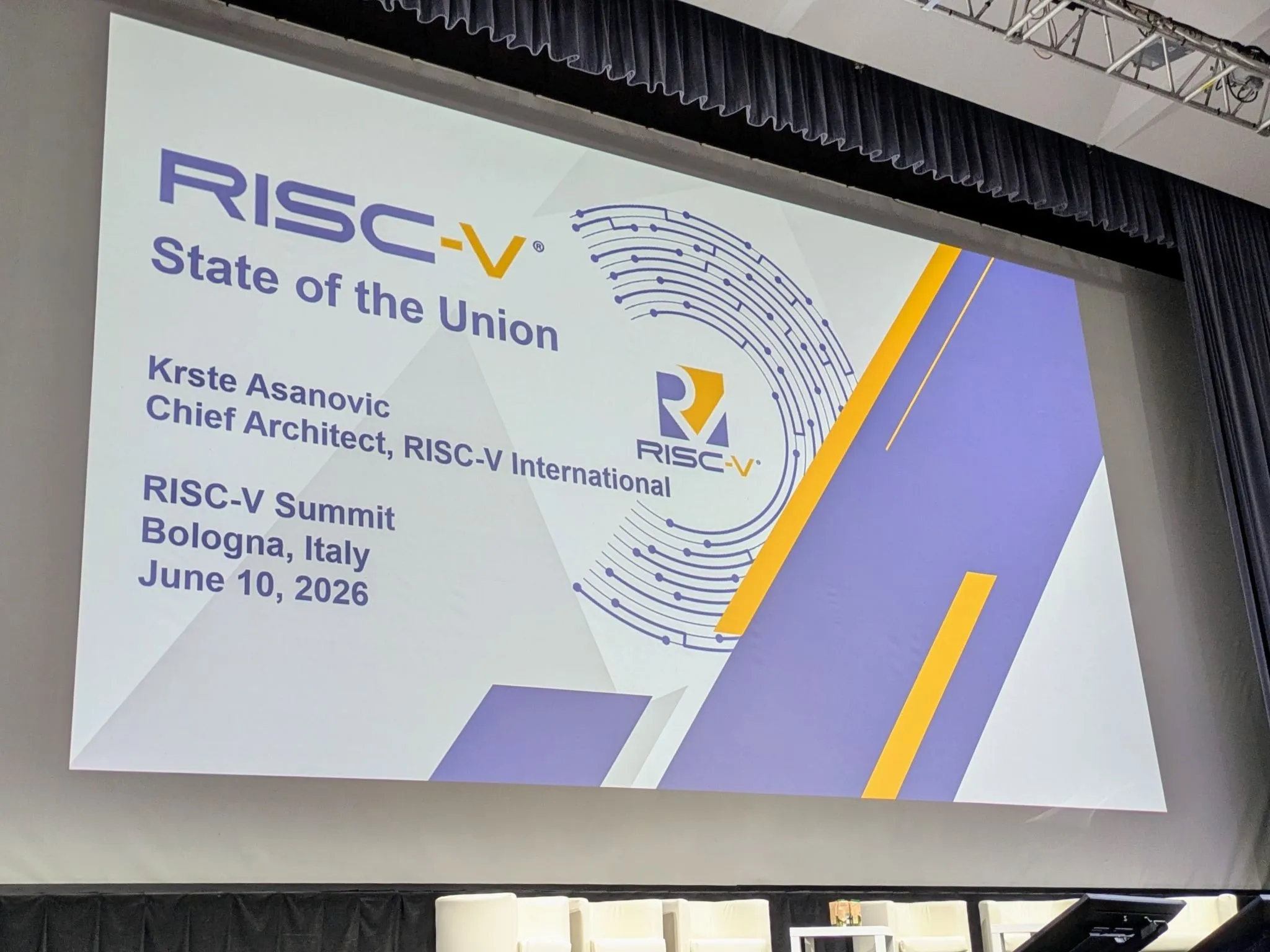
The ecosystem is now supported by a massive coalition of tech giants and agile startups. During his "State of the Union" address, Krste Asanović, chief architect at SiFive and a foundational lead of the RISC-V project, noted that major industry players—including Nvidia, Qualcomm, and Alibaba—are actively integrating RISC-V into their product portfolios.
The data center performance metrics were a focal point of the event. With the RVA23 profile, engineers now have a unified framework that combines hardware and software. This integration allows for the deployment of 128-core processors that compete directly with the performance benchmarks of established incumbents, but with the added benefit of a flexible, open business model.

Official Responses and Strategic Vision
The keynote delivered by Krste Asanović underscored a critical strategic philosophy: the prevention of ecosystem fragmentation. Asanović warned against the tendency of engineers to strip away features to save space, emphasizing that the "standard" in RISC-V is not a suggestion—it is a mandate for interoperability.
"We are already working closely with several hyperscalers and data center owners and suppliers to design these next-generation processors," Asanović told EE Times. "They are investing in RISC-V as an alternative to incumbent architectures because it provides much greater flexibility, both in technical features and in the business model. There is no barrier to providing dominant performance in this space."

His message was clear: While the architecture is modular and allows for immense innovation, the community must coalesce around the RVA23 framework to ensure that software developers can write code once and run it everywhere. This is the bedrock of the "standardization" that allows RISC-V to compete at scale.
Implications: A New Frontier for Innovation
The implications of this shift are profound, touching sectors as diverse as space exploration, environmental conservation, and artificial intelligence.

The Space Industry’s New Backbone
The "RISC-V in Space" session featured experts from NASA’s Jet Propulsion Laboratory and the European Space Agency (ESA). The aerospace industry is moving away from aging architectures like SPARC, which have become prohibitively expensive to maintain and support. By standardizing on RISC-V, agencies like NASA are building fault-tolerant, radiation-resistant computers using open-source foundations. The debut of the NOEL processor line from Frontgrade Gaisler and NASA’s testing of the PIC64-HPSC eight-core processor prove that RISC-V is robust enough for the rigors of deep space missions.
The "Internet of Trees"
Perhaps the most evocative example of RISC-V’s versatility is the "Internet of Trees" project led by researchers from the University of São Paulo. Professors Marcelo Zuffo and Laisa Costa developed the PULGA microcontroller using RISC-V to monitor the Amazon rainforest. By avoiding the "black box" nature of proprietary chips, they created a decentralized mesh network of sensors that perform local neural network processing. This allows for the real-time detection of illegal logging and forest fires—a feat that would be too costly and power-inefficient using conventional proprietary hardware.

Physical AI and the Edge
The summit highlighted "Physical AI"—the integration of AI decision-making into the hardware that controls robots and machinery. RISC-V is uniquely positioned for this because of its advanced vector and matrix extensions. By allowing complex AI algorithms to run on the same core as the control software, engineers can eliminate the latency associated with transferring data to separate neural processing units. This architecture is not only faster but significantly more energy-efficient, a critical requirement for autonomous mobile robots and drones.
Conclusion: The Path Forward
The 2026 RISC-V Summit Europe has effectively closed the door on the era of architectural stagnation. The industry has reached a consensus: the benefits of an open-standard, modular, and vendor-neutral ISA are too great to ignore.

As we look toward the remainder of 2026—the "year of the RVA silicon"—the focus will shift toward the deployment of these processors at scale. We are witnessing the democratization of high-performance computing, where the same open-source principles that powered the rise of Linux are now transforming the physical silicon that defines our digital existence.
The message from Bologna is unequivocal: Whether in the deep canopy of the Amazon, the cold vacuum of space, or the high-density racks of a global hyperscaler, RISC-V is no longer just an alternative—it is the architecture of choice for a new generation of innovation. The "State of the Union" is indeed strong, and the foundation has been laid for a more open, transparent, and collaborative technological future.