WASHINGTON — In a move underscoring the United States’ deepening security commitments in the Middle East, the State Department has authorized a series of potential arms sales to Saudi Arabia, Oman, and Iraq totaling approximately $6.1 billion. The notifications, transmitted to Congress as part of the formal Foreign Military Sales (FMS) process, highlight both the urgent need for replenishment of precision munitions in the region and the ongoing strategic importance of maintaining U.S.-aligned air and ground capabilities across the Gulf and Levant.
Main Facts: A Strategic Re-Arming
The authorization encompasses a diverse array of hardware, ranging from high-tech precision-guided munitions and sophisticated tank powerplants to rotary-wing aircraft.
The centerpiece of this announcement is a massive $5 billion agreement with the Kingdom of Saudi Arabia. Under the proposal, Riyadh would acquire over 10,000 extended-range Joint Direct Attack Munition (JDAM) tail kits. These kits transform "dumb" gravity bombs into precision-guided weapons. The deal includes an equivalent number of 500 lb. and 2,000 lb. munition bodies, effectively providing the Royal Saudi Air Force (RSAF) with a massive surge in strike capacity.
In a secondary, smaller deal for Saudi Arabia, the State Department cleared the sale of 60 AGT-1500 tank engines—the heavy-duty powerplants for the M1 Abrams main battle tank—valued at $750 million.
Additionally, the Sultanate of Oman has been granted approval for a $188 million sustainment package for its fleet of F-16 Fighting Falcons, while Iraq is set to bolster its aviation capabilities with the purchase of Bell 412EPX helicopters in a deal valued at $150 million.
Chronology of Regional Tensions
The rapid-fire nature of these announcements reflects a region currently operating at a high tempo of military activity.
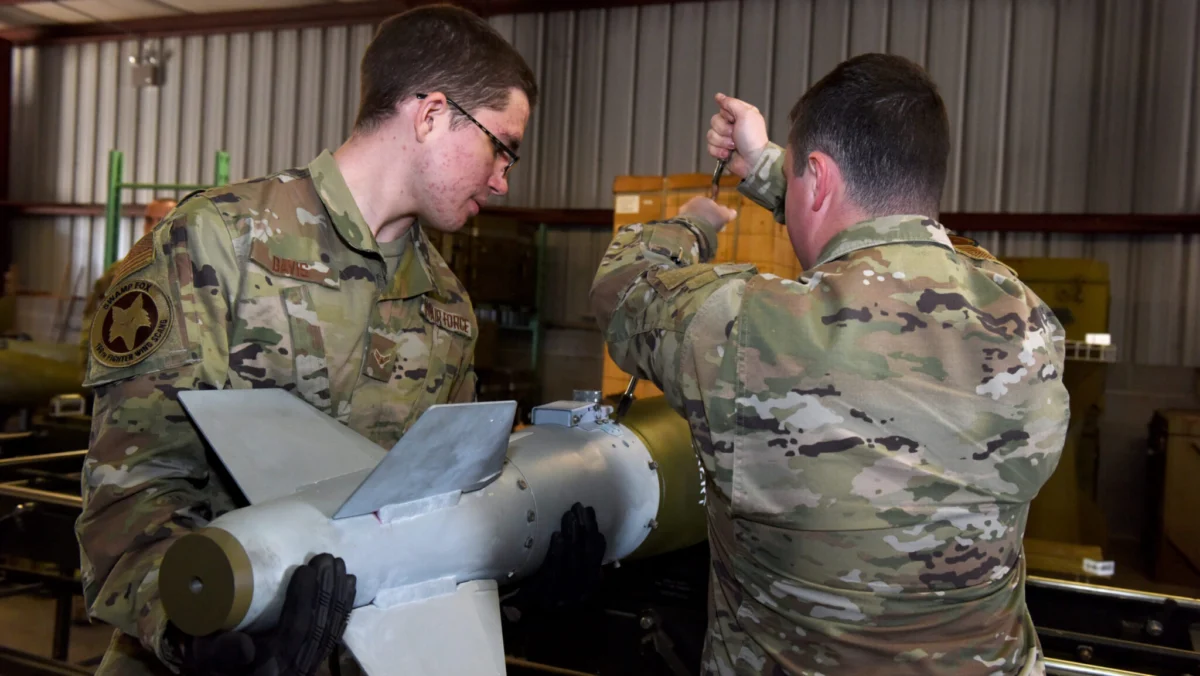
- January 2021: U.S. Air National Guard units document the routine maintenance of GBU-38 JDAM kits, a baseline capability that has since become the standard for regional air forces seeking to emulate U.S. precision-strike doctrines.
- August 2026: Tensions peak as reports emerge of potential friction between the Trump administration and Oman, with the U.S. President publicly criticizing the Sultanate’s role in regional diplomacy and issuing threats related to the security of the Strait of Hormuz.
- Early September 2026: The Department of State approves a massive $800 million helicopter package for Iraq, signaling a continued commitment to Baghdad’s internal security and counter-insurgency capabilities.
- September 2026: The current $6.1 billion package is unveiled, signaling a coordinated effort to address munitions shortfalls and maintenance backlogs among key partners in the shadow of the ongoing conflict with Iran.
Supporting Data and Technical Context
The Saudi JDAM procurement is perhaps the most significant indicator of the current intensity of air operations in the Middle East. According to analysis from the Center for Strategic and International Studies (CSIS), Saudi inventories of precision munitions have been significantly depleted by sustained operations against Iranian-backed proxies and regional threats.
The Boeing JDAM Advantage
The JDAM, manufactured by Boeing, is the workhorse of Western air forces. By integrating a GPS-guided tail kit into existing gravity bombs, military planners can achieve precision accuracy at a fraction of the cost of "exquisite" cruise missiles like the Tomahawk or AGM-158 JASSM. However, the "extended range" variant specified in the contract—which allows for strike distances of roughly 45 miles—still requires the delivery aircraft to operate within a specific proximity to the target, a strategic trade-off that the RSAF has been willing to accept.
The AGT-1500 and M1 Abrams Sustainment
The $750 million engine sale to Saudi Arabia is focused on the maintenance of its armored core. The Honeywell-produced AGT-1500 is a gas turbine engine known for its immense power-to-weight ratio, which gives the M1 Abrams its distinct mobility. As the Saudis continue to operate their M1 fleet, the ability to source spare engines directly from the U.S. is vital to keeping these heavy assets operational in the harsh, sandy terrain of the Arabian Peninsula.
Iraqi Aviation Modernization
Iraq’s procurement of the Bell 412EPX represents a shift toward multi-role rotary-wing platforms. These helicopters are essential for troop transport, medical evacuation, and light tactical support. Coming on the heels of the $800 million deal for Bell 412EPX and 407M aircraft, this latest purchase suggests an Iraqi military effort to standardize its fleet, simplifying logistics and maintenance training.
Official Responses and Diplomatic Nuance
The State Department has maintained a disciplined silence regarding the strategic timing of these back-to-back notifications. When questioned about the rapid succession of the Iraqi helicopter sales, a department spokesperson declined to provide a statement for the record, adhering to the standard protocol that these notifications are "pre-decisional" until the congressional review period concludes.
The inclusion of Oman in this round of sales is particularly noteworthy. Despite recent public vitriol from the Trump administration—which has included threats of direct military action against the Sultanate—the institutional relationship between the U.S. and Omani militaries remains robust. The F-16 sustainment package demonstrates that even when political rhetoric is heated, the pragmatic necessity of keeping regional security partners fully operational takes precedence in the eyes of the Pentagon and State Department.
Strategic Implications
The authorization of these sales carries profound implications for the regional balance of power:
1. Sustaining Air Dominance
By replenishing the RSAF’s JDAM stockpiles, the U.S. is ensuring that Saudi Arabia remains capable of persistent air campaigns. This is a direct response to the "munitions drought" caused by years of high-intensity operations, ensuring that the primary regional deterrent against Iranian regional influence remains well-equipped.
2. The Maintenance of Legacy Platforms
The sales of tank engines to Saudi Arabia and sustainment services to Oman reflect a broader trend in U.S. foreign policy: "Buy-to-Maintain." Rather than pushing for the immediate sale of entirely new, next-generation platforms, the U.S. is focused on ensuring that the massive inventories of existing American-made hardware already in the region do not become "hangar queens" due to lack of parts.
3. Congressional Oversight
While the State Department has cleared these sales, they are not yet final. Under the Arms Export Control Act, Congress has a 30-day window to review these notifications and, theoretically, block them via a joint resolution of disapproval. However, given the bipartisan consensus on the importance of maintaining regional stability and supporting key partners against Iranian expansionism, a legislative block is considered highly unlikely.
4. A Message to Tehran
The cumulative effect of these sales is a clear signal to Tehran. By providing thousands of precision munitions to Riyadh and upgrading the aerial fleets of Baghdad and Muscat, Washington is reinforcing the "interoperability" of its Middle Eastern partners. This creates a more cohesive, U.S.-standardized security architecture that makes it increasingly difficult for adversaries to exploit vulnerabilities in any single partner’s defense grid.
In conclusion, these $6.1 billion in authorizations represent a significant solidification of the U.S. security umbrella in the Middle East. Whether through the direct supply of strike capability or the long-term sustainment of armored and rotary-wing fleets, the Biden-Harris administration—via the State Department—is betting that a well-armed group of regional allies is the most effective way to maintain order in an increasingly volatile global landscape.