In a defining moment for the semiconductor industry, AMD has signaled its most aggressive attempt yet to unseat Nvidia as the undisputed king of artificial intelligence infrastructure. At the highly anticipated "Advancing AI 2026" event in San Francisco, AMD executives unveiled a vertically integrated ecosystem designed to power the next generation of large-scale reasoning models, agentic AI workflows, and massive-scale data center deployments.
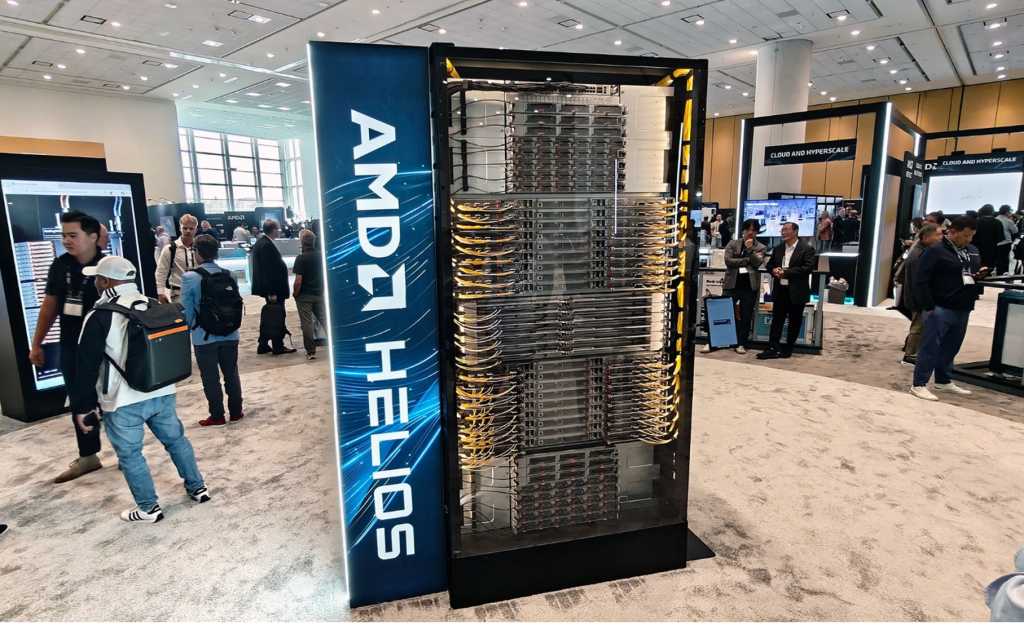
The centerpiece of this announcement is the Helios AI platform, a rack-scale solution that marks the culmination of years of internal development and the strategic integration of ZT Systems’ engineering prowess. By combining the new Instinct MI455X accelerators, "Venice" 6th Gen EPYC CPUs, and advanced Pensando networking into a single, cohesive architecture, AMD is moving beyond selling individual chips to offering complete, turnkey data center solutions.
Main Facts: The Anatomy of a Rack-Scale Powerhouse
The Helios platform is not merely a collection of parts; it is a sophisticated, liquid-cooled infrastructure designed to solve the "memory wall"—the bottleneck where data movement fails to keep pace with raw compute power.
The Compute Engine: Instinct MI455X
The MI455X GPU, the first to utilize AMD’s CDNA 5 architecture, is built on a modular, multi-chiplet design incorporating 2nm and 3nm nodes. It features a staggering 432GB of HBM4 memory and a peak memory bandwidth of 23.3TB/s. These specifications are engineered specifically for large reasoning models that require vast amounts of data to be held in active memory to maintain context and attention states.

The Orchestrator: "Venice" CPUs
AMD’s 6th Gen EPYC "Venice" processors provide the muscle for agentic AI. As AI models move toward autonomous agentic workflows—where the model must interact with databases, security protocols, and external code execution—the demand for high-performance CPU orchestration has skyrocketed. Venice offers up to 256 Zen 6 cores and 512 threads, providing the necessary compute density to handle tokenization, vector searches, and complex logic that fall outside the domain of the GPU.
The Connectivity: Pensando Networking
To prevent data congestion, AMD has integrated its Pensando "Vulcano" AI NICs. A single Helios rack can be configured to allow each GPU to connect to three 800Gbps NICs, utilizing an open standard called UALink over Ethernet (UALoE). This creates a shared-memory domain across 72 GPUs, allowing models to operate across the entire rack without the latency overhead typical of traditional scale-out networking.
Chronology: From Acquisition to Deployment
AMD’s path to the Helios platform has been a calculated, multi-year transition from a component supplier to a systems integrator.
- 2025: The Strategic Pivot: Following the acquisition of ZT Systems, AMD began folding specialized data center engineering talent into its core design teams. This move was widely viewed as the company’s most important strategic step to address the "rack-scale" reality of modern AI.
- Mid-2026 (June): AMD begins shipping samples of its Ryzen AI Embedded X100, signaling a move into robotics and industrial automation, while simultaneously preparing the supply chain for Helios.
- July 2026 (Advancing AI Event): AMD officially unveils the Helios platform, the MI455X, and the Venice CPU line.
- H2 2026 (Current Period): Shipments of the Helios platform commence. Initial deployment phases for major partners, including Microsoft and Oracle, are scheduled to begin immediately.
- 2027 (H1): The planned activation of the first gigawatt of Anthropic’s AMD-powered compute capacity.
Supporting Data: By the Numbers
AMD’s internal benchmarks suggest a massive generational leap over its own MI355X predecessors. While these figures await third-party validation, the technical delta is significant:
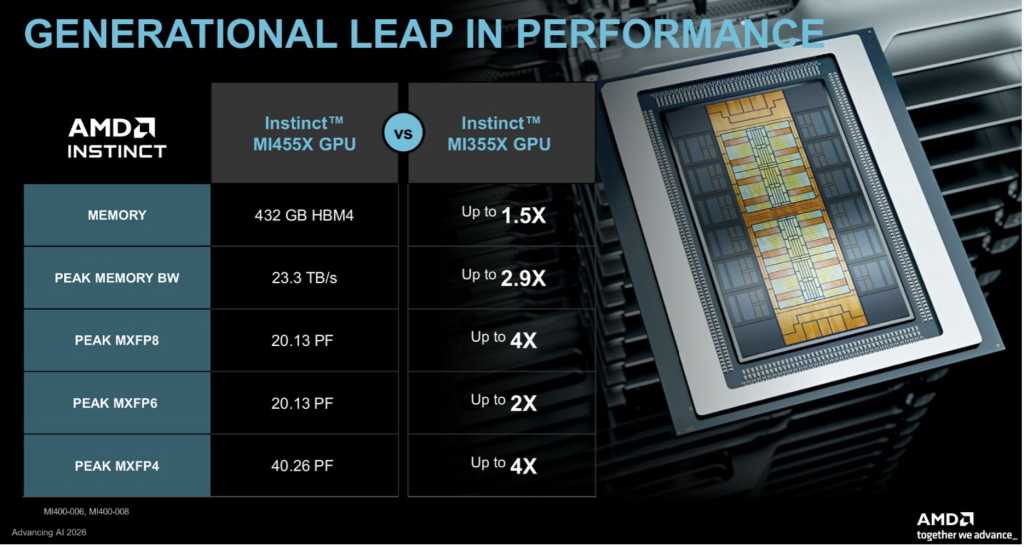
- Performance Metrics: The MI455X offers up to 4x the peak matrix performance for MXFP4 and MXFP8 data types, which are vital for efficient inference. AMD reports a 3.8x increase in FP8 decode performance and 3.5x higher FP4 compute performance compared to the MI355X.
- Throughput: Helios delivers a total of 31TB of aggregate HBM4 capacity and 1.7PB/s of memory bandwidth per rack.
- Agentic Efficiency: The Venice CPU provides a 1.7x performance lift over the current EPYC 9965 "Turin" architecture across core agentic AI tasks, including gateway processing and short-lived code execution.
- Scale: The partnership commitments are massive. Meta, OpenAI, Microsoft, and Anthropic have combined to reserve up to 6 gigawatts of AMD compute capacity, underscoring a industry-wide desire for a viable alternative to Nvidia’s closed ecosystem.
Official Responses and Strategic Partnerships
The industry’s reaction to the announcement has been characterized by a collective push for supply chain diversification. The support from hyperscalers is not merely a vote of confidence in AMD’s hardware, but a calculated hedge against Nvidia’s dominant market position.
- Microsoft: The tech giant is positioning Helios as a foundational component for Azure AI inference, indicating that the platform meets the strict reliability and deployment requirements of cloud-scale enterprise services.
- Anthropic: In a major strategic partnership, Anthropic has committed to utilizing AMD’s Instinct MI450 series GPUs for up to 2 gigawatts of compute power. This partnership is bolstered by AMD’s $5 billion investment commitment to Anthropic, tying the futures of the two companies together in the race for frontier model development.
- Oracle: Oracle Cloud Infrastructure (OCI) plans to stand up a massive 50,000-GPU cluster in Q3, leveraging AMD’s hardware to provide a high-performance alternative to Nvidia-based cloud instances.
Implications: The "Open" vs. "Closed" Battle
The introduction of Helios forces a confrontation between two distinct philosophies in the AI hardware market.
The Case for Openness
AMD is betting that hyperscalers and enterprise customers will prefer an "open" ecosystem. By leveraging UALink over Ethernet and the ROCm.AI software stack, AMD is offering customers more control over their system architecture. This allows for greater flexibility in software tuning and helps prevent vendor lock-in, which has been a primary criticism of Nvidia’s CUDA-centric model.
The Execution Challenge
Despite the impressive specifications, the market remains skeptical of software maturity. Nvidia’s CUDA ecosystem benefits from years of developer familiarity and a deep library of optimized kernels. AMD’s introduction of ROCm.AI—an AI-assisted development layer—is a direct attempt to bridge this gap. However, the true test will not be the raw hardware specs, but the "day-two" operations: the ability to deploy, maintain, and scale these systems without significant software friction.
Financial and Market Impact
AMD’s decision to issue performance-based warrants to OpenAI and invest in Anthropic signals that the company is willing to "put its money where its architecture is." This financial alignment serves as a bridge, giving developers and hyperscalers the incentive to endure the growing pains of migrating to a new platform.
Conclusion: A War of Attrition
The battle for the AI crown is no longer just about who can build the fastest GPU; it is about who can deliver the most reliable, efficient, and scalable rack. By shifting the focus to rack-scale platforms like Helios, AMD is challenging Nvidia on its own terms. If AMD can demonstrate that its performance claims translate into real-world production throughput and a lower total cost of ownership, the competitive landscape of the AI era will undergo a seismic shift.
The next six months will be the most critical in AMD’s modern history. As the first Helios racks go online, the tech world will be watching to see if AMD’s "big iron" approach can truly provide the stability required to power the future of artificial intelligence. If it succeeds, the monopoly on AI compute will finally be broken, ushering in an era of unprecedented choice for the builders of the next generation of intelligent models.