The modern smart home has evolved from a simple connected space into a complex, data-hungry ecosystem. As households increasingly rely on high-bandwidth applications—ranging from 8K streaming and immersive gaming to remote work and IoT-integrated security—the pressure on Internet Service Providers (ISPs) to deliver flawless, wall-to-wall Wi-Fi has reached a fever pitch. However, a persistent "connectivity gap" remains: the chasm between theoretical lab performance and the messy, unpredictable reality of a consumer’s living room.
Linksys, a global leader in networking hardware, is taking a decisive step to close this gap. With the launch of its Signal Studio in Reading, UK, the company is shifting the paradigm of Wi-Fi validation, moving away from sterile laboratory environments toward a "lived-in" approach that mirrors the complexities of the modern home.
The Connectivity Crisis: Why Labs Are No Longer Enough
For decades, the telecommunications industry has relied on controlled, clinical laboratory environments to validate hardware. In these settings, radio frequency (RF) interference is minimized, device positioning is optimized to perfection, and the variables that plague the average consumer—such as thick masonry, kitchen appliances, and competing signals—are systematically stripped away.
While these tests provide essential data on the theoretical maximums of Wi-Fi equipment, they fail to account for the "lived experience." Today’s subscribers do not live in labs. They live in homes with varied floor plans, signal-blocking furniture, and a fluctuating density of connected devices. When a consumer experiences a "dead zone" in their bedroom or latency during a video call, they don’t blame the laws of physics; they blame their ISP.
The Complexity of Real-World Deployment
The challenge for ISPs is twofold: rising customer expectations and the increasing technical complexity of in-home networks. As broadband speeds accelerate, the bottleneck has shifted from the "last mile" of fiber to the "first few feet" of Wi-Fi.
"Subscribers don’t live in labs," says Canus Augustus, ISP Sales Director for Linksys. "They live in busy homes filled with connected devices, competing demands on the network, and constantly changing environments. For too long, the industry has relied on laboratory testing to predict customer experience, but that approach ignores the reality of how people actually use Wi-Fi every day."
Chronology: Building the Future of Testing
The journey to the Signal Studio began as a strategic response to the shifting requirements of the UK’s fiber-to-the-premises (FTTP) rollout. Recognizing that ISPs were struggling with high churn rates driven by poor in-home Wi-Fi performance, Linksys identified the need for a facility that could serve as both a research hub and a collaborative partner for providers.
- Mid-2024: Planning and architectural design phase begins, focusing on the ability to replicate diverse residential layouts.
- Late 2024: Construction of the Reading facility is completed, incorporating modular wall structures and residential aesthetics.
- December 2025: The Linksys Signal Studio officially opens its doors to select ISP partners.
- Q1 2026 – Present: The facility hosts a series of "real-world validation" sessions, including collaborative work between ISPs, independent regulators, and Linksys engineers.
The choice of Reading—strategically located near London and Heathrow—was intentional. It serves as a central hub, allowing Linksys to engage with the UK’s vibrant ISP market and European partners who require a neutral, high-tech environment for product testing and deployment validation.
Inside the Signal Studio: Recreating the Modern Home
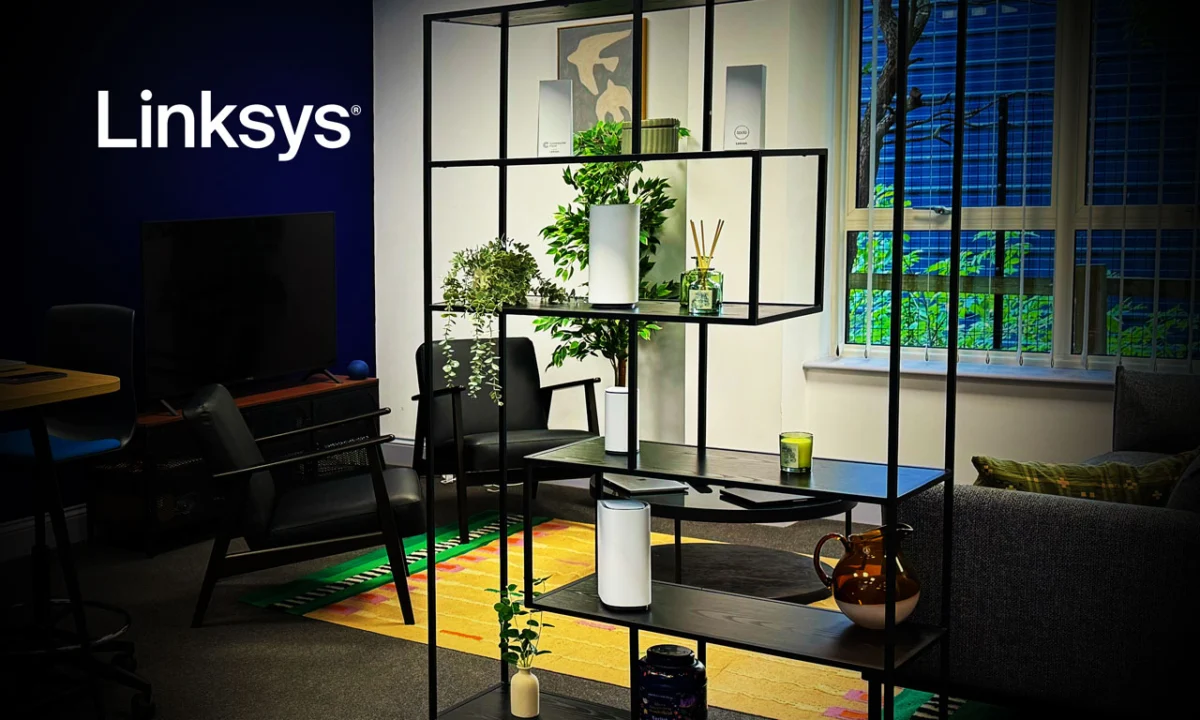
The Signal Studio is not a warehouse filled with testing rigs; it is a meticulously crafted simulation of a residential property. The facility is divided into functional zones that mimic common living areas: bedrooms, kitchens, living rooms, and home offices.
Structural Flexibility
One of the most innovative features of the studio is its configurable wall architecture. Because signal attenuation (the weakening of a Wi-Fi signal) is heavily dependent on building materials—such as brick, lath-and-plaster, or modern drywall—Linksys has installed modular walls. These can be repositioned to simulate everything from the cramped, thick-walled layouts of historical British homes to the open-plan, signal-permeable designs of new-build developments.
The "Lived-In" Variable
By populating these rooms with typical furniture and a high density of competing IoT devices, the Signal Studio forces hardware to perform under "stressed" conditions. This allows operators to observe:
- Mesh Placement Efficiency: Where to place nodes for maximum coverage without sacrificing speed.
- Self-Installation Success: Analyzing the user journey for customers setting up their own hardware.
- Interference Mitigation: Observing how the router handles signals from other household electronics.
Supporting Data and Collaborative Impact
Since its opening, the Signal Studio has transcended its role as a mere demonstration facility. It has become a collaborative engine for innovation.
Multiple ISP partners have already utilized the space to solve critical deployment hurdles. By moving beyond theoretical metrics, these partners have been able to:
- Reduce Support Calls: By validating the optimal mesh configuration for specific house types, ISPs can provide more accurate installation guidance, significantly lowering post-installation service requests.
- Validate New Technologies: As Wi-Fi 7 enters the mainstream, the Studio provides a platform to test how the new protocol handles real-world interference compared to Wi-Fi 6E.
- Neutral Arbitration: The facility has even hosted sessions involving industry regulators and ISP customers, acting as a "neutral ground" to assess connectivity standards and performance benchmarks.
Jessica Peck, Linksys Product Marketing Director, emphasizes the collaborative nature of the project: "Signal Studio was designed to be a collaborative space where our customers can work alongside us. Whether that’s validating a deployment, exploring a new technology, filming product content, or simply meeting together, we’ve created an environment that feels much closer to the homes their subscribers actually live in."
Implications: The Strategic Shift for ISPs
The move toward "home-centric" testing has profound implications for the telecommunications industry.
From "Best Effort" to "Assurance"
Historically, ISPs have provided a connection up to the router, treating the home network as a "best effort" service. However, in an era of churn-sensitive markets, ISPs are increasingly adopting a "connectivity assurance" model. By proving that their service provides a consistent, high-speed experience in every room, they can differentiate themselves from competitors who offer lower-tier, unverified solutions.
Reducing Churn Through Quality
The most significant cost to any ISP is customer churn. When a user experiences poor Wi-Fi, they often assume the broadband provider is at fault, regardless of whether the issue stems from hardware placement or signal interference. By using the Signal Studio to "pre-validate" deployments, ISPs can ensure that the customer experience is seamless from day one, effectively building brand loyalty through reliable technology.
Looking Ahead: The Future of Wi-Fi Validation
As Wi-Fi 7 and advanced mesh technologies mature, the complexity of the home network will only increase. The industry stands at a crossroads: continue to rely on the safety of the lab, or embrace the complexity of the home.
Linksys has made its choice clear. By inviting partners into the Signal Studio, the company is fostering a culture of transparency and rigorous, real-world testing. This collaborative model is likely to become the gold standard for hardware manufacturers and ISPs alike.
"Signal Studio allows us to validate performance in conditions that genuinely reflect how people use Wi-Fi every day," says Canus Augustus. "That collaboration helps operators deploy with greater confidence, optimize the customer experience, and ultimately reduce support issues post-install."
Connecting Britain
For those interested in seeing this vision in action, Linksys will be showcasing its insights at the upcoming Connected Britain conference at Stand F20. As the fiber broadband industry continues to scale, the lessons learned in Reading will be vital in ensuring that the next generation of connectivity is not just fast, but everywhere.
For ISPs looking to bridge the gap between their network and their subscribers’ living rooms, the message is simple: the future of testing isn’t found in a sterile room—it’s found in the home.
For more information on how to participate in collaborative testing or to secure an all-access guest pass for the upcoming Connected Britain event, contact the Linksys ISP team directly.