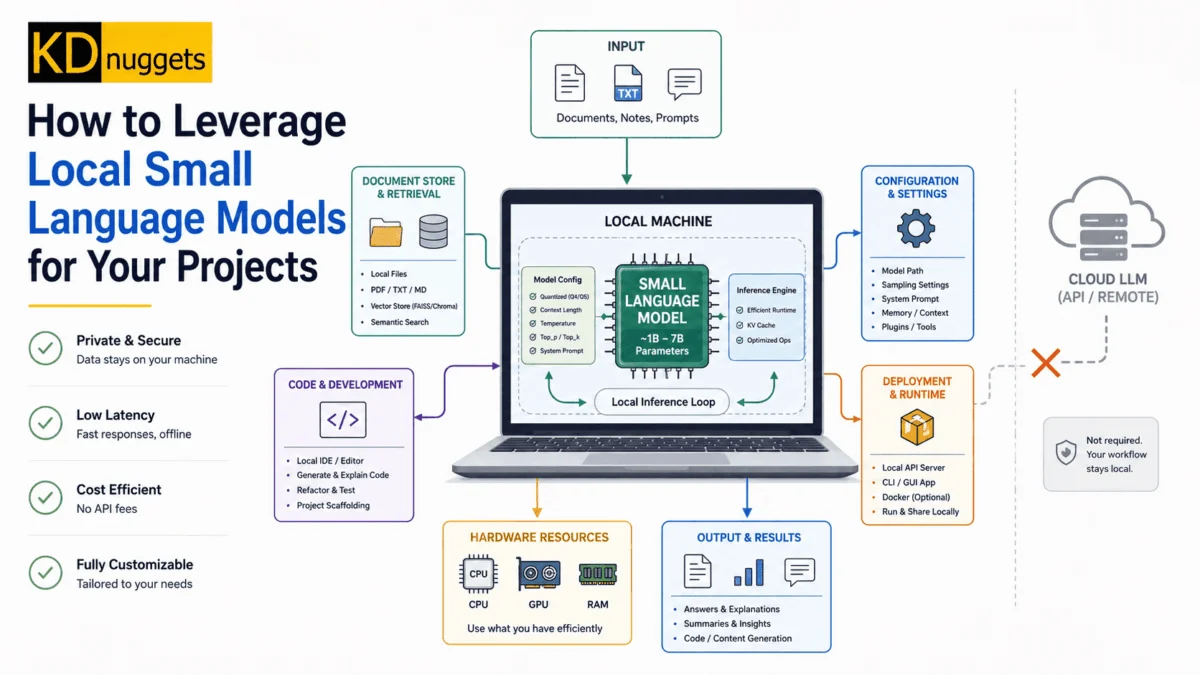
For years, the trajectory of artificial intelligence was defined by a singular, monolithic assumption: bigger is better. The industry was locked in an arms race of parameter counts, with developers routing their applications through gargantuan cloud-based APIs. In this environment, latency, recurring usage costs, and the risks associated with data exposure were viewed as the "cost of doing business."
However, a paradigm shift is underway. The maturation of Small Language Models (SLMs)—typically ranging from 1 billion to 13 billion parameters—has dismantled the necessity of the cloud-first approach. These models are compact enough to run on modern laptops or single consumer-grade GPUs, yet they possess the nuance and capability to handle sophisticated, real-world tasks. This shift marks a move toward privacy, cost-predictability, and architectural sovereignty.
Main Facts: The New Landscape of Local AI
The core proposition of the SLM movement is simple: decentralization. By moving inference from a remote server farm to a local machine, developers reclaim total control over their data and infrastructure.
Key advantages of this transition include:
- Data Sovereignty: By keeping inference local, sensitive documents, proprietary codebases, and personal information never leave the machine. This is a critical requirement for industries bound by strict compliance and privacy regulations.
- Predictable Economics: Unlike cloud providers that charge per token, local models involve a one-time hardware investment. Once deployed, the cost of inference is essentially zero, allowing for unrestricted experimentation.
- Performance and Latency: Eliminating the network round-trip significantly reduces response times, a factor that is vital for interactive applications like real-time coding assistants or high-speed document search engines.
Chronology: From Experimental Research to Production Infrastructure
The evolution of SLMs can be tracked through a rapid, three-phase acceleration:
- The Era of Gigantism (2020–2022): The industry was obsessed with "scaling laws," where increasing parameter counts consistently yielded lower loss. During this period, local inference was largely the domain of researchers and hardware enthusiasts.
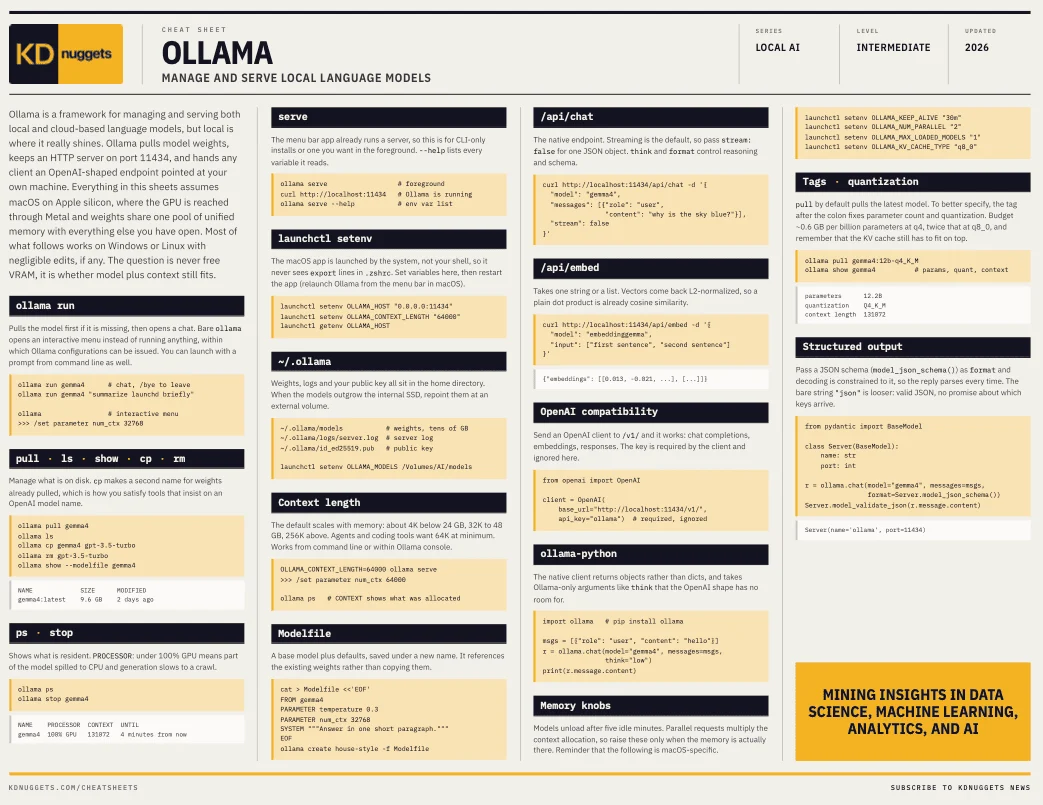
- The Efficiency Breakthrough (2023): Techniques such as 4-bit and 8-bit quantization—specifically the GGUF format—began to gain traction. These allowed massive models to be compressed without a catastrophic loss in performance. Simultaneously, projects like Ollama began to abstract the complexity of local deployment, making it accessible to generalist developers.
- The Maturity Phase (2024–Present): We have entered an era where SLMs are being purpose-built. Models like Mistral, Phi-3, and Llama 3 are not just "downsized" versions of larger models; they are architected from the ground up for high-density reasoning, making them highly effective for specific vertical tasks.
Supporting Data: Hardware Constraints and Model Selection
To successfully implement SLMs, developers must align their hardware capabilities with the appropriate model architecture. The following table serves as a general guide for current deployments:
| Model Size | RAM/VRAM Requirement | Target Hardware |
|---|---|---|
| 1B – 3B Parameters | 4GB – 8GB | Ultrabooks, Tablets, Edge Devices |
| 7B Parameters | 8GB – 12GB | Standard Consumer Laptops/PCs |
| 13B Parameters | 16GB+ | High-end Workstations/Single GPU |
Note: These figures assume 4-bit quantization, which has become the industry standard for balancing speed and accuracy.
The performance of these models is heavily dependent on the "System Prompt." Recent internal benchmarks suggest that a well-engineered system prompt—defining role, format, and boundaries—can allow a 7B model to outperform a generic 70B model in highly specific, domain-restricted tasks.
Official Perspectives: The Industry Shift
Industry experts and educators like Vinod Chugani have been vocal about this transition. According to Chugani, the bridge between "emerging technology" and "practical application" is no longer built by simply calling an API. "The path forward is incremental," he notes. "Most practical applications don’t require the largest model available; they require the right model, set up thoughtfully, for the task at hand."
This perspective is echoed in the shift toward "Agentic Workflows." Rather than relying on a single "super-model" to solve every query, the current trend favors a multi-agent approach. In this system, small, specialized agents handle specific tasks—one for retrieval, one for synthesis, and one for formatting—creating a modular, highly efficient ecosystem that runs entirely on-device.
Implications: Building for the Future
The implications of adopting local SLMs extend far beyond cost-saving measures.
1. The Death of the "Black Box"
When an application relies on a cloud API, the developer is at the mercy of the provider’s updates and model deprecations. Local deployment offers stability. Once a model is integrated into a project, it remains functional regardless of the developer’s changing Terms of Service or connectivity status.
2. Democratization of AI
Local SLMs lower the barrier to entry for small businesses and independent developers. By removing the dependency on costly cloud subscriptions, the barrier for creating sophisticated, AI-driven software has been lowered to the cost of a consumer laptop.
3. The Shift to "Small" as a Feature
In the future, we will likely see a move toward "Small Language Models as a Service" (SLMaaS), where developers build and deploy their own, fine-tuned, private versions of Llama or Mistral to serve specific internal functions. This decentralization will likely improve the overall resilience of the AI ecosystem, as applications will no longer be vulnerable to massive, centralized service outages.
Strategic Implementation Guidelines
For those looking to transition to local infrastructure, the following framework is recommended:
- Phase 1: Evaluation: Create a "Gold Standard" dataset of 50–100 queries specific to your application. Run these through your target model. Do not rely on generic leaderboard scores; test for failure modes, such as how the model handles long-context inputs or specific formatting requirements.
- Phase 2: Tooling: Leverage existing frameworks like Ollama for orchestration. Use these tools to manage the model lifecycle, including versioning and API serving, which allows your existing stack (e.g., Python/LangChain) to interact with local models as if they were remote services.
- Phase 3: Optimization: Use Modelfiles to tune parameters. For analytical tasks, keep the
temperaturelow (0.1–0.3) to ensure deterministic outputs. For creative tasks, increase this to 0.7–1.0. - Phase 4: Architecture: Integrate the model into a RAG (Retrieval-Augmented Generation) pipeline. This keeps your "knowledge base" local while using the SLM solely as a reasoning engine, ensuring the system remains both fast and private.
Final Thoughts
The era of assuming that bigger is always better has concluded. We are witnessing the democratization of machine intelligence, where the most powerful tools are becoming the most portable. By choosing to develop locally, professionals are not just saving money or protecting data; they are positioning themselves at the forefront of a more modular, efficient, and sovereign AI future.
As the ecosystem matures, the gap between local capability and cloud capability will continue to shrink. For developers, the message is clear: start small, build thoughtfully, and maintain control over your stack. The future of AI is not in the cloud—it is on your machine.