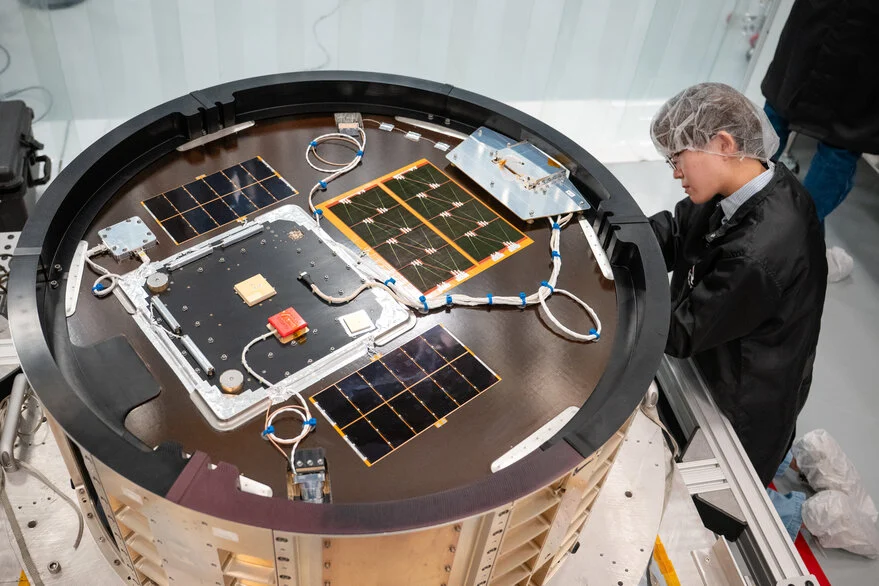
SALT LAKE CITY — At the annual Small Satellite Conference, engineers, researchers, and commercial space executives gathered to discuss the next evolution in orbital technology. Among the most anticipated updates was the on-orbit performance of DiskSat, a revolutionary, pancake-shaped satellite platform designed by The Aerospace Corporation. Launched in December 2025, this two-dimensional satellite architecture represents one of the most radical departures from traditional spacecraft design in decades, offering a high-efficiency alternative to the standard box-shaped CubeSats that have dominated the small satellite market for more than twenty years.
"It’s the biggest advancement in containerized satellites since CubeSats were introduced in the early 2000s," said Darren Rowen, the Chief Engineer for the DiskSat demonstration mission, in an interview with SpaceNews.
As the space industry increasingly eyes Very Low Earth Orbit (VLEO) for its atmospheric advantages, the flat, aerodynamic profile of DiskSat could unlock sustainable, long-duration missions at altitudes previously considered too hostile for long-term satellite survival.
Main Facts: A Paradigm Shift in Satellite Architecture
The traditional CubeSat, typically built in standardized cubic units (1U, 3U, 6U, etc.), has democratized access to space. However, its boxy form factor presents inherent limitations, particularly regarding surface-area-to-volume ratios, aerodynamic drag, and antenna placement. The Aerospace Corporation’s DiskSat addresses these constraints by flattening the satellite into a circular, two-dimensional disk.
Key Characteristics of the DiskSat Platform:
- Dimensions: 1 meter in diameter and a mere 2.5 centimeters in depth.
- Mass: Approximately 17 kilograms.
- Structural Composition: Carbon fiber composite facesheets bonded to an aluminum-honeycomb core.
- Launch Vehicle: Deployed via a Rocket Lab Electron rocket from NASA’s Wallops Flight Facility in Virginia.
- Initial Altitude: 550 kilometers, with a planned descent to Very Low Earth Orbit (VLEO) below 300 kilometers.
- Propulsion System: Enpulsion Nano Field Emission Electric Propulsion (FEEP) thrusters.
The demonstration mission, consisting of four DiskSats, was designed to test the feasibility of manufacturing, launching, deploying, and operating flat satellites. By utilizing a custom-designed dispenser, the mission demonstrated that multiple disk-shaped spacecraft can be stacked tightly inside a rocket fairing, maximizing launch volume and potentially driving down launch costs for massive constellations.
Chronology of the DiskSat Demonstration Mission
The journey of the DiskSat from an experimental laboratory concept to an active orbital mission spans several years of intense development, culminating in its recent milestone-heavy flight operations.
[Development & Design] ──> [Dec 2025: Launch & Deployment] ──> [Early 2026: Commissioning & Anomalies] ──> [Aug 2026: VLEO Descent Phase]1. Development and Ground Testing (Pre-Launch)
Engineers at The Aerospace Corporation spent years redesigning standard satellite subsystems—including power distribution, attitude control, thermal management, and communications—to fit within a ultra-thin 2.5-centimeter envelope. Because standard commercial off-the-shelf (COTS) components are designed for 3D boxes, nearly every internal system had to be custom-modified or laid out flat.
2. Launch and Deployment (December 2025)
The demonstration mission officially commenced in December 2025. A Rocket Lab Electron rocket lifted off from the Mid-Atlantic Regional Spaceport (MARS) on Wallops Island, Virginia, carrying the four experimental DiskSats. The satellites were housed in a custom-built dispenser designed by Aerospace Corp. Upon reaching an initial circular orbit of 550 kilometers, the dispenser successfully released the four 17-kilogram spacecraft into the vacuum of space.

3. Early Orbit Operations and Troubleshooting (Early 2026)
Upon deployment, the mission operations team entered a period of rapid learning. Operating a flat satellite introduced immediate, unexpected physical dynamics.
- Attitude Control Adjustments: Engineers identified that stray light was reflecting off the satellite’s flat surfaces and entering the star trackers, temporarily blinding the navigation systems. The team resolved this by adjusting the satellite’s concept of operations (ConOps) and changing orientation angles relative to the sun.
- Thermal Management: With all critical components mounted on the exterior skin of the disk, the spacecraft experienced extreme temperature fluctuations. Thermal models were updated in real-time to balance the heat generated by payloads and thrusters against the freezing shadows of orbital eclipse.
- Battery Heater Anomaly: A design flaw in the battery heater system caused unequal power distribution. Before a software patch could be fully developed, tested, and uploaded, the hardware anomaly permanently disabled both batteries on DiskSat C and one of the batteries on DiskSat A.
4. Transition to VLEO (Mid-to-Late 2026)
By August 2026, despite the battery degradation on two of the units, the mission operations team began commissioning the Enpulsion Nano FEEP thrusters. The satellites are currently using natural atmospheric drag to lower their altitude from 550 kilometers. The next phase of the mission involves utilizing the electric propulsion systems to actively drive the satellites down to an altitude below 300 kilometers, where they will attempt to maintain a stable orbit in the high-drag VLEO environment.
Supporting Technical Data: Inside the 2D Framework
The engineering behind DiskSat represents a major departure from classical aerospace structural design. Standard micro-satellites rely on machined aluminum frames to provide structural rigidity and shield internal electronics from radiation and thermal extremes. DiskSat, by contrast, uses advanced materials and a novel structural layout.
| Parameter | Traditional 12U CubeSat | DiskSat |
|---|---|---|
| Form Factor | 3D Rectangular Prism (approx. 20x20x30 cm) | 2D Flat Disk (100 cm diameter, 2.5 cm depth) |
| Structural Material | Machined Aluminum (6061-T6) | Carbon Fiber Composite with Aluminum-Honeycomb Core |
| Surface Area (Solar) | Limited by external panel faces | Maximized (entire 1-meter face can host solar cells) |
| Aerodynamic Drag (VLEO) | High (due to blocky profile) | Extremely Low (when oriented edge-on to velocity vector) |
| Component Mounting | Internal card cages / structural brackets | External face-mounting |
Structural and Material Innovation
The primary structure of the DiskSat is manufactured using carbon fiber composite facesheets bonded to an aluminum-honeycomb core. While carbon fiber composites are widely used in aviation and high-end automotive industries for their high strength-to-weight ratios, they have rarely been utilized as the primary load-bearing structure for small, containerized satellites. This material selection keeps the structural mass of the satellite incredibly low while providing the rigidity necessary to survive the intense vibrational forces of a rocket launch.
The Thermal and Power Challenge
Because DiskSat has virtually no "inside," there is no protective interior cavity to shield delicate electronics. Every subsystem—including the S-band radio, star trackers, batteries, and the Enpulsion thrusters—is mounted directly to the exterior facesheets.
This layout presents severe thermal challenges:
$$textThermal Gradient propto fractextSolar Radiation Exposed AreatextThermal Mass$$
Because the disk has a large surface area but very low thermal mass, it heats up rapidly when exposed to direct sunlight and cools down just as quickly when passing into Earth’s shadow.
The battery heater anomaly experienced by DiskSats A and C highlighted the tight tolerances of this thermal-electrical loop. The unequal drawing of power by the heaters caused localized thermal stresses and electrical overloads, leading to permanent battery failures. However, the survival of the remaining battery capacity and the resilience of the overall fleet demonstrated that software-defined workarounds can successfully mitigate severe hardware anomalies on orbit.

Official Responses and Engineering Perspectives
In papers and presentations delivered at the 2026 Small Satellite Conference, key figures from the DiskSat program reflected on both the triumphs and the harsh lessons of operating a brand-new satellite class.
In their joint paper, "DiskSat: On-Orbit Performance and Lessons Learned from the Inaugural Flight of Two-Dimensional Satellites," authors Darren Rowen, Catherine Venturini, and their colleagues noted:
"The early-orbit phase of the DiskSat mission was a time of intense learning from ‘firsts’ on many fronts. With nearly every subsystem being new, whether it was the bus, the dispenser, the S-band radio, or the ground network, the operations team faced a steep learning curve."
Addressing the battery heater issue during an presentation on August 24, 2026, Rowen did not shy away from the engineering setback, calling it "a painful lesson learned." However, he emphasized the overall resilience of the platform:
"Despite this outcome, the mission is on track to complete all of the mission objectives successfully."
Catherine Venturini, the Principal Investigator for the DiskSat demonstration mission, looked toward the future of the technology, emphasizing that the physical validation of the satellite is only one half of the project’s ultimate goal.
"Propulsive lowering and sustainment at lower altitude is coming next," Venturini stated, highlighting the upcoming VLEO operations. "The success of this demo is not only the actual technology and proof of concept, but this parallel effort of getting it out there to trying to build an industrial base to build their own DiskSats in the future."
Implications for the Global Space Industry and Future Outlook
The successful demonstration of DiskSat has profound implications for the commercial, scientific, and military space sectors, particularly as the industry transitions toward Very Low Earth Orbit (VLEO) and mega-constellations.

1. Opening the VLEO Frontier
Very Low Earth Orbit (altitudes between 100 and 300 kilometers) is highly desirable for several reasons:
- Enhanced Imaging: Cameras and optical sensors can capture much higher-resolution images from 250 kilometers than they can from traditional sun-synchronous orbits at 600 kilometers.
- Lower Latency: Communications signals travel shorter distances, reducing latency for real-time data transfer.
- Debris Mitigation: Spacecraft in VLEO experience significant atmospheric drag. If a satellite fails, its orbit will naturally decay within days or weeks, preventing the creation of long-lasting space debris.
However, operating in VLEO requires satellites to constantly fight atmospheric drag. Traditional boxy satellites require massive amounts of propellant to maintain their altitude. DiskSat’s flat profile allows it to fly "edge-on" into the residual atmosphere, presenting an incredibly small cross-section that minimizes drag and drastically reduces the amount of thrust (and propellant) needed to maintain orbit.
[Traditional Satellite in VLEO] ──> High Drag ──> Rapid Propellant Depletion ──> Short Mission Life
[DiskSat (Edge-On) in VLEO]     ──> Low Drag  ──> Minimal Propellant Needed   ──> Extended Mission Life
2. Launch Economics and Packing Efficiency
Launch costs are heavily dictated by volume and mass. Standard CubeSats, despite their utility, leave significant unused volume inside rocket fairings due to their rigid, boxy shapes. DiskSats can be stacked like dinner plates inside a custom dispenser. A single launch vehicle that might only accommodate 10 or 20 traditional CubeSats could theoretically carry dozens of DiskSats, drastically lowering the launch cost per satellite and accelerating the deployment of global communications and Earth observation constellations.
3. Commercialization and Tech Transfer
The Aerospace Corporation is actively working to transition DiskSat technology from an experimental government-backed program into the commercial sector. To date, three commercial space companies have signed formal licensing agreements to develop their own variations of the DiskSat architecture:
- Neumann Space: An Australian propulsion company exploring the integration of their unique metal-fed thrusters into flat satellite buses.
- Orbotic Systems: A space hardware manufacturer looking to commercialize the structural and deployment mechanisms of the DiskSat platform.
- Satlyt: A satellite communications and data-processing firm aiming to utilize the flat form factor for high-surface-area antenna arrays.
By licensing this technology, The Aerospace Corporation is fostering an industrial base capable of mass-producing 2D satellites. As these commercial partners refine the manufacturing processes and resolve early-stage design flaws, the flat-satellite paradigm may soon transition from an experimental novelty into the standard operational architecture for next-generation orbital constellations.