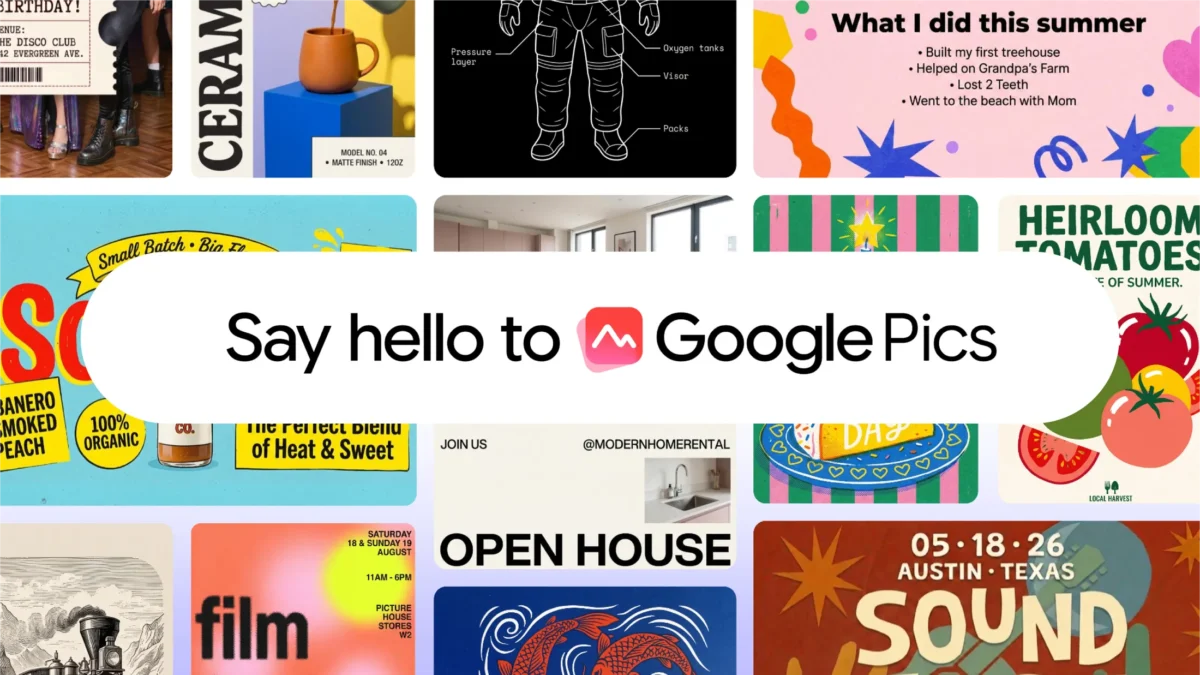
In a move that signals a significant expansion of its enterprise ecosystem, Google has officially unveiled Google Pics, a robust image-creation and editing suite integrated directly into the Google Workspace environment. Designed to compete with industry stalwarts like Canva and Adobe Express, the platform represents Google’s most aggressive play yet into the creative design market, leveraging its proprietary "Nano Banana" generative AI model to transform how businesses and professionals produce visual content.
As the lines between productivity software and creative suites continue to blur, Google Pics aims to position itself as the "everyday designer" for the modern office. By embedding AI-powered generation directly into Docs and Slides, Google is betting that the future of corporate communication isn’t just about text—it’s about the seamless, instant generation of bespoke visuals.
The Core Offering: What is Google Pics?
At its heart, Google Pics is an AI-first design interface. Unlike traditional graphic design software that relies on manual manipulation of vectors, layers, and brushes, Google Pics is built on a prompt-based architecture. Users describe the visual output they require—such as a promotional poster, an infographic for a slide deck, or a social media graphic—and the Nano Banana model synthesizes the requested asset in seconds.
Key Functional Capabilities:
- Prompt-to-Creation: The primary workflow involves natural language processing. Users input descriptive text, and the AI generates multiple variations of the requested image, allowing the user to select the most relevant output.
- Object Manipulation: The suite includes advanced editing features, such as the ability to isolate specific subjects within a generated image, move them, or transform their appearance.
- Integrated Text Editing: Perhaps one of the most practical features for business users is the ability to modify or translate text already embedded within an image, bridging the gap between static design and localized marketing assets.
- Collaborative Design: True to the Google Workspace ethos, Pics is built for teams. Multiple users can iterate on a visual asset simultaneously, making it an ideal tool for remote marketing teams and cross-functional project groups.
A Chronological Shift in the Design Landscape
The trajectory of Google’s entry into this market has been long-anticipated. For years, the company has integrated basic image-editing features into its ecosystem, but these were largely reactive.
The Rise of Generative AI (2022–2023)
Following the industry-wide pivot toward Large Language Models (LLMs) and diffusion models, Google began integrating AI into its search and creative products. The development of the "Nano Banana" model—a specialized iteration optimized for high-fidelity visual consistency—marks the culmination of these internal R&D efforts.
The Workspace Integration (Current Quarter)
Google announced the immediate rollout of the tool for Workspace customers and Google AI Pro/Ultra subscribers. Starting with Google Docs and Slides, the integration allows users to move from drafting a report to creating a supporting visual without ever switching tabs or logging into a third-party application.
Future Roadmap
While the initial rollout is focused on Docs and Slides, the company has confirmed that Google Pics will be integrated into Google Drive in the coming months. This will transform Drive from a static storage repository into an active creative workspace, where images can be generated, edited, and shared without the friction of downloading and re-uploading files.
Comparative Analysis: Google Pics vs. The Market Leaders
To understand the implications of this launch, one must compare Google Pics against established incumbents. The market currently rests on two pillars: the creator-driven marketplace model (Canva) and the professional-grade creative suite (Adobe Express).
The "No-Marketplace" Philosophy
A key differentiator for Google Pics is its lack of a creator marketplace. On platforms like Canva, professional artists and photographers can upload templates or assets, earning royalties when users utilize their work. Google Pics operates entirely on an AI-generative model. This is a double-edged sword: while it provides users with endless unique content, it eliminates the ecosystem of independent contributors that currently sustains the creator economy on other platforms.
Prompt-Based vs. Layer-Based Design
Adobe Express is often used by creators who want granular control over every pixel. They design from scratch, manipulating typography, vector paths, and lighting. Google Pics, conversely, is an "opinionated" tool. It is designed for the user who needs a professional-looking asset now but lacks the time or formal design training to build it from the ground up. It prioritizes speed and efficiency over the meticulous craftsmanship found in traditional Adobe workflows.
Data and Technical Foundations: The Nano Banana Model
While Google has kept the precise architecture of the Nano Banana model proprietary, industry analysts note that it is optimized for high-speed, high-resolution rendering. Unlike models trained solely on open-web scraping, Google has leveraged its massive internal datasets and licensed artistic works to train the model, aiming for a balance between aesthetic diversity and professional utility.
The model’s capacity to handle multiple generations of a single request—providing a "pick-the-best" interface—is supported by Google’s high-performance cloud infrastructure. By distributing the compute load across its global data centers, Google is able to offer sub-second generation times, a critical factor for business users who cannot afford to wait for complex AI rendering.
Official Responses and Strategic Implications
Google’s positioning of this tool within its Workspace ecosystem is a strategic masterstroke. By bundling the tool with business subscriptions, Google effectively lowers the "cost of entry" for high-quality design for millions of businesses that already pay for Gmail, Drive, and Docs.
Why Business Customers Matter
For Google, the target audience isn’t necessarily the graphic designer—it is the project manager, the startup founder, and the internal communications lead. By solving the "blank page problem" for these users, Google increases the "stickiness" of its Workspace ecosystem. A user who creates all their marketing collateral inside Google Docs is significantly less likely to churn to a competitor.
The Ethical Question
Google’s reliance on models trained on artists’ work remains a point of contention. While the company maintains that its training sets are legally compliant, the creative community remains wary. Unlike platforms that pay royalties to the artists whose work informs the model, Google Pics represents a shift toward a model where the AI effectively "internalizes" the value of the human artist, providing it as a service to the end-user.
Implications for the Creative Industry
The introduction of Google Pics will likely trigger a ripple effect throughout the design industry.
1. The Death of the "Placeholder"
For years, non-designers have struggled to create professional visuals, often resulting in lackluster documents or the use of generic, overused stock photos. With Google Pics, the standard for "internal-grade" visuals is being raised. Employees will be expected to produce high-quality, relevant imagery as part of their standard reporting.
2. Market Consolidation
The creative software market is becoming increasingly crowded. For companies like Canva, Google’s entry represents a direct threat to their "everyday user" base. For Adobe, it forces a greater focus on high-end, professional-grade tools that AI cannot yet replicate in terms of technical precision and workflow integration.
3. The Democratization of Visual Communication
Perhaps the most significant implication is the democratization of design. By abstracting away the technical barriers—such as layer management, color balancing, and typography—Google is making visual literacy a core competency for the average office worker. In the future, the ability to prompt effectively may become as important as the ability to write a clear email.
Conclusion: A New Chapter for Workspace
Google Pics is more than just an image editor; it is a declaration of intent. Google is positioning its AI not as an external "add-on," but as a fundamental layer of the productivity stack. As the tool rolls out to the broader Workspace ecosystem, the metrics of success will not be measured by the number of downloads, but by the frequency of usage within the enterprise.
For the professional, the tool offers a way to reclaim hours previously spent on mundane visual tasks. For the industry, it signals the beginning of a period where AI-assisted design becomes the default. As we watch the initial adoption phase unfold, one thing is clear: the blank page is becoming a relic of the past, replaced by the predictive, generative, and collaborative power of Google’s new creative suite.
Note: This article is for informational purposes. When you purchase through links in our articles, we may earn a small commission, which helps support our independent reporting.