In the modern digital economy, the traditional user profile is failing. For decades, organizations have relied on static demographic data—age, location, job title, and aggregate interaction counts—to predict customer behavior. However, this "snapshot" approach treats users as fixed entities, ignoring the fluid, erratic, and context-dependent nature of human decision-making.
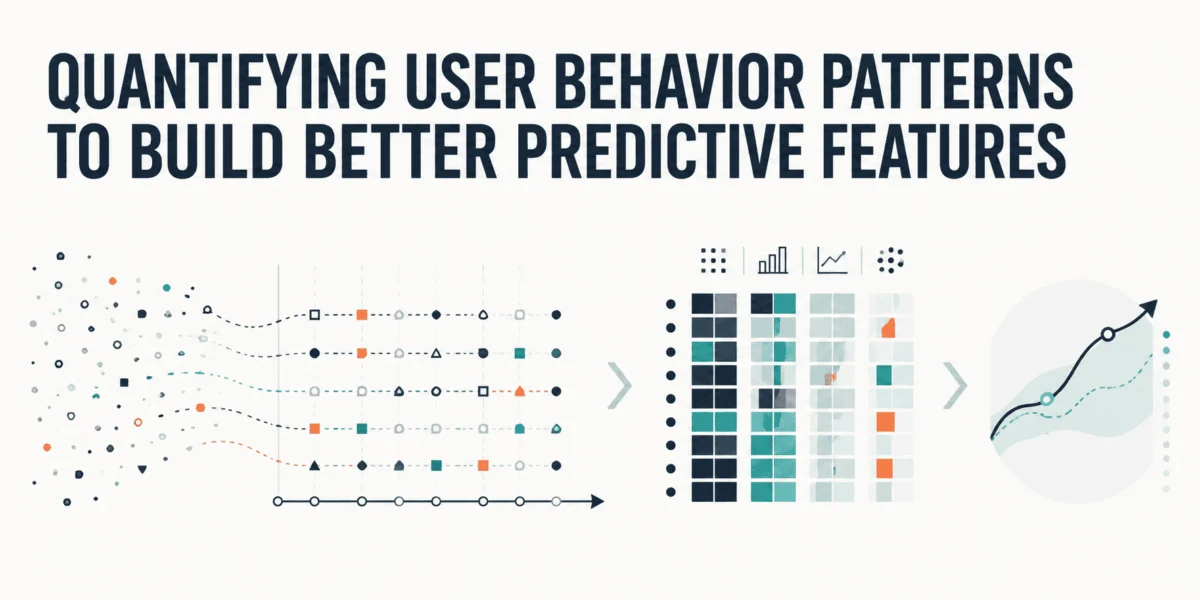
As machine learning matures, the industry is shifting toward a more sophisticated paradigm: dynamic behavioral feature engineering. By treating user actions as temporally evolving graphs rather than isolated data points, data scientists are uncovering predictive signals that were previously invisible. This article explores how to bridge the gap between raw, noisy event logs and high-fidelity predictive intelligence.
The Failure of Static Profiles: Why Demographics Don’t Predict Intent
The core limitation of conventional analytics is its reliance on "macroscopic" features. Knowing that a 35-year-old male in Seattle clicked 12 times last month offers zero insight into his current intent. Does he have a problem with his account? Is he researching a competitor? Or was he simply browsing during a lunch break?
Static profiles act as "post-mortems"—they tell you what happened in the past but fail to diagnose the present. Conversely, dynamic behavioral features function as live diagnostic tools. Research into temporally evolving action graphs has demonstrated that the sequence of actions—the "rhythm" of a user session—is a far more potent predictor of churn or conversion than any count-based metric could ever be. When a user opens an app, lingers on a pricing page, and returns three times in a single hour, they are signaling a specific psychological state: hesitation, curiosity, or intent. Click counts, by contrast, treat these events as disconnected integers, burying the narrative of the user journey.
Advancing User Analytics: A Three-Pillar Framework
To move beyond the limitations of raw event streaming, organizations must engineer features that quantify the nuance of behavior. We suggest three primary techniques to transform raw logs into actionable model inputs.
1. Measuring Behavioral Velocity and Acceleration
Velocity is the measure of the speed and intensity of behavior over specific time intervals. By calculating action frequency within sliding windows—be it hourly for high-frequency trading platforms or session-based for SaaS products—analysts can detect surges that correlate with conversion.
However, raw velocity is only half the picture. Acceleration—the rate of change in activity between consecutive windows—is where the real predictive power lies. A user whose session frequency doubles week-over-week is exhibiting a momentum that is fundamentally different from a user who maintains a consistent, low-level engagement. By pairing these velocity metrics with "recency," models can distinguish between active, high-intent exploration and the frantic activity of a user struggling to find a solution.
2. Evaluating Feature Usage Depth
Not all interactions carry equal weight. A user landing on a home page is not engaging with the product in the same way a user completing a multi-step workflow is. Depth measures how thoroughly a user navigates an application.
Before implementing these features, rigorous Exploratory Data Analysis (EDA) is non-negotiable. Data quality remains the chief priority for 43% of chief operations officers, and for good reason: without EDA, you risk training models on "noise" (e.g., accidental clicks or modal dismissals) while ignoring the "signal" (e.g., deep-dive configuration changes). By identifying hierarchical navigation patterns and feature-specific dwell times, data teams can prioritize the depth signals that actually correlate with long-term retention.
3. Calculating Decision Friction
Friction is the silent killer of growth. It is defined by hesitation, backtracking, and repetitive failure. When a user navigates backward multiple times or toggles between the same two pages, they are signaling confusion or a broken workflow.
By comparing the "expected path length" (the optimal, shortest route to a task) against the "actual path length," engineers can create a "friction delta." A three-step delta—where a task takes seven steps instead of four—is a high-value feature. It allows models to trigger intervention (such as a proactive support chat or a simplified prompt) long before the user decides to churn.
Mapping Physical Actions to Digital Signals
The parallels between brick-and-mortar retail and digital platforms are striking. In physical stores, nearly 73% of purchase decisions are made in-the-moment, often triggered by "visual salience"—attractive end-cap displays or eye-level product placement.
Digital platforms, when engineered correctly, mimic this psychology. By tracking exposure to high-salience UI elements—like time spent on a promotional banner or the specific path taken after a recommendation—data scientists can quantify "spontaneous digital behavior." When a user interacts with a contextual trigger and converts within seconds, the model recognizes this as a high-intent, impulse-driven event. Training models on these micro-patterns allows for real-time personalization that leverages behavioral momentum rather than lagging historical averages.
Handling the "Long Tail": Sparse Datasets and Embeddings
One of the greatest challenges in behavioral modeling is data sparsity. Power users generate a wealth of data, but the "long tail" of infrequent visitors creates a dataset riddled with missing values. Traditional models often downsample or delete these rows, which is a mistake—these sparse interactions are often where the most critical churn signals reside.
The Power of Zero-Inflated Embeddings
Sparse matrices contain two types of zeros: "structural zeros" (the user didn’t have the opportunity to act) and "true zeros" (the user chose not to act). To solve this, teams should employ zero-inflated exponential-family embeddings. This technique allows the model to differentiate between a lack of interest and a lack of exposure. By modeling these as distinct categories, the algorithm stops down-weighting the entire sparse segment and instead learns which gaps carry information.
Mining Frequent Sub-Trajectories
The combinatorial explosion of possible user journeys is a nightmare for compute resources. To manage this, data scientists are increasingly using frequent sub-trajectory mining. By identifying the most common behavioral pathways—and treating those pathways as "features" rather than modeling every individual click—teams can compress the data while preserving the temporal structure. This dimensionality reduction allows the model to recognize "the path to purchase" or "the path to churn" without being overwhelmed by the noise of every single interaction.
Implications for Retail Demand Forecasting
The application of these principles in retail demand forecasting provides a clear roadmap for success. By applying the "friction" metric to cart abandonment, retailers can identify exactly where in the checkout flow a customer encounters doubt. By treating featured product placements as digital "end-caps," they can measure the direct conversion lift of promotional UI.
Finally, by using sub-trajectory mining, retailers can identify the "three common paths" to purchase and prioritize inventory or promotional spend accordingly. This shift from aggregate demand forecasting to individual, path-based prediction is the next frontier of supply chain and retail optimization.
Conclusion: From Post-Mortem to Predictive Intelligence
The transition from static profiles to dynamic behavioral intelligence is more than just a technical upgrade; it is a fundamental shift in how organizations perceive their users. By discarding the outdated notion that a user is a static demographic and embracing the reality of a user as a dynamic, temporal agent, companies can build systems that are responsive, predictive, and inherently more human.
The future of data science lies in the ability to capture the "moment-to-moment" shifts in behavior. As we refine our ability to measure velocity, depth, and friction, we move away from analyzing the "post-mortem" of the past and toward a future where our models can anticipate needs before the user even fully articulates them. The tools are available; the challenge now lies in the architecture of our feature engineering.
About the Author
Cooper Adwin is an Assistant Editor at Designerly Magazine with over five years of experience covering data analytics, software infrastructure, and AI tools. He specializes in bridging the gap between complex machine learning theory and practical, scalable data workflows.