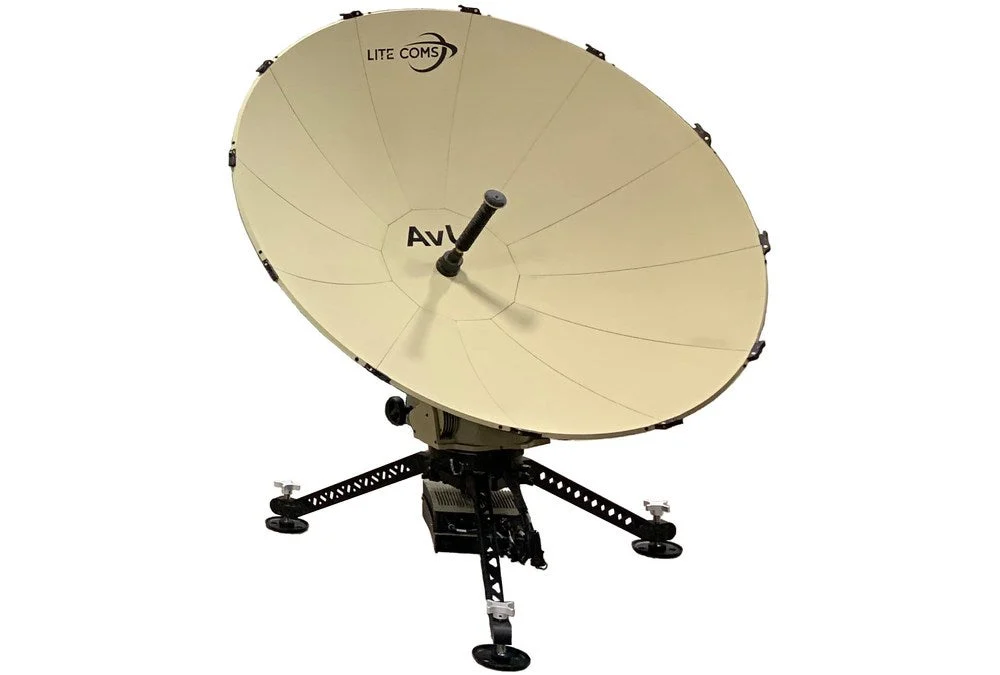
August 27, 2026 | In a significant advancement for tactical satellite communications, U.S.-based terminal manufacturer Lite Coms has announced that its flagship Lite Sat 1.3A terminal has achieved formal validation for use within the SES O3b mPOWER Sovereign Services and Hybrid Sovereign Gateway architectures. This development represents a critical milestone in the ongoing effort to provide military and government users with resilient, high-throughput, and secure connectivity in the world’s most challenging operational environments.
By integrating the Comtech SLM-5650B modem—a platform already renowned for its Wideband Global Satcom (WGS) certification—the Lite Sat 1.3A is now positioned to serve as a cornerstone of modern defense communications. This strategic alignment between hardware engineering and satellite network architecture offers forward-deployed units a reliable, low-risk pathway to the high-performance Medium-Earth Orbit (MEO) capabilities provided by SES’s next-generation constellation.
The Core Development: Validated Interoperability
The core of this announcement lies in the interoperability between the Lite Coms terminal and the O3b mPOWER ecosystem. The Lite Sat 1.3A is designed specifically for portability and performance; it is a lightweight, ruggedized VSAT (Very Small Aperture Terminal) capable of multi-band operation across X-, Ku-, and Ka-frequency bands.
However, a terminal is only as effective as the modem that powers it. Through the SES Government Technology Certification (GTC) Type 2 process, the combination of the Lite Sat 1.3A and the Comtech SLM-5650B modem has been validated to meet the stringent requirements of sovereign MEO missions. Sovereign Services, a hallmark of the SES government portfolio, allows nations to maintain control over their data traffic, encryption, and network management—a non-negotiable requirement for modern national security operations.
Chronology: Building the Sovereign Ecosystem
The path to this certification was not overnight, but rather the result of a deliberate, multi-year integration strategy.
- September 2025: Comtech’s SLM-5650B modem receives formal certification for operation on the O3b mPOWER constellation. This was a watershed moment, as it established the modem as a "gold standard" for WGS-compatible, high-throughput MEO communications.
- Early 2026: Lite Coms enters the final phases of testing for the 1.3A terminal, focusing on thermal performance, signal acquisition speeds, and interoperability with the SES gateway architecture.
- August 2026: Final validation is achieved, and the Lite Sat 1.3A is formally added to the SES ecosystem registry, signaling that the equipment is ready for procurement and deployment by government agencies.
This timeline reflects a broader industry trend where hardware manufacturers and network providers are shifting toward pre-validated, "plug-and-play" architectures to reduce the integration burden on end-users.
Supporting Data: Why MEO Matters for Defense
The shift toward MEO constellations like O3b mPOWER is driven by the unique technical requirements of the modern battlefield. Unlike Geostationary (GEO) satellites, which sit at approximately 35,786 kilometers, MEO satellites operate much closer to Earth—typically between 8,000 and 12,000 kilometers.
Key Performance Benefits:
- Reduced Latency: By lowering the orbital distance, round-trip latency is reduced from the 600-700ms range common in GEO to under 150ms. This is critical for real-time applications, such as remote-piloted aircraft (RPA) control, cloud-based battlefield management systems, and voice-over-IP (VoIP) communications.
- High Throughput: The O3b mPOWER system utilizes advanced beam-forming technology, allowing it to deliver gigabit-per-second speeds to small terminals like the Lite Sat 1.3A.
- Resilience and Agility: The constellation’s ability to steer capacity dynamically means that military units can receive concentrated bandwidth exactly where it is needed, without waiting for satellite repositioning or terrestrial infrastructure development.
The Lite Sat 1.3A terminal is designed specifically to capitalize on these metrics. Its lightweight design ensures that a team of soldiers or a small mobile command unit can deploy high-speed internet in under 30 minutes, turning an austere, disconnected environment into a fully networked command node.
Official Perspectives: Bridging the Gap
The strategic importance of this certification was underscored by Lite Coms CEO Robert Jacobson during the announcement.
"The certification of our Lite Sat 1.3A in this terminal-modem configuration gives our government and military customers a validated, low-risk path to sovereign MEO connectivity through the SES O3b mPOWER ecosystem," Jacobson stated.
For the government, "low-risk" is the operative term. When a mission is on the line, the cost of equipment failure or compatibility issues is high. By opting for a pre-validated configuration, defense program managers can bypass the months of testing usually required to ensure that a third-party terminal will "talk" correctly to a satellite network. This accelerates the fielding of capabilities, allowing the military to adopt the latest satellite technology as soon as it becomes available.
Implications: The Future of Tactical Satcom
The implications of this integration extend far beyond a single product announcement.
1. The Death of the "Proprietary Silo"
Historically, satellite terminals were often tied to specific modems or proprietary networks. The Lite Coms-SES-Comtech collaboration represents an industry-wide pivot toward open architectures. By ensuring that the SLM-5650B modem works across multiple platforms (WGS and MEO), the industry is helping the government consolidate its supply chain, reduce training costs, and simplify logistics.
2. Supporting the Hybrid Multi-Orbit Strategy
Modern defense strategy is increasingly reliant on a "hybrid" approach, where connectivity is routed across multiple orbits (LEO, MEO, and GEO) to ensure redundancy. A terminal that is optimized for MEO—but built with the ruggedization necessary for field deployment—serves as a vital component in a multi-layered communications strategy. If one satellite network is jammed or compromised, the Lite Sat 1.3A’s ability to switch bands and maintain high throughput is a significant defensive asset.
3. Enabling the "Edge" Command
The concept of "Tactical Edge" refers to the ability to process data at the point of action rather than relying on back-hauling data to a distant headquarters. With the throughput provided by the O3b mPOWER network and the portability of the 1.3A terminal, command units can now run AI-driven reconnaissance tools, real-time high-definition video feeds, and large-scale data analytics directly from the front line.
Conclusion
The validation of the Lite Sat 1.3A terminal marks a significant step forward in the democratization of high-performance satellite communications. By streamlining the path to O3b mPOWER connectivity, Lite Coms and SES have provided a clear template for how industry partners should collaborate to meet the evolving needs of national security.
As military operations become increasingly data-dependent, the demand for portable, resilient, and sovereign connectivity will only grow. With this certification, Lite Coms has ensured that its customers are not just keeping pace with the digital transformation of the battlefield, but are leading it. For the warfighter in the field, this means faster information, better situational awareness, and the confidence that when the command is given, the connection will hold.