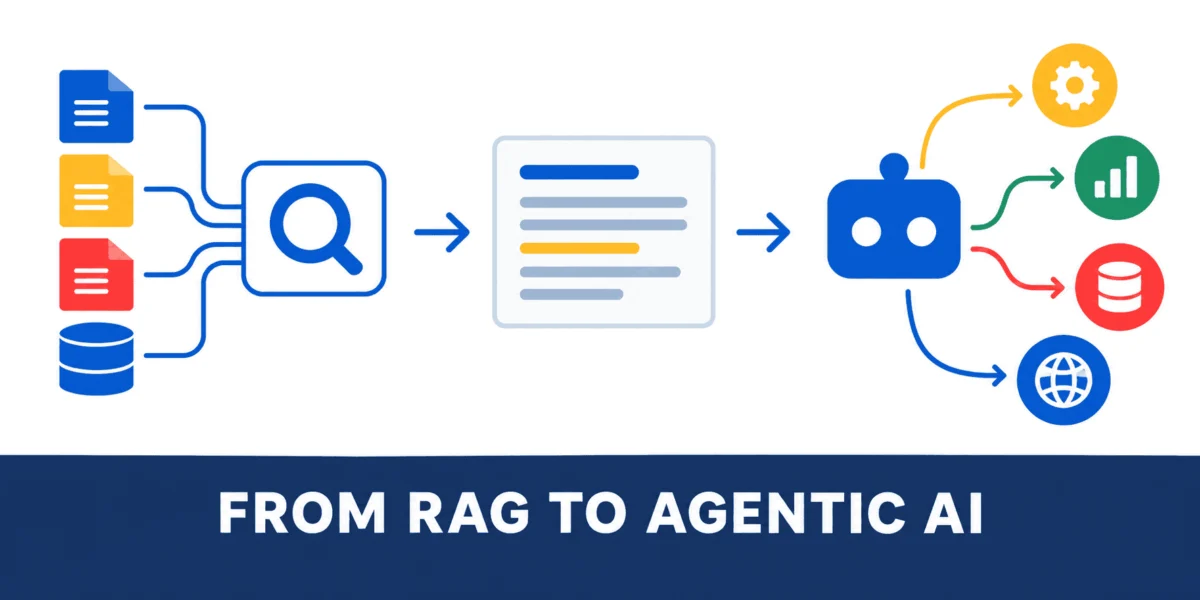
The rapid adoption of Large Language Models (LLMs) has fundamentally altered the corporate technology landscape. For many organizations, the initial answer was Retrieval-Augmented Generation (RAG)—a technique that bridges the gap between static pre-trained models and proprietary enterprise data. By grounding LLM responses in internal documentation, companies unlocked a new era of productivity.
However, as deployments move from proof-of-concept to mission-critical infrastructure, the limitations of "vanilla" RAG have become starkly apparent. Industry experts are now recognizing that true enterprise intelligence requires more than just a vector database and an LLM; it demands a multi-generational architectural shift toward hybrid retrieval, knowledge-graph integration, and, ultimately, autonomous agentic systems.
The Inherent Failures of "Just RAG"
The "standard" RAG pipeline—embedding a query, retrieving similar document chunks, and generating an answer—is conceptually elegant but operationally fragile. In complex enterprise environments, this approach frequently collapses under the weight of three persistent challenges:
- Semantic Ambiguity: Enterprise environments are dense with domain-specific acronyms and jargon. Standard RAG lacks a mechanism to clarify intent, often misinterpreting a query by relying solely on the LLM’s general-purpose training.
- Vocabulary Mismatch: Vector similarity, while powerful, often fails to surface critical documents that use different terminology for the same concept. If a user searches for "stockouts" but the documentation uses "supply gaps," the system may fail entirely.
- The Hallucination Transparency Gap: A critical failure in RAG is the system’s inability to communicate its own confidence. Because a hallucinated answer is syntactically indistinguishable from a grounded one, users are often left without a reliable way to verify the validity of the response.
Chronology of Innovation: A Three-Generation Framework
To address these shortcomings, AI scientists have moved through three distinct generations of retrieval architecture, each building upon the lessons of its predecessor.
Generation One: The Hybrid Retrieval Paradigm
The first step toward production-grade reliability is the rejection of the "one-size-fits-all" retrieval method. The industry has converged on hybrid retrieval, which runs dense vector search and sparse keyword search (BM25) in parallel.
Engineering this in production requires more than just running two queries. Success hinges on:
- Intelligent Rank Fusion: Utilizing Reciprocal Rank Fusion (RRF) to combine scores from heterogeneous sources, prioritizing documents that perform well across both semantic and lexical metrics.
- Multi-Tier Deduplication: Naive concatenation of results leads to redundant content. A robust system must employ deduplication across unique identifiers, source locations, and content fingerprints before the data ever reaches the reranker.
- Asynchronous Latency Optimization: By executing searches concurrently rather than sequentially, engineers can reduce retrieval latency by upwards of 40%, ensuring the system remains responsive for end-users.
Generation Two: The Rise of GraphRAG
The second generation addresses the "island" problem: standard RAG treats document chunks as isolated snippets of text, ignoring the structural relationships between entities. By integrating a knowledge graph—a technique termed GraphRAG—systems can map the ontology of an enterprise.
A crucial design decision here is the rejection of LLM-based Named Entity Recognition (NER) for ingestion. Relying on an LLM to extract entities at scale introduces unacceptable latency, costs, and, most importantly, non-determinism. Instead, industry-leading systems favor rule-based, multi-pass entity extraction. By performing longest-first phrase matching against a curated entity index, organizations achieve consistent, high-fidelity mapping at virtually zero marginal cost. This structured data is then used to weight search results, ensuring that even if a document uses different surface language, it will be prioritized if it contains the correct entities.
Generation Three: Agentic AI and Reasoning Systems
The current frontier is the move from "retrieve-then-generate" pipelines to Agentic AI. These systems do not merely follow a fixed path; they function as reasoning engines. When faced with a complex inquiry, an agent decomposes the request into sub-tasks, evaluates the necessary data sources, and plans the execution workflow dynamically.
Supporting Data and Technical Architecture
For an enterprise system to be considered "production-ready," it must prioritize deterministic logic over the "black box" behavior of generative models.
The Logic of Confidence Scoring
Most production RAG systems fall into the trap of averaging confidence signals across pipeline stages. This obscures failure. Experts now advocate for multiplicative confidence scoring. If a planning module reports 0.9 confidence and a retrieval module reports 0.1, the multiplicative result is 0.09. This provides a hard, unambiguous signal that the system is unable to answer the question, allowing it to gracefully trigger a "human-in-the-loop" fallback rather than providing a flawed, confident-sounding hallucination.
Safety as an Architectural Boundary
In the enterprise, safety cannot be a downstream "guardrail." It must be the first step in the pipeline. By treating privacy and policy compliance as an architectural boundary—where queries containing sensitive or restricted data are rejected before they touch the retrieval or generation layers—organizations can mitigate risk by design.
Implications for the Future of Enterprise AI
The trajectory of this technology indicates that the era of simple chat interfaces is ending, replaced by systems capable of high-stakes reasoning.
Key Principles for Future Deployment
- Determinism vs. Flexibility: Reserve the LLM’s generative capacity for tasks that strictly require it. Use deterministic, rule-based systems for routing, disambiguation, and entity extraction to ensure debuggability.
- Latency as a Feature: In enterprise software, latency is a core user-experience metric. Every millisecond saved is a gain in adoption and utility.
- The "I Don’t Know" Capability: A system that cannot express uncertainty is a liability. Confidence scoring must be integrated into the architecture from day one.
Official Perspectives on Multi-Agent Orchestration
As the industry matures, the focus is shifting toward multi-agent orchestration. In this vision, specialized agents—each with distinct access to specific knowledge domains or APIs—discover each other dynamically to solve complex, cross-functional enterprise problems. Standards like the Model Context Protocol (MCP) are facilitating this shift, providing a common language for agents to interoperate.
Conclusion: The Path Forward
The transition from RAG to Agentic AI represents a maturation of the entire field. The building blocks—hybrid retrieval, knowledge graphs, and agentic workflows—are no longer theoretical; they are established pillars of intelligent enterprise architecture.
For organizations currently navigating the "valley of disappointment" with basic RAG implementations, the path to success lies in moving away from monolithic, black-box pipelines toward modular, deterministic, and self-correcting systems. As companies begin to invest in these architectural foundations, they move closer to building truly "intelligent" enterprise systems—systems that don’t just mimic human communication, but mirror the structured, reliable reasoning required to manage the complexities of modern business.
The next generation of AI will not be defined by the size of the model, but by the sophistication of the system that orchestrates it. Those who master these principles today will define the competitive landscape of tomorrow.