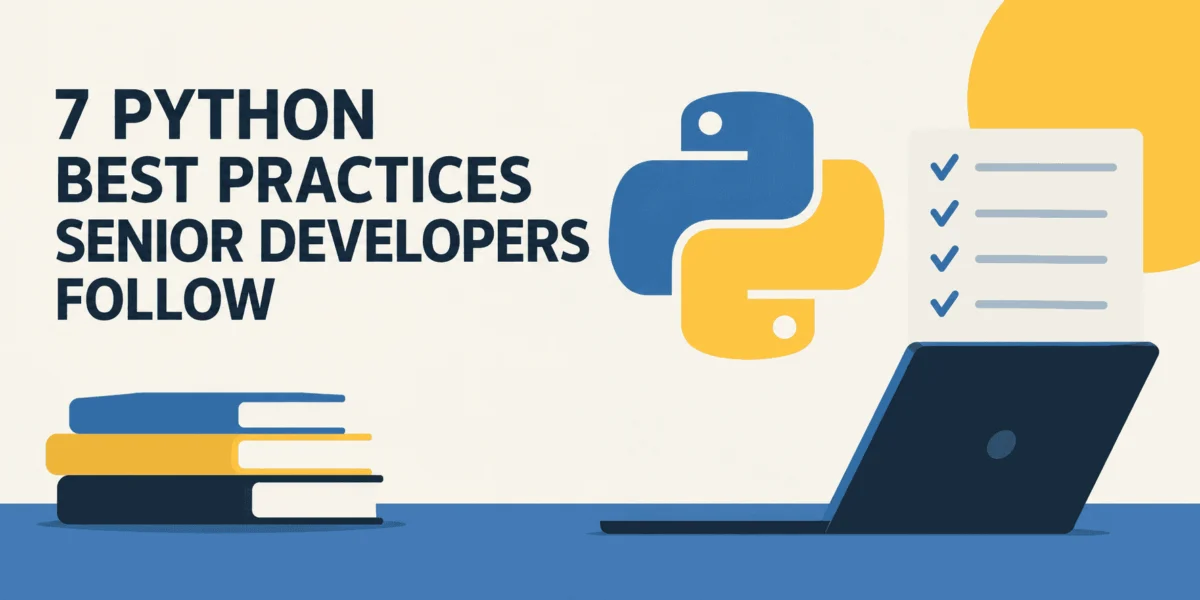
In the world of software engineering, "clean code" is often reduced to a set of aesthetic preferences—variable naming conventions, indentation depth, and the absence of redundant comments. While these practices are essential for readability, they represent only the surface level of professional software craftsmanship.
A function may pass a linter with flying colors, adhere perfectly to PEP 8 standards, and breeze through unit tests on the "happy path," yet remain a liability in production. Such code often hides dangerous, unverified assumptions: that the network will always respond, that external services will remain stable, or that resources will be cleaned up by magic. For senior developers, the true challenge of engineering is not just writing code that works; it is "surprise reduction"—building systems that fail gracefully, are easily observable, and remain maintainable as they scale.
The Anatomy of Operational Failure
The difference between a junior and a senior developer is often found in how they handle the "unhappy path." A junior developer focuses on the logic required to achieve a specific outcome. A senior developer, by contrast, spends the majority of their mental energy designing for the failure of that logic.
Consider a standard API interaction. A novice implementation might initialize an HTTP client, fire a request, and log a generic "processing failed" message if an error occurs. In production, this becomes a nightmare for the on-call engineer: the network call might hang indefinitely, starving the worker process, or the error message might provide no context as to which job triggered the failure. Without a mechanism to simulate these failures, the system remains a "black box" that only reveals its flaws under the high-pressure environment of a live outage.
The Hierarchy of Professional Python Habits
| Hidden Assumption | Production Symptom | Practice That Exposes It |
|---|---|---|
| "The client will be there" | Untestable code, deep patching | Dependency injection (using Protocol) |
| "Cleanup will happen" | Leaked handles, locks held | ContextManager resource ownership |
| "The service will answer" | Stalled workers, infinite waits | Hard-coded timeouts on external calls |
| "We’ll know what happened" | Vague errors, zero context | Structured logging with metadata |
| "Happy path is the behavior" | Hidden bugs in production | Testing the "failure contract" |
| "Everyone knows how it runs" | Environment drift, CI failures | Explicit metadata in pyproject.toml |
| "Nobody uses that old code" | Unannounced breaking changes | Formal deprecation cycles |
1. Dependency Injection: Decoupling for Testability
One of the most common pitfalls in Python development is tight coupling. When a function instantiates its own dependencies—such as an httpx.Client()—it becomes inextricably linked to the network. Testing this code requires either hitting live endpoints (slow and unreliable) or "monkeypatching" internals (brittle and confusing).
Senior developers treat dependencies as inputs. By using typing.Protocol, they define the "shape" of the required collaborator rather than the concrete implementation. This allows for structural typing, where any object that implements the required method will satisfy the interface. During testing, this enables the developer to inject a "fake" client that records its own calls, allowing the entire suite to run in milliseconds without ever touching the network.
2. Resource Stewardship via Context Managers
Resource leaks are the silent killers of long-running Python applications. Whether dealing with database transactions, file handles, or threading locks, relying on Python’s garbage collector to eventually clean up is a dangerous strategy.
The with statement is the primary tool for deterministic cleanup. By wrapping resource acquisition and release in a context manager, developers guarantee that teardown logic executes even when an exception is raised inside the block. For custom objects, contextlib makes this pattern trivial to implement, ensuring that system resources are returned to the OS as soon as they are no longer required, regardless of whether the process succeeded or crashed.
3. The Necessity of Timeouts
An unbounded wait is an undeclared failure mode. If an external service hangs, a synchronous Python application can quickly exhaust its worker pool, causing a total system outage. Senior developers enforce "deadlines" on every external interaction.
In modern Python, asyncio.timeout() provides a clean way to bound asynchronous operations. For synchronous code, developers must explicitly configure timeouts on their drivers, whether for SQL databases or HTTP requests. The habit is not merely to set a number, but to decide on a recovery strategy: should the system retry, return a cached partial result, or fail loudly? A well-designed system knows exactly when to give up.
4. Observability: Structured Logging
"Processing failed" is a useless log message. In a distributed system, a log line is only as valuable as the context attached to it. Senior developers utilize structured logging, appending metadata like job_id, user_id, or attempt_number directly to the log event.
Using the extra parameter or the LoggerAdapter pattern, developers can ensure that every log message provides enough breadcrumbs for an engineer to trace the root cause without having to reproduce the issue locally. The goal is to make the system "interrogable"—if a failure happens at 2 a.m., the logs should tell the on-call engineer exactly which component failed and why.
5. Testing the Failure Contract
If a test suite only covers the "happy path," it is effectively a confirmation of the developer’s optimism, not a validation of the software’s robustness. Senior developers prioritize testing the failure contract.
By using pytest.mark.parametrize, developers can efficiently test how a function behaves when provided with empty, malformed, or hostile inputs. They also use monkeypatch to force timeouts or simulate network failures. A well-written test suite shouldn’t just check if the code works; it should prove that the code fails gracefully, logs the error, and recovers as expected.
6. Infrastructure as Code: The pyproject.toml Contract
"It works on my machine" is the classic symptom of unmanaged environment assumptions. A project should explicitly state its requirements, Python version constraints, and build dependencies in a machine-readable format.
The pyproject.toml file serves as the definitive source of truth for the project’s contract. By declaring these metadata points, developers enable CI/CD pipelines to build the environment correctly every time. It eliminates the tribal knowledge required to "just get it running," ensuring that new contributors and automated agents operate on the same playing field.
7. The Art of Deprecation
Breaking APIs is an unavoidable part of software evolution, but doing so without notice is a breach of trust. Senior developers manage change through explicit deprecation cycles.
By utilizing the warnings module, developers can notify users that a function is slated for removal, providing a clear migration path to the new implementation. Using stacklevel=2 ensures the warning points directly to the caller’s code, making it visible to the developer utilizing the library. By setting filterwarnings = ["error::DeprecationWarning"] in their test configuration, teams can treat deprecations as failures, ensuring that technical debt is addressed before it becomes a production crisis.
Implications for Future Development
These seven habits are not about adding bureaucratic overhead; they are about moving assumptions from the developer’s head into the code itself. When assumptions are explicit, they become testable, observable, and maintainable.
Ultimately, senior development is the process of building systems that are resilient to the inevitable realities of production. By prioritizing dependency injection, resource cleanup, timeouts, structured logging, rigorous failure testing, explicit metadata, and formal deprecation, developers create software that can survive the long-term pressures of maintenance and evolution. Code that shows its assumptions is, quite simply, the code that survives.