In a landmark achievement for the telecommunications industry, Samsung Electronics and Verizon have successfully conducted the industry’s first field trial of Integrated Sensing and Communication (ISAC) technology over a live, virtualized Radio Access Network (vRAN). Executed at a major international soccer event in Dallas, Texas, the trial signals a paradigm shift in how global network operators view their infrastructure: moving away from simple data pipes toward "perceptive networks" that can understand and interact with the physical world.
This demonstration provides a tangible glimpse into the future of 6G, where the network itself acts as a massive, distributed sensor array capable of real-time environmental analysis. By leveraging existing commercial vRAN infrastructure, the companies have proven that the road to 6G may be paved with software-driven upgrades rather than massive hardware overhauls.
The Core Innovation: What is ISAC?
At its most fundamental level, ISAC represents the convergence of radar-like sensing capabilities with traditional wireless communication protocols. While current 5G networks are designed to transmit data between devices, ISAC allows the network to use the radio waves themselves as a medium to "see."
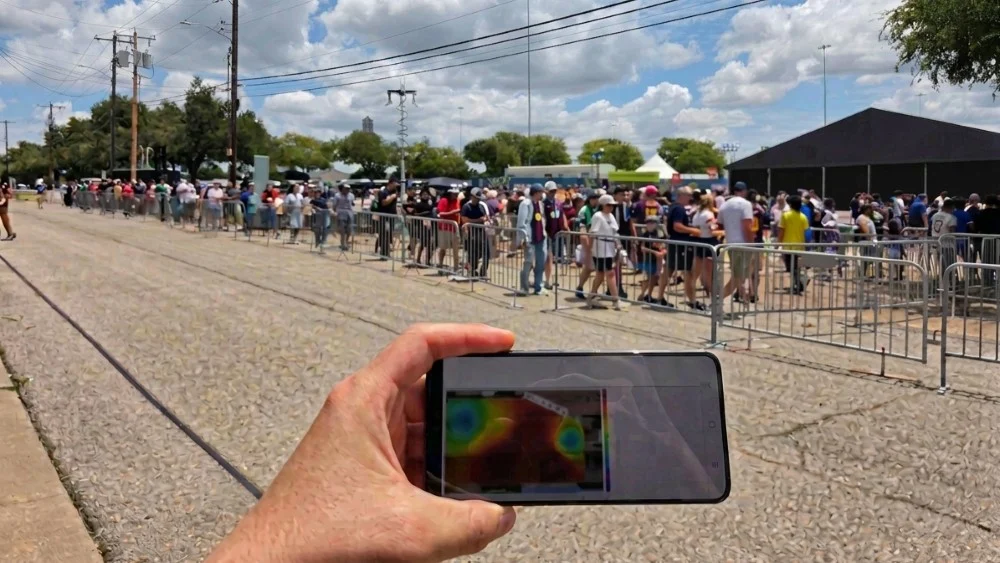
By analyzing the way radio signals reflect off objects, people, and surfaces, the network can calculate the presence, speed, movement, and location of entities within its coverage area. In the Dallas trial, this meant the network was able to generate a real-time "crowd density heatmap," identifying areas of high congestion or movement patterns without requiring attendees to carry specific tracking devices or utilize GPS.
Technical Architecture: The "Network in a Server" (NIS)
The success of this trial rested on Samsung’s Network in a Server (NIS) platform. Unlike traditional base stations that require fragmented hardware, the NIS is an end-to-end, software-driven edge-AI platform. It consolidates network functions and accelerated compute power into a single, compact server.
During the Dallas event, the system functioned as follows:
- The Radio Unit: A CBRS (Citizens Broadband Radio Service) radio unit mounted on a Verizon "Cell-On-Wheels" (COW) acted as the sensing receiver.
- Signal Processing: The unit captured channel variations in the transmissions from a commercial 5G device.
- AI Analysis: The data was fed into the NIS, where Samsung’s proprietary AI algorithms analyzed the signal reflections in near-real time.
- Visualization: These insights were translated into an actionable heatmap, allowing event managers to see crowd flow and density metrics dynamically.
Chronology of the Development
The path to this successful Dallas trial was years in the making, reflecting a deliberate, strategic investment in virtualization and AI-native networking.
- 2020–2022: The Foundation of Virtualization. Verizon embarked on an aggressive push to virtualize its core and RAN. By moving away from proprietary, fixed-function hardware to a software-driven vRAN, the carrier created a flexible ecosystem capable of hosting new applications on demand.
- 2023: Research and Development Phase. Samsung Research America (SRA) began refining AI-driven ISAC algorithms, testing the feasibility of extracting sensing data from standard 5G waveforms. The goal was to ensure that sensing would not degrade existing voice or data services.
- Early 2024: Lab-to-Field Transition. The partners moved the technology from controlled lab environments to the Verizon 6G Innovation Forum, focusing on how the software could be integrated into existing commercial commercial deployments.
- Mid-2024: The Dallas Trial. The deployment of the ISAC application at the international soccer event served as the final stress test. Operating in a high-density, real-world environment, the system successfully proved that the technology could scale to meet the needs of massive public venues.
Supporting Data: Why ISAC Changes Everything
The implications of this trial are supported by the move toward "AI-Native" networks. Traditionally, network management has been reactive—operators add capacity after they see a bottleneck. ISAC transforms this into a proactive model.
- Infrastructure Efficiency: By utilizing existing CBRS spectrum (40 MHz) and current vRAN hardware, the trial demonstrated that ISAC does not necessarily require massive new spectrum allocations or dedicated radar hardware.
- Resource Allocation: In a stadium environment, knowing exactly where crowds are gathering allows the network to perform "beamforming"—directing more wireless capacity toward high-density areas before users even experience a slowdown.
- Public Safety: Real-time sensing enables the automatic detection of anomalies. If a crowd suddenly surges or disperses in an unexpected direction, the system can provide automated alerts to venue security, potentially preventing dangerous crushing incidents.
Official Perspectives: Industry Leadership
The partnership between Samsung and Verizon is viewed by industry analysts as a bellwether for the 6G transition.
Yago Tenorio, CTO and SVP of Technology Development at Verizon, emphasized the strategic pivot toward intelligence:
"Verizon’s strategy has always been focused on building an intelligent, AI-native network that translates into meaningful real-world value for our customers. This field trial with Samsung proves that the network of the future will do far more than just transfer data—it will actively perceive and interact with its environment."
Ji-Yun Seol, EVP and Head of Product Strategy, Networks Business at Samsung Electronics, highlighted the importance of early adoption:
"Forward-thinking operators like Verizon are unlocking untapped potential, spearheading the shift toward a new era where unprecedented services, devices, and use cases converge on next-generation networks."
Charlie Zhang, EVP at Samsung Research America, underscored the technical synergy:
"By combining Verizon’s innovative approach with Samsung’s advanced vRAN solutions, we’ve demonstrated the practical application of ISAC in a real-world scenario to enhance safety, efficiency, and user experience."
Implications: A New Era for Public Infrastructure
The successful integration of ISAC into a commercial 5G network creates a roadmap for several industries, well beyond the immediate scope of telecommunications.
1. Smart Cities and Urban Planning
ISAC-enabled networks could replace expensive, privacy-invasive camera systems for urban planning. By sensing traffic patterns, pedestrian flow, and vehicle speeds, city managers can optimize traffic light cycles and public transportation routes in real-time, all while maintaining anonymized data sets.
2. Autonomous Systems
For autonomous vehicles and robotics, the network could provide a secondary layer of "perception." If an autonomous car is approaching a blind corner, the network—acting as an ISAC sensor—could inform the vehicle of an obstacle around the bend that its onboard cameras cannot yet see, effectively extending the "senses" of the machine.
3. Future-Proofing 6G
Perhaps most importantly, this trial proves that 6G will not be a "hard reset" of cellular technology. By proving that 5G vRAN can support 6G features like ISAC, Samsung and Verizon have shown that the transition will be evolutionary. It demonstrates that the software-defined nature of modern networks allows for continuous innovation, turning every cell tower into a potential sensor platform.
Looking Forward: Challenges and Next Steps
While the Dallas trial was a resounding success, scaling the technology faces hurdles. Privacy remains a paramount concern; as networks become more "aware" of the physical environment, operators must develop robust governance frameworks to ensure that sensing data is handled with the same security as private communications data.
Additionally, the computational load of processing sensing data alongside massive amounts of cellular traffic requires continued advancements in edge-computing power. Samsung’s NIS platform is a strong start, but as 6G networks expand, the integration of specialized AI chips and low-latency processing at the edge will become the next frontier.
As a founding member of the Verizon 6G Innovation Forum, Samsung is committed to pushing these boundaries. The company continues to invest in a broad portfolio—from Open RAN and Cloud-native cores to AI-powered automation tools like CognitiV NOS. As the industry marches toward 6G, the collaboration between Samsung and Verizon sets a high bar, proving that the most powerful network of the future isn’t just one that transmits information, but one that understands the world it serves.