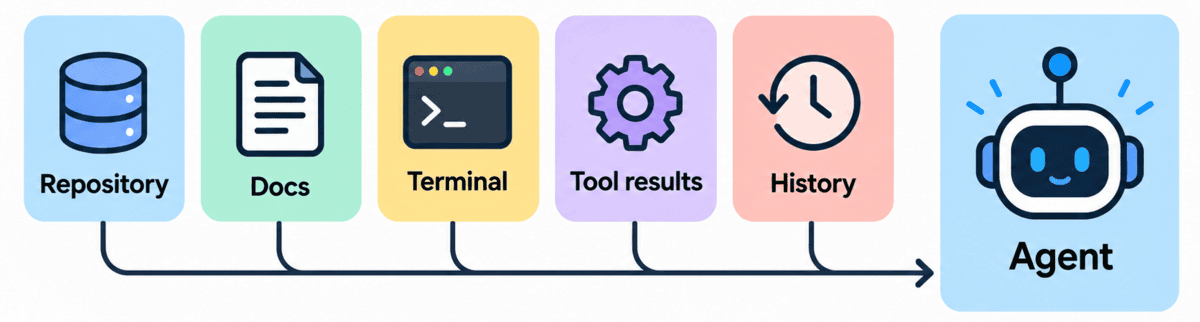
The landscape of Artificial Intelligence has long been dominated by a "bigger is better" philosophy, where increasing parameter counts and training data volumes were the primary metrics of progress. However, as the industry pivots toward complex, autonomous AI agents—systems that must read massive codebases, navigate terminals, and maintain context over long, multi-step tasks—raw parameter size has become a liability. Enter DeepSeek-V4.1-Flash, a release that signals a fundamental departure from traditional architectural norms, focusing instead on the practical economics of long-context inference.
DeepSeek’s latest model isn’t just another incremental upgrade. By re-engineering the inference stack and rethinking how models ingest and store information, DeepSeek has produced a 552B-parameter behemoth that behaves with the agility of a much smaller system.
The Core Innovation: Breaking the Prefill-Decode Bottleneck
To understand why DeepSeek-V4.1-Flash is a watershed moment, one must first look at the mechanics of LLM inference. Modern agents operate in a state of perpetual imbalance. They spend the vast majority of their time "reading"—ingesting massive prompts, documentation, and historical logs—before generating relatively short, actionable responses. Traditional decoder-only architectures process these two stages with near-identical compute costs.
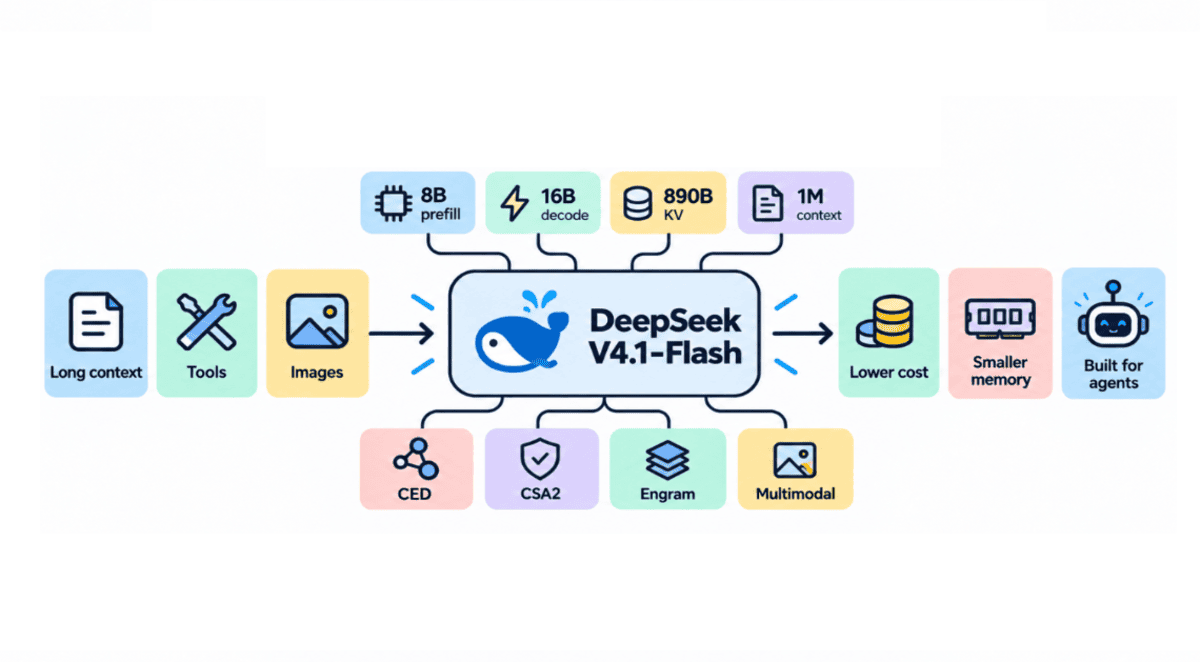
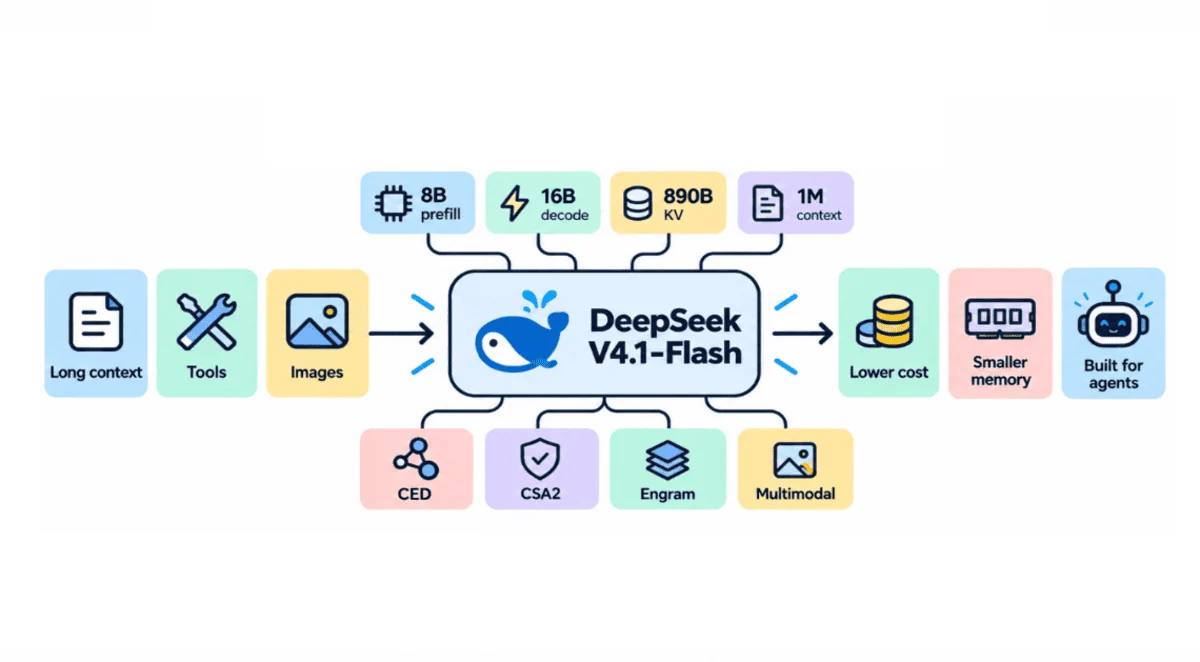
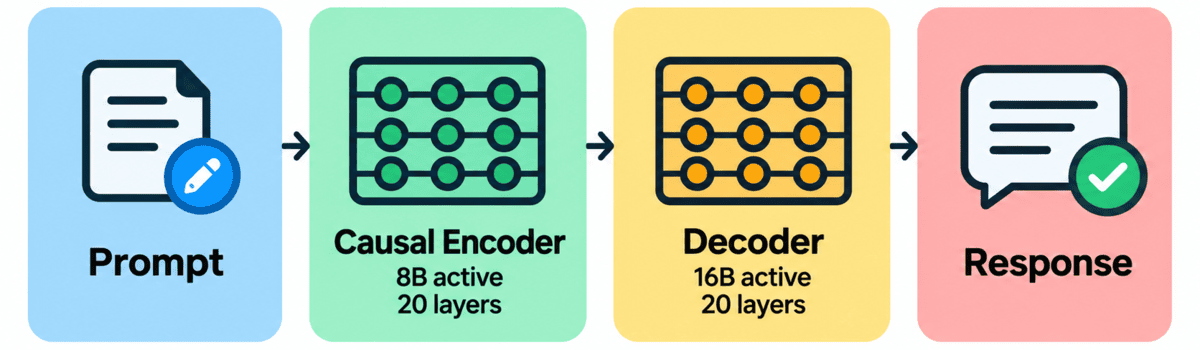
DeepSeek has addressed this through the introduction of a Causal Encoder-Decoder (CED) architecture. By splitting the model into a 20-layer causal encoder and a 20-layer decoder, the model creates a unique compute profile: it activates only 8B parameters during the prefill stage, scaling to 16B parameters during the decoding stage.
This asymmetry is the "secret sauce." By reducing the compute overhead for reading information and reserving more power for the reasoning and generation phases, DeepSeek has optimized the model for the actual lifecycle of an AI agent. It allows for high-speed ingestion of million-token context windows without the prohibitive energy costs that usually accompany such high-capacity models.
Chronology of the Release and Technical Milestones
The release of V4.1-Flash follows a rapid, iterative development cycle that characterizes DeepSeek’s current trajectory. While the model builds upon the foundations of its predecessors (V4-Flash and V4-Pro), the transition to V4.1 represents a significant leap in memory management.
- Foundation: Development began with the training of the backbone on 45 trillion multimodal tokens, a massive dataset designed to ensure the model excels in both textual logic and visual understanding.
- The Engram Integration: Alongside the 552B backbone, engineers integrated a 196B-parameter "Engram" conditional-memory component. Unlike traditional parameters that are always active, this component functions as a sparse lookup table, allowing the model to retrieve specific knowledge without the overhead of full neural activation.
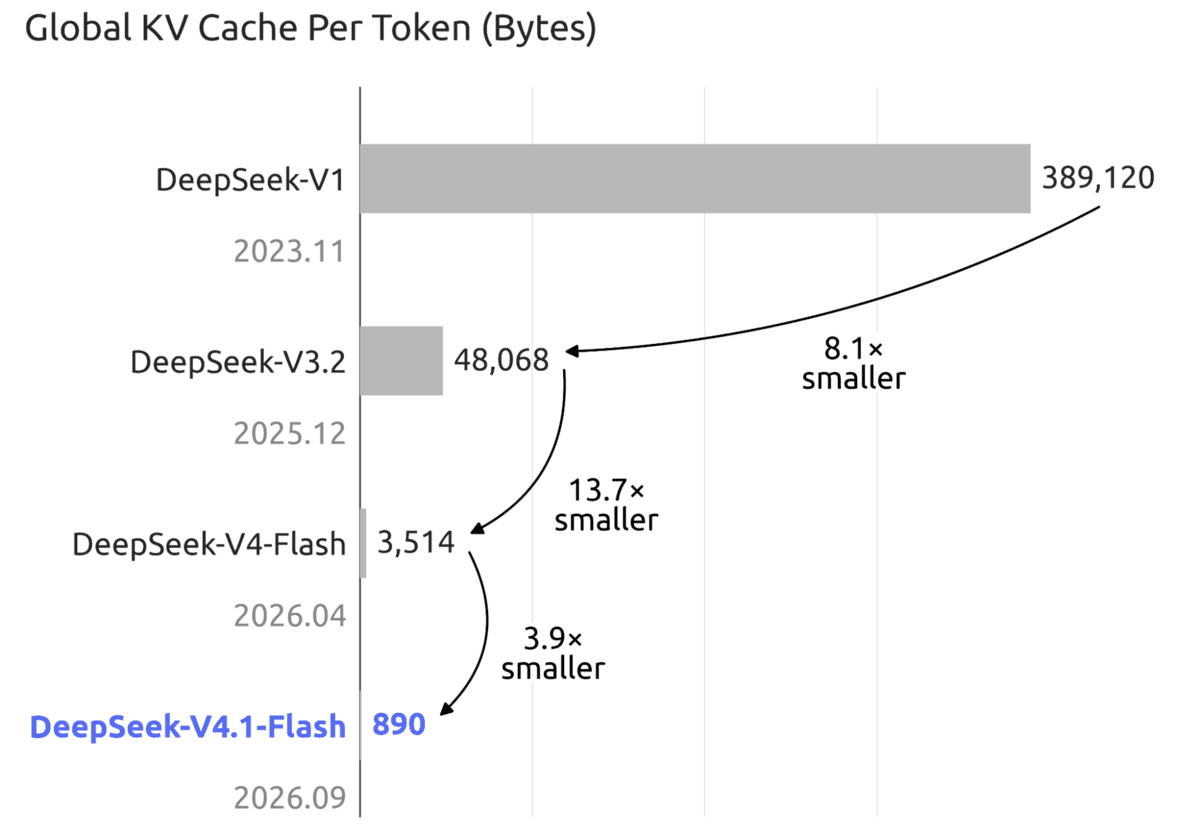
- Optimization Rollout: Throughout the development process, the team focused on reducing the global KV (Key-Value) cache, which has historically been the primary bottleneck for long-context models. By the time of the V4.1 release, they successfully reduced this footprint to a mere 890 bytes per token.
Supporting Data: Efficiency Metrics
The efficiency gains are not merely theoretical. DeepSeek’s architectural choices yield concrete, measurable improvements in infrastructure utilization.
| Attribute | Specification |
|---|---|
| Total Backbone Parameters | 552B |
| Active Parameters (Prefill) | 8B |
| Active Parameters (Decode) | 16B |
| Context Window | 1,000,000 tokens |
| Global KV Cache | 890 bytes/token |
| Training Data | 45T Multimodal Tokens |
| Memory Component | 196B Engram (Sparse) |
The reduction in the KV cache is particularly striking. By employing Compressed Sparse Attention 2 (CSA2), the model avoids the redundancy found in standard Transformer layers. Where previous models would force every layer to re-search the entire context, CSA2 uses a hierarchical indexing system that narrows down relevant information early, allowing subsequent layers to focus only on a subset of the data. This, combined with FP4 KV caching (which compresses the stored data), results in a cache that requires roughly one-quarter of the High Bandwidth Memory (HBM) used by previous iterations.
Advanced Architectural Tricks
Beyond the CED and CSA2, several secondary innovations contribute to the model’s performance:
1. SWA Bounded Replay
To manage memory constraints, the model employs SWA (Sliding Window Attention) Bounded Replay. Instead of keeping the entire historical attention state in volatile memory, the system discards older segments and reconstructs them on the fly when necessary. This reduces persistent storage requirements by roughly 87.5% compared to the V4-Flash architecture.
2. Single-Pass mHC
Memory traffic is often the "hidden" cost of inference. The Single-Pass mHC (Multi-Head Compression) technique allows the model to read and mix activations in a single pass, effectively halving the memory traffic required for these operations and drastically reducing latency during the generation phase.
3. DSpark Speculative Decoding
For speed, the model uses DSpark, a speculative decoding mechanism. By generating draft tokens and verifying them in parallel, the model can accept multiple tokens simultaneously, ensuring that even with massive parameter counts, the output speed remains highly competitive.

Official Responses and Industry Context
In the wake of the release, the AI community has noted that DeepSeek-V4.1-Flash is not necessarily trying to claim the "King of Intelligence" crown. Instead, it is positioning itself as the most "pragmatic" choice for developers.
Benchmarks show the model significantly outperforming its predecessors in agent-specific tasks. On the DeepSWE v1.1 benchmark, it achieved a score of 74.2, compared to the V4-Flash’s 54.4. Similarly, in CyberGym and AutomationBench, the gains were substantial, reflecting the model’s superior ability to navigate complex, multi-step environments rather than just answering static questions.
DeepSeek’s decision to release the model under the MIT license is a strategic move to standardize these architectural improvements. By providing the reference code for the CED architecture and the sparse memory components, DeepSeek is effectively inviting the open-source community to build on their research, potentially setting a new standard for how large-scale models are deployed in production.
Implications for the Future of AI Agents
The most profound implication of this release is the potential for democratization of high-performance agents. If the cost of maintaining a 1-million-token context is reduced by 75%, businesses can deploy agents that possess "total recall" of enterprise-wide documentation, code repositories, and user history without needing an exponentially larger server farm.
The Agentic Shift
We are moving away from chatbots—which are essentially glorified search engines—toward "Action Agents." These agents need to interact with terminals, execute code, and manage cybersecurity incidents. These tasks are compute-intensive and memory-heavy. DeepSeek-V4.1-Flash provides a blueprint for an infrastructure that can handle this load without collapsing under its own weight.
Impact on Open Source
The "Engram" concept—sparse, conditional memory—is likely to be the most replicated feature in the coming months. If developers can successfully decouple a model’s "logic" (backbone) from its "knowledge" (Engram), we could see the rise of modular AI systems where developers can swap out specialized memory components without retraining the entire backbone.

Final Assessment: A New Benchmark for Pragmatism
While some may argue that newer, smaller models offer better price-to-performance ratios for simple query-response tasks, DeepSeek-V4.1-Flash wins where it counts: complexity management. It is not designed to be the cheapest model to answer "What is the capital of France?" It is designed to be the engine that runs an autonomous coder for eight hours straight without exceeding memory limits or incurring astronomical latency.
The research presented by DeepSeek—specifically regarding asymmetric compute and hierarchical attention—is likely to influence the next generation of inference engines, such as vLLM or TensorRT-LLM. By prioritizing efficiency and memory-efficient architectures, DeepSeek has provided the industry with a roadmap for scaling AI, not just in size, but in intelligence and utility.
In conclusion, the true value of DeepSeek-V4.1-Flash lies in its contribution to the "science of efficiency." As AI moves from the lab to the real-world operational environment, these architectural breakthroughs will prove far more influential than a few points on a static benchmark. The model serves as a clear indicator that the future of AI isn’t just about building bigger brains; it’s about building faster, leaner, and more responsive systems capable of sustaining long-term, autonomous thought.