In the rapidly evolving landscape of generative AI, the focus has shifted from the brute-force scaling of massive foundation models toward the surgical optimization of Small Language Models (SLMs). As organizations seek to deploy artificial intelligence for "narrow automation"—tasks like customer support ticket classification, document extraction, or sentiment analysis—the overhead of recomputing static instructions for every single inference request has emerged as a significant bottleneck.
In our ongoing exploration of SLM optimization strategies, we recently examined the importance of constraining output spaces. Today, we advance to the second core pillar of efficiency: Key-Value (KV) Cache Prefix Reuse. By treating the static portion of a prompt as a reusable computational asset rather than a recurring cost, developers can achieve dramatic reductions in latency and compute overhead, effectively turning modest models into high-performance production workhorses.
The Core Fact: Why Recomputation is Wasteful
At the heart of every Transformer-based model lies the self-attention mechanism. When a model processes a prompt, it computes a "key" and "value" vector for every token in every layer. In a typical narrow automation task—such as routing a customer support ticket—the prompt is rarely entirely new. It usually consists of a lengthy system instruction, a complex taxonomy of categories, and several "few-shot" examples that remain constant across thousands of requests.
If your instruction block spans 200 tokens and your incoming ticket adds only 20, the model is forced to recompute the attention states for those 200 static tokens on every single pass. This is, by any engineering standard, redundant.
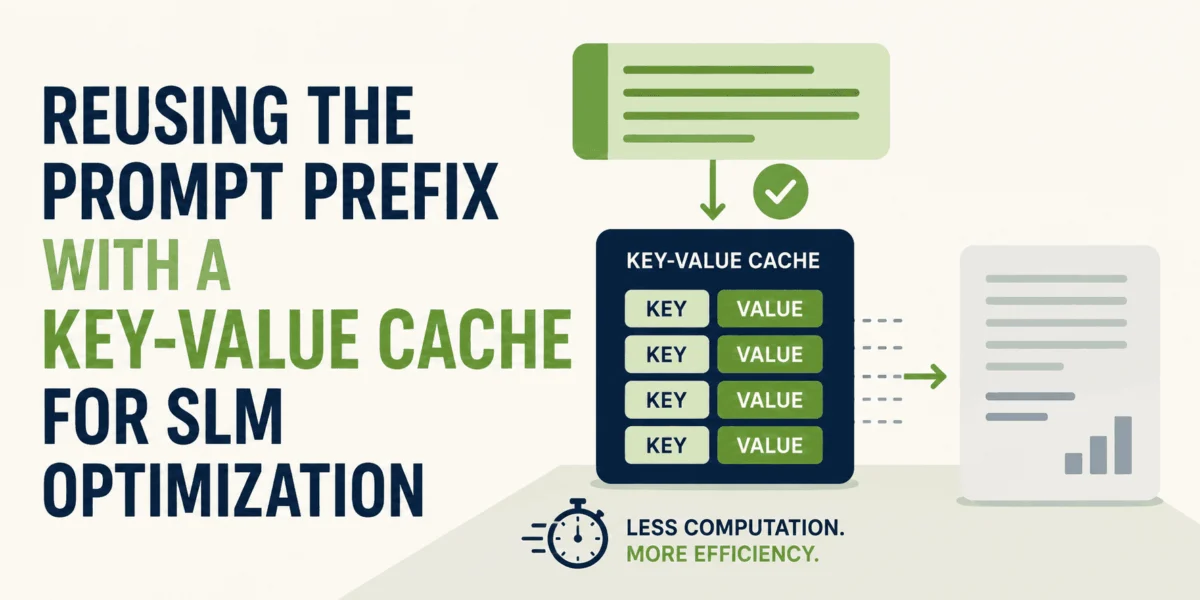
The strategy explored here is simple but profound: encode the static prefix once, store the resulting KV tensors in a cache, and feed the model only the "delta"—the few tokens that actually change from one request to the next.
Chronology of the Optimization Strategy
To demonstrate the efficacy of this approach, we utilized the Qwen2.5-0.5B-Instruct model, running on an M2 MacBook Air equipped with 24GB of RAM. The benchmark utilized a standard Python environment with torch and transformers.
Phase 1: The Naive Baseline
We established a baseline by processing 600 support tickets in a standard loop. Each ticket was concatenated with the full system prompt and few-shot examples, then passed through the model. As expected, this approach treated each inference as a discrete event, forcing the model to perform a "pre-fill" of the entire context window, including the 145 tokens of static instructions, 600 times.
Phase 2: Implementing the KV Cache
We then modified the pipeline to use the DynamicCache class from the Hugging Face transformers library. By populating the cache once with the system prompt, we effectively "pre-baked" the model’s understanding of its task. For each subsequent ticket, we provided only the user input, using the cache_position argument to tell the model where the new tokens sit relative to the cached instructions.
Phase 3: Validation and Measurement
To ensure the optimization did not sacrifice accuracy, we verified that the cached approach produced identical classification labels to the naive baseline across all 600 tickets. Once correctness was confirmed, we measured the execution time.
Supporting Data: Quantifiable Gains
The performance results are striking. When recomputing the full prompt every time, the process took approximately 184.85 seconds, averaging 308.1 milliseconds per ticket. After implementing the KV cache, the total time dropped to 80.07 seconds, with an average of 133.5 milliseconds per ticket.
| Metric | Full Re-encoding (Baseline) | KV Cache Optimization |
|---|---|---|
| Total Time (600 tickets) | 184.85 seconds | 80.07 seconds |
| Avg. Time per Ticket | 308.1 ms | 133.5 ms |
| Performance Gain | – | ~57% Reduction in Runtime |
This 57% reduction in runtime illustrates a vital principle: the efficiency of this technique grows in proportion to the size of your static context. As your prompt requirements become more complex—perhaps adding more detailed taxonomy definitions or additional few-shot examples—the "full re-encoding" method becomes progressively slower, while the KV cache method remains virtually constant in its performance for the dynamic portion of the task.
Technical Implementation Notes
Implementing this in production requires attention to "token-clean" boundaries. When you split a prompt into a prefix (the static instructions) and a suffix (the ticket), you must ensure that the token IDs produced by encoding them separately are identical to the IDs produced by encoding the full string at once. If the split occurs in the middle of a multi-token word or an improperly handled space, the model will see different input IDs, leading to hallucinations or errors.
The code uses the DynamicCache.crop() method to reset the cache after each inference. This is essential; it rolls the model’s memory back to the state immediately following the system prompt, ensuring the next ticket is processed against a "clean" slate of instructions, preventing the model from conflating different customer queries.
Implications for Production AI
The implications for developers and businesses are significant.
1. The Death of the "Large Model" Necessity
Many developers default to massive models (like 70B parameter variants) because they assume smaller models lack the reasoning depth for classification or automation. However, by using a 0.5B or 1B parameter model with a rich, cached system prompt, you can often achieve superior performance with significantly lower latency and cost. The model is not "smarter" in the traditional sense; rather, it is "better informed" by the comprehensive context provided in the prefix.
2. Lowering Operational Costs
In high-volume environments—such as a customer support platform processing millions of tickets a month—a 57% reduction in compute time translates directly into lower cloud infrastructure costs. When scaling across thousands of requests per second, the ability to bypass redundant computations is the difference between a viable business model and a cost-prohibitive one.
3. Scalability and Real-time Responsiveness
The reduction in per-ticket latency allows for more responsive applications. In scenarios where a user is waiting for a categorization to trigger a downstream workflow, reducing latency from 300ms to 133ms enhances the perceived quality of the software. It transforms the AI from a background process into a near-instantaneous utility.
Future Outlook: Beyond Simple Prefixes
While prefix caching is a powerful optimization, it is not the end of the road. Future advancements in SLM optimization will likely focus on:
- Multi-User Caching: Implementing systems that store the KV cache in a shared memory space, allowing multiple concurrent users to benefit from the same "system prompt" cache without duplicating memory usage.
- Context Compression: Exploring techniques to compress the KV cache itself, allowing for even larger instruction blocks to be held in memory without hitting hardware constraints.
- Adaptive Caching: Developing intelligent controllers that decide, in real-time, which parts of a prompt should be cached based on the frequency of specific instruction blocks.
Conclusion
The transition from "experimental AI" to "production-grade automation" is defined by the move from naive implementation to systematic optimization. As demonstrated by the 57% reduction in latency through KV cache reuse, the bottleneck in AI performance is often not the model itself, but how we feed it information.
By offloading the computational burden of static instructions, we allow small models to shine. We are no longer treating these models as isolated, expensive engines; we are treating them as optimized components within a larger, efficient architecture. For those building the next generation of narrow automation tools, the message is clear: stop recomputing the instructions. Focus your compute on the unique, the dynamic, and the valuable.
About the Author
Matthew Mayo (Twitter: @mattmayo13) holds a master’s degree in computer science and a graduate diploma in data mining. As the managing editor of KDnuggets and a contributor to Machine Learning Mastery, Matthew specializes in making complex data science concepts accessible. With a coding background spanning over two decades, he is a dedicated advocate for the democratization of AI knowledge and the practical, efficient deployment of machine learning algorithms.