In the rapidly evolving ecosystem of Large Language Models (LLMs) and autonomous AI agents, a hidden tax is eroding the bottom line of development teams: the "Token Tax." As agents become more sophisticated, they are increasingly tasked with retrieving real-time information from the web—searching logs, analyzing documentation, and scraping file repositories. However, the standard formats in which this data is delivered often contain significant "noise" that AI models do not require for reasoning, yet developers pay for in full.
A recent shift in data delivery, pioneered by tools like SerpApi, suggests that the solution to spiraling API costs and bloated context windows isn’t necessarily a more powerful model, but a smarter way of packaging data. By moving away from traditional machine-readable formats like JSON and toward human-readable, token-efficient formats like Markdown, organizations are seeing up to 74% reductions in token usage.
The Economics of AI: Why Tokens Matter
To understand the significance of this shift, one must first understand the fundamental constraint of current LLM architectures: the context window and the cost per token. Every time an AI agent is prompted, it consumes tokens for both the input (the prompt and retrieved data) and the output (the generated response).
When an agent is tasked with a seemingly simple request—such as "find the best-rated coffee shops in downtown Seattle"—it triggers a cascade of processes. The search engine returns a payload filled with nested objects, tracking links, metadata, and schema markup designed for browser rendering or database parsing. While this data is essential for a software application, an LLM only needs the semantic core: the name of the shop, the rating, and perhaps a brief description.
When an agent consumes 24,000 tokens for a search that could have been summarized in 6,000, the cost is not merely financial. It is also operational. Excess tokens crowd the context window, leaving less room for the actual reasoning logic, previous conversation history, or system instructions, often forcing developers to truncate information and lose critical context.
Chronology of a Search: From Raw Data to Token Bloat
The journey of a search query has traditionally followed a rigid path:
- The Request: An AI agent initiates a search via an API.
- The Payload: The server returns a massive JSON object, heavily laden with redundant keys, internal IDs, and tracking parameters.
- The Tokenization: Before the LLM can process the data, the entire payload is tokenized. The "overhead"—data intended for a UI or a database—is treated with the same weight as the information the AI actually needs to reason.
- The Rerun: Because the response is bloated, the agent may struggle to extract the correct answer, prompting a recursive loop or a secondary search, multiplying the token cost exponentially.
This cycle has remained largely unchallenged until recently. As LLMs grew more capable of "reading" unstructured data, the industry began to realize that the rigid structure of JSON—while perfect for backend software—was an inefficient delivery vehicle for the generative AI era.
Supporting Data: The Case for Markdown
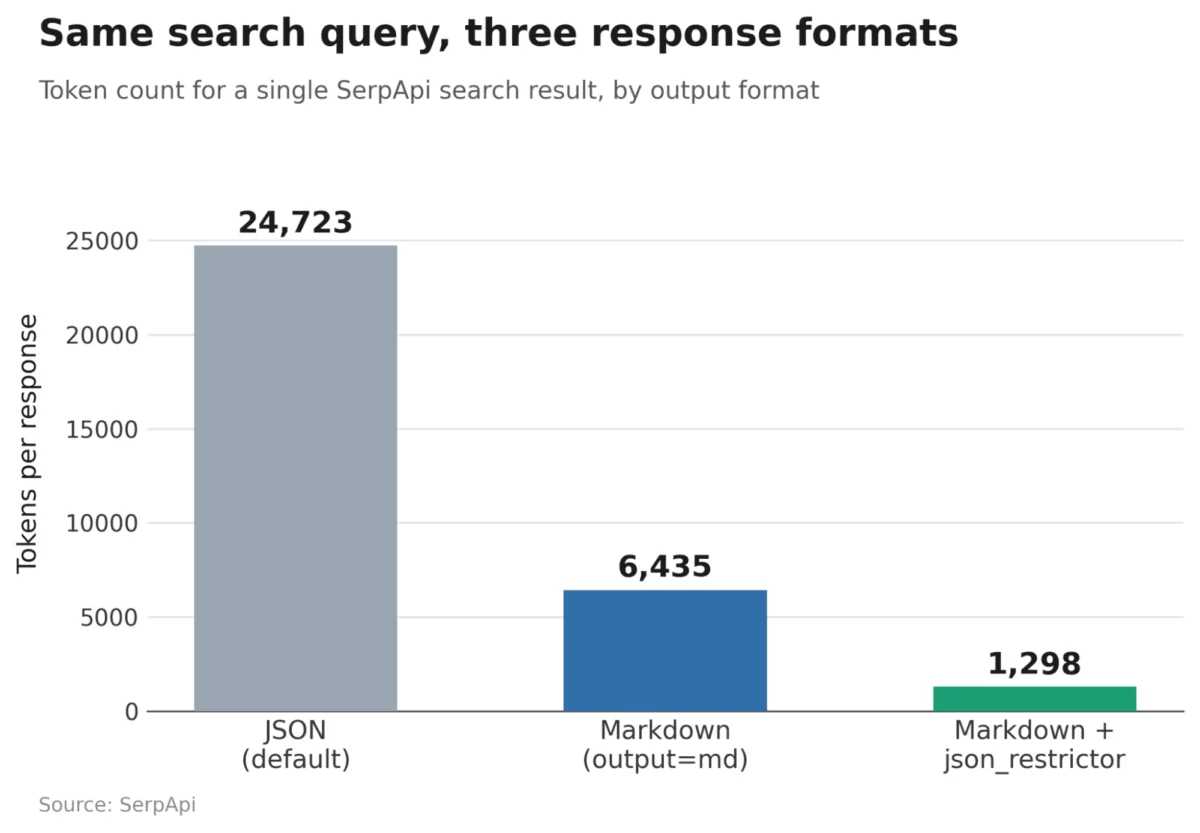
The recent benchmarks provided by SerpApi illustrate the stark contrast between traditional JSON and the newly adopted Markdown output. In a controlled test, a standard search for "coffee" was executed using both formats.
- JSON Performance: The standard JSON response required 24,723 tokens to process.
- Markdown Performance: By utilizing Markdown, the same search results were compressed into just 6,435 tokens.
This represents a 74% reduction in token consumption. Furthermore, by applying additional server-side field restrictions, that number can be pruned down to as little as 1,298 tokens.
The implications of this are profound. For a startup running thousands of agentic queries per day, this is not just an optimization; it is a fundamental shift in unit economics. By stripping away tracking noise, duplicate fields, and metadata intended for browser rendering, developers are effectively stretching their budget by a factor of four.
Understanding the "Signal vs. Noise" Ratio
Why does Markdown perform so much better? It comes down to how LLMs interpret text. Markdown is a lightweight markup language that organizes information into readable hierarchies—headers, tables, and bullet points.
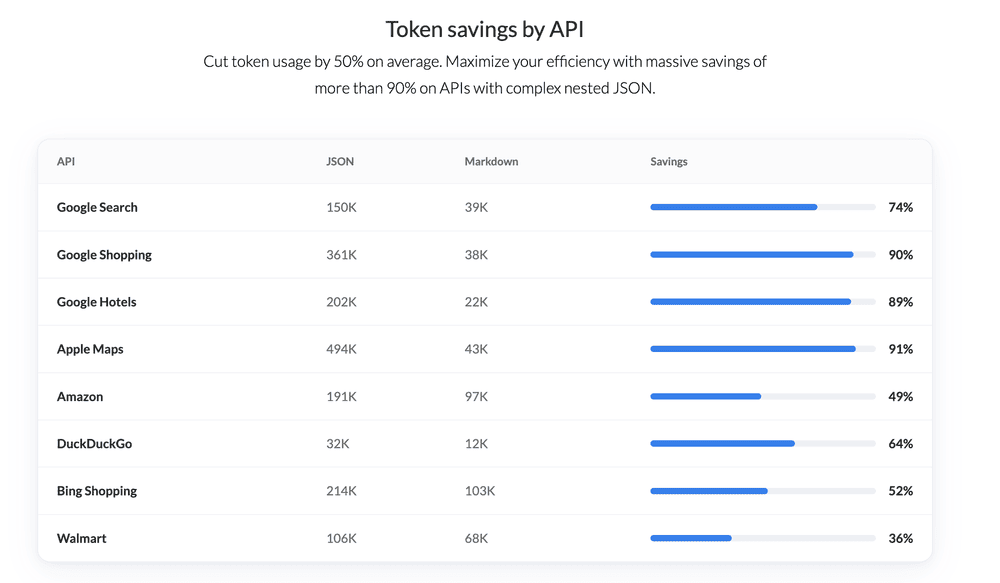
JSON, by contrast, relies on a verbose syntax of braces, quotes, and repetitive keys that are essential for programmatic parsing but add little value to a model that is essentially "reading" the information.
What gets stripped?
When data is converted to Markdown for an AI agent, the following are typically discarded:
- Tracking Pixels and IDs: Internal database references that have no semantic meaning for a reasoning model.
- Schema Markup: HTML/CSS metadata that helps a browser display content but provides zero informational value to a model.
- Redundant Keys: If an object contains a
namefield, atitlefield, and analiasfield that all essentially state the same thing, the Markdown converter can flatten these into a single, concise entry. - Nested Hierarchy: LLMs often struggle with deep nesting in JSON. Converting this to a flat Markdown table makes the information more accessible to the model’s attention mechanism.
The Strategic Divide: When to Use What
While the benefits of Markdown are clear, it is not a universal replacement for JSON. In the architecture of modern software, there is a clear divide:
The Case for JSON
If your pipeline involves downstream programmatic processing—such as a pricing engine that needs to perform arithmetic on coupon_price or old_price, or a database that requires strict type-casting—JSON remains the gold standard. When a machine needs to parse data with 100% precision, the strict structure of JSON is non-negotiable.
The Case for Markdown
Markdown is optimized specifically for Agentic Intelligence. When the goal is summarization, sentiment analysis, or identifying trends, Markdown provides the signal with minimal interference. It allows the model to focus its "attention" on the content, rather than parsing the syntax.
Implementation: A Frictionless Transition
One of the most compelling aspects of the move toward Markdown-optimized APIs is the ease of integration. Developers do not need to rewrite their entire architecture to see the benefits.
For users of SerpApi, the feature is implemented as a simple query parameter. Whether via a route extension or a header, requesting output=md allows the API to handle the transformation on the server side. This is a critical distinction: by performing the "trimming" server-side, the reduction in token cost happens before the data even reaches the user’s network, saving both bandwidth and latency.
Key Strategies for Implementation:
- The
output=mdSwitch: A simple toggle that immediately reduces payload bloat. json_restrictoror Field Filtering: The ability to specify exactly which keys to return at the source, preventing unnecessary data from ever being generated.- Iterative Benchmarking: Developers are encouraged to perform their own "before and after" token counts. By testing a standard query with and without the Markdown flag, teams can calculate their exact ROI based on their specific usage patterns.
Implications for the Future of Agentic Systems
The move toward token-efficient data formatting signals a maturing of the AI industry. We are moving away from the "brute force" era, where developers simply threw more compute and more tokens at a problem, toward an era of "intelligent efficiency."
As AI agents become more prevalent in enterprise environments, the "Token Tax" will become a primary KPI for engineering managers. Those who ignore the structure of their data will find their agents becoming increasingly expensive and sluggish. Those who prioritize payload optimization—treating every token as a valuable resource—will be able to build more complex, more capable, and more cost-effective systems.
The lesson here is simple: if your AI agent is consuming massive amounts of tokens to "read" your data, it’s likely that the data is structured for the wrong audience. By reformatting for the model rather than the machine, we unlock a new tier of efficiency, proving that sometimes, the best way to make an AI "smarter" is simply to give it less to read.