By Industry Desk | November 20, 2026
In a landmark development for the satellite communications sector, Swedish-based SSC Space and Japanese telecommunications titan NTT have officially entered into a Memorandum of Understanding (MoU) to reshape the landscape of optical space-to-ground communications. Announced on November 20, 2026, the partnership seeks to fuse SSC Space’s extensive global infrastructure with NTT’s cutting-edge optical network and control technologies, addressing the growing demand for high-bandwidth, secure, and resilient data transmission from orbit.
Main Facts: The Intersection of Global Infrastructure and Innovation
The core objective of the collaboration is to develop a seamless, interoperable optical ground network capable of overcoming one of the most persistent hurdles in space communications: atmospheric interference. While radio frequency (RF) communications have long been the standard for satellite links, they are increasingly congested and bandwidth-limited. Optical (laser) communications promise data transfer rates orders of magnitude faster than traditional RF. However, laser beams are notoriously susceptible to cloud cover and atmospheric turbulence.
To mitigate these risks, SSC Space—which manages an expansive, multi-continental array of ground stations—requires deep integration with intelligent network controllers. NTT, leveraging its expertise in terrestrial fiber-optic networks and network management systems, provides the missing piece of the puzzle: the ability to switch between ground stations in real-time, ensuring that a satellite maintains a constant "handshake" with a cloud-free ground terminal.
The MoU establishes a framework for:
- Interoperability: Aligning NTT’s space-optical terminals with SSC Space’s existing and future ground station architecture.
- Site Diversity: Utilizing geographical distribution to ensure continuous coverage, regardless of local weather conditions.
- Service Integration: Developing a unified service model that allows commercial and government satellite operators to access a "one-stop-shop" for space-to-ground data delivery.
Chronology: The Road to the MoU
The partnership did not emerge in a vacuum. It follows years of iterative growth in the optical space communications sector.
- Early 2024: SSC Space accelerated its investment in optical ground station infrastructure, identifying the "optical gap" as a critical bottleneck for upcoming Low Earth Orbit (LEO) constellations.
- Late 2025: NTT intensified its R&D into the "IOWN" (Innovative Optical and Wireless Network) initiative, seeking to integrate space-based assets into its terrestrial high-speed network.
- Mid-2026: Informal technical discussions between the two organizations began, centered on the requirements for standardizing optical interfaces.
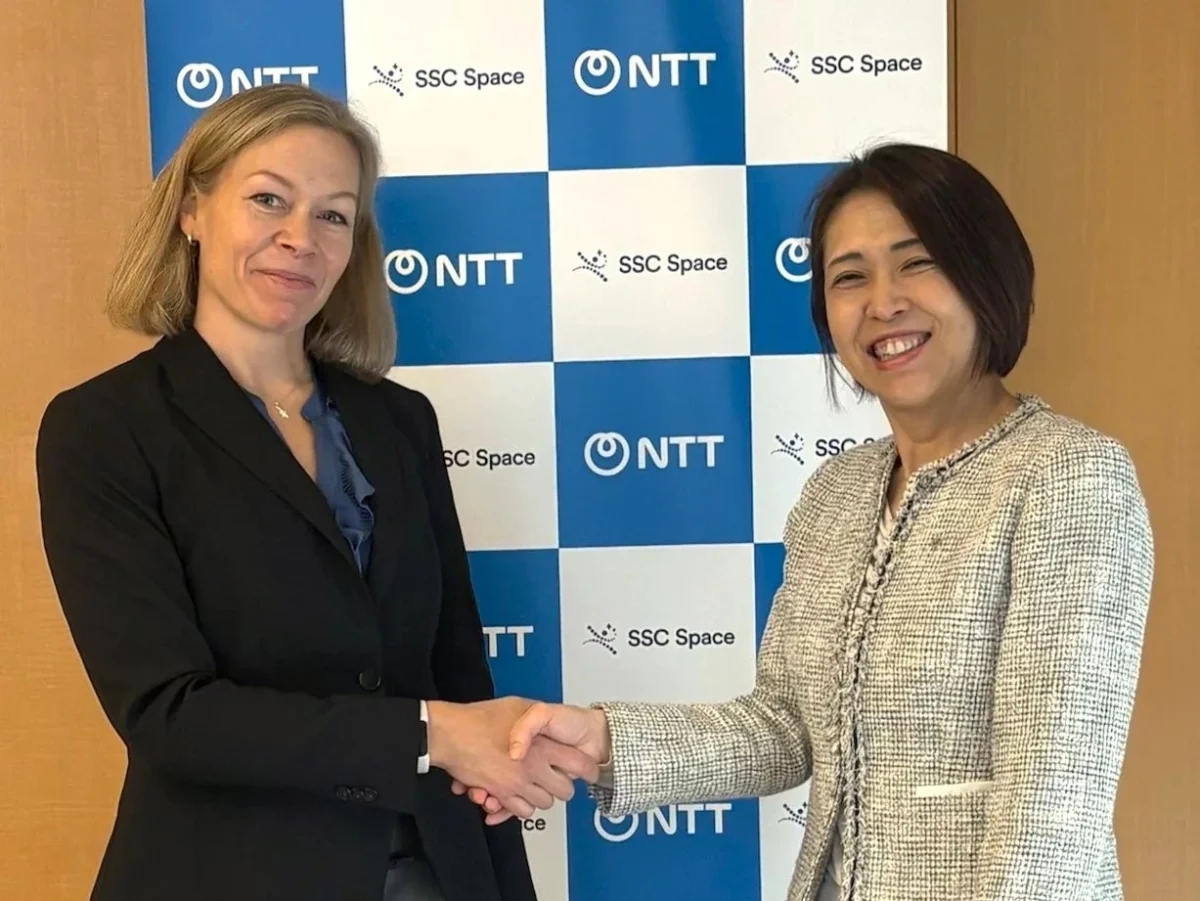
- November 20, 2026: The formal signing ceremony took place, represented by SSC Space optical program manager Hanna Sundberg and NTT head of alliances Minako Tsumenaga, signaling the start of a multi-year collaborative roadmap.
Supporting Data: Why Optical Matters
The demand for this partnership is driven by a radical shift in satellite usage. By the end of 2026, the volume of data generated by Earth observation (EO) satellites, synthetic aperture radar (SAR), and high-resolution video sensors has surged.
According to industry analysts, traditional RF networks are reaching a "spectrum wall." Optical communication offers a solution by utilizing the unlicensed, high-frequency infrared spectrum. However, the reliability of these links depends heavily on site diversity. A single ground station may only have a 60–70% probability of clear-sky access, but by networking five to seven strategically located, globally dispersed stations, the probability of successful data transfer approaches 99.9%.
NTT’s contribution is technical, not just logistical. Their work on "Network Control Technologies" allows for the dynamic routing of data packets. If a ground station in Sweden reports incoming cloud cover, the NTT system can automatically trigger a hand-off to a station in a clearer region—such as Australia or the Pacific—without dropping the connection. This "make-before-break" capability is essential for mission-critical satellite data.
Official Responses and Strategic Vision
The leadership of both organizations has framed this partnership as a proactive response to the future of the space economy.
"This agreement marks a significant milestone for SSC Space in optical communications and reflects our investments in this innovative business segment," said Charlotta Sund, President and CEO of SSC Space. "NTT’s world-leading position and global reach make it a highly valued partner. We look forward to exploring how our optical ground station infrastructure and expertise can support NTT’s efforts to advance space-to-ground connectivity and meet customers’ evolving communications needs."
NTT, meanwhile, views this as a vital step in their "Space-Integrated Computing Network." By extending their terrestrial fiber-optic expertise into the vacuum of space, they aim to create a global backbone where data from orbit can be processed as seamlessly as data moving through a local data center. This alignment with SSC Space allows NTT to move out of the laboratory and into the operational, global-scale deployment phase.
Implications for the Industry
The implications of this collaboration are profound for several stakeholders:
1. For Satellite Operators
Satellite operators, particularly those in the LEO and MEO (Medium Earth Orbit) sectors, have long been wary of the risks associated with optical communications. By having a robust, interoperable network supported by two industry giants, the barrier to entry for adopting laser terminals on satellites is significantly lowered. It provides the "carrier-grade" reliability that government and defense customers demand.
2. For the Ground Segment Market
The partnership signals a consolidation trend. Smaller ground station operators may find it difficult to compete with the "SSC-NTT" model of integrated, weather-resilient, global optical networks. This could drive further M&A activity in the sector as companies race to achieve the scale necessary to offer "optical-as-a-service."
3. For Data Latency and Security
Optical communications are inherently more secure than RF because the laser beam is narrow, making it nearly impossible to intercept without physical detection. Combined with NTT’s encryption and network control protocols, the partnership creates a high-security corridor for sensitive Earth observation and defense data.
4. Future Outlook: The "Optical Internet"
Looking forward, this partnership is a foundational block for the future space-based internet. As the industry moves toward constellations that require inter-satellite links (ISLs) and rapid downlinking to terrestrial data centers, the ability to seamlessly transition between space and ground will define the next decade of connectivity.
The success of the SSC Space and NTT alliance will likely be measured by how quickly they can move from this MoU to a fully operational, multi-site network. If they succeed, they will have successfully bridged the gap between the terrestrial internet and the orbital cloud, effectively turning space into a natural extension of the global communications grid.
As the industry observes this partnership, the focus will remain on technical milestones: the standardization of optical terminal interfaces (ensuring that a satellite from any manufacturer can "talk" to an SSC/NTT station) and the expansion of the ground station footprint into new, strategically critical regions.
In the competitive race for the orbital frontier, the team that solves the "weather problem" first will effectively hold the keys to the future of space data. With the combined resources of SSC Space and NTT, that future has become significantly more attainable.