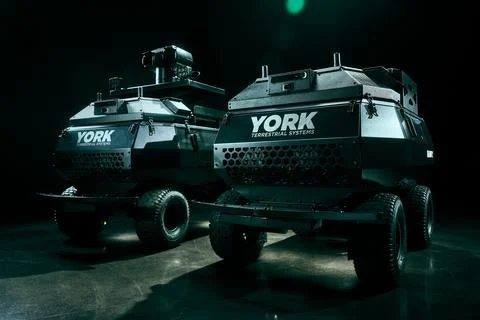
DENVER, CO — November 12, 2026 — In a move that signals a significant pivot for the aerospace industry, Denver-based satellite developer and operator York Space Systems announced on Thursday its definitive agreement to acquire Australian-based Outlook Industries. The strategic acquisition marks York’s official entry into the unmanned ground vehicle (UGV) market, a sector the company intends to dominate by integrating terrestrial mobility with its existing multi-orbit satellite communications architecture.
The acquisition of the boutique Australian firm—which currently employs fewer than 20 personnel—is more than a simple expansion of product lines; it represents a bold bet on the "connected battlefield." By bringing the production of Outlook’s signature "Shadow" UGV to the United States, York aims to bridge the gap between orbital intelligence and edge-of-network terrestrial operations.
Main Facts: The Strategic Integration of Land and Space
York Space Systems has long been recognized for its prowess in the small-satellite market and its recent aggressive expansion into ground-based communications infrastructure. With the acquisition of Outlook Industries, the company is establishing a new dedicated division, York Terrestrial Systems.
The cornerstone of this deal is the "Shadow" UGV, a specialized robotic platform designed for high-endurance, high-risk environments. Unlike standard autonomous rovers, the Shadow is engineered specifically for active conflict zones, featuring armor capable of withstanding small-arms fire and a ruggedized frame designed for extreme environmental conditions.
The platform is impressively efficient, boasting a hybrid power system that utilizes high-capacity batteries bolstered by an automatic fuel-powered generator. This configuration allows for between 30 and 45 days of continuous operational endurance—a critical requirement for long-term reconnaissance and logistics support in contested environments. Measuring roughly the size of a shopping cart but with a wider, lower center of gravity, the Shadow is designed for tactical mobility and stealth.
While the financial terms of the transaction were not disclosed, York confirmed that the deal was considered immaterial in terms of cash and equity, bypassing the requirement for an SEC Form 8-K filing. The transaction remains subject to customary closing conditions, including mandatory approval from the Australian government.
Chronology: A Path Toward Integrated Defense
York’s evolution from a pure-play satellite manufacturer to a comprehensive defense contractor has been marked by a series of high-profile acquisitions over the last two years:
- July 2026: York Space Systems finalized the acquisition of All.Space, a leader in multi-orbit satellite terminal technology. This move was pivotal in allowing York to offer seamless, high-speed data connectivity to moving platforms.
- Early 2026: The company continued to consolidate its ground segment capabilities by acquiring Atlas Space Operations, a firm specializing in global ground-based antenna infrastructure and satellite communications management.
- November 2026: With the announcement of the Outlook Industries acquisition, York completes the vertical integration of its "integrated ecosystem." By controlling the satellite, the ground station, the communication terminal, and now the mobile robotic platform, York creates a closed-loop system for military command and control.
Supporting Data: The Market Opportunity
The decision to acquire Outlook Industries is underpinned by significant growth projections in the autonomous systems sector. York’s internal market analysis estimates the total addressable market (TAM) for unmanned ground systems at approximately $3.1 billion. However, the company’s ambitions extend far beyond the terrestrial sphere.
York believes that by applying its proprietary software architecture—originally developed for satellite constellation management—to mobile robotic platforms, it can rapidly pivot into the unmanned maritime sector. The market for unmanned surface vehicles (USVs) and unmanned underwater vehicles (UUVs) is estimated at a much larger $10.3 billion.
The "Integrated Ecosystem" Metrics
- Shadow Endurance: 30–45+ days of continuous operation.
- Target Manufacturing: Shifting production from Australia to the U.S. (contract manufacturing or York-owned facilities).
- Scalability: High. The design is mature and modular, requiring minimal capital expenditure to ramp up production lines compared to traditional aerospace manufacturing.
Official Responses: Defining the Future of Defense
Dirk Wallinger, CEO of York Space Systems, emphasized that the acquisition is a proactive response to the shifting nature of modern warfare. In a formal statement, Wallinger noted:
"The future of national defense will be defined by the ability to deploy and coordinate large fleets of unmanned systems while keeping the people commanding them farther from danger. York has been building the architecture that makes that possible, from proven spacecraft and global ground infrastructure to mobile terminals and mission software. With Outlook, we intend to deliver the unmanned systems operating at the edge of the network as well. This is a defining step in our ability to provide the integrated systems our customers will need to fight and win."
In a follow-up exchange regarding the technical integration of the systems, a York spokesperson clarified the company’s long-term vision:
"The opportunity extends beyond connectivity to how these platforms are tasked, controlled, and operated. While each domain has distinct requirements, applying a common software architecture across different vehicle types creates a path for York to expand into the USV and UUV markets. We are not just building hardware; we are building an intelligent mesh where the satellite is the brain and the UGV is the hand."
Implications: A Shift in Tactical Doctrine
The acquisition of Outlook Industries carries profound implications for the defense industry, particularly regarding how unmanned systems are procured and deployed.
1. The Death of the "Siloed" Approach
Historically, military contractors have specialized in specific domains—either aerospace, naval, or land systems. By aggressively acquiring companies that touch every aspect of the "data chain," York is positioning itself as a "Prime" contractor capable of offering a turnkey solution. A defense customer no longer needs to integrate a satellite provider with a robotic provider; York provides the full stack.
2. Resiliency at the Edge
The integration of York’s multi-orbit terminal technology with the Shadow UGV addresses a primary concern for the U.S. Department of Defense: resiliency in the face of electronic warfare. By utilizing a "globally distributed" network that can switch between different satellite constellations, York’s UGVs can maintain command-and-control links even if one or more communication paths are jammed or intercepted.
3. Domestic Manufacturing Pressures
The explicit plan to bring the production of the Shadow UGV to the United States reflects the broader trend of "onshoring" critical defense technologies. As geopolitical tensions rise, the U.S. military is increasingly wary of supply chain vulnerabilities. By manufacturing the Shadow in domestic facilities, York provides the Department of Defense with a secure, reliable supply of high-endurance ground assets, free from the risks associated with international logistics and overseas manufacturing.
4. Software-Defined Warfare
Perhaps the most significant implication is the focus on software. By treating the Shadow UGV as a "node" on a network rather than a standalone robot, York is emphasizing that the true value of the platform lies in its mission software. This suggests that future updates to the Shadow will not require physical upgrades to the hardware, but rather over-the-air software deployments that could, in theory, improve the vehicle’s autonomy, navigation, and collaborative swarm capabilities.
Conclusion
As the defense sector moves toward an increasingly automated and connected future, the acquisition of Outlook Industries serves as a masterclass in strategic positioning. York Space Systems is no longer merely an "aerospace company"; it is evolving into a comprehensive defense tech integrator.
By marrying the high-altitude vantage point of its satellite fleet with the boots-on-the-ground capability of the Shadow UGV, York is effectively shrinking the battlefield. As the company begins the process of integrating Outlook’s team and evaluating U.S.-based manufacturing sites, all eyes will be on how effectively it can scale its software-defined vision to match the physical demands of modern combat. Whether this "integrated ecosystem" will truly change the calculus for the modern warfighter remains to be seen, but York has clearly signaled that the future of the company—and perhaps the future of tactical operations—is firmly grounded.