In a strategic move poised to redefine the American digital landscape, AT&T has inked a landmark multi-year agreement with Corning, committing over $3 billion to secure a vast supply of fiber optic cable and related infrastructure. This substantial investment underscores AT&T’s aggressive acceleration of its broadband expansion initiatives, a critical component of its broader $250 billion commitment to U.S. connectivity through 2030. The move signals a clear intent to meet the escalating demands of AI, cloud computing, high-definition streaming, and an ever-growing ecosystem of connected devices, solidifying AT&T’s position as a vanguard in the nation’s digital infrastructure build-out.
The Cornerstone of a $3 Billion Deal: Securing the Future of Connectivity
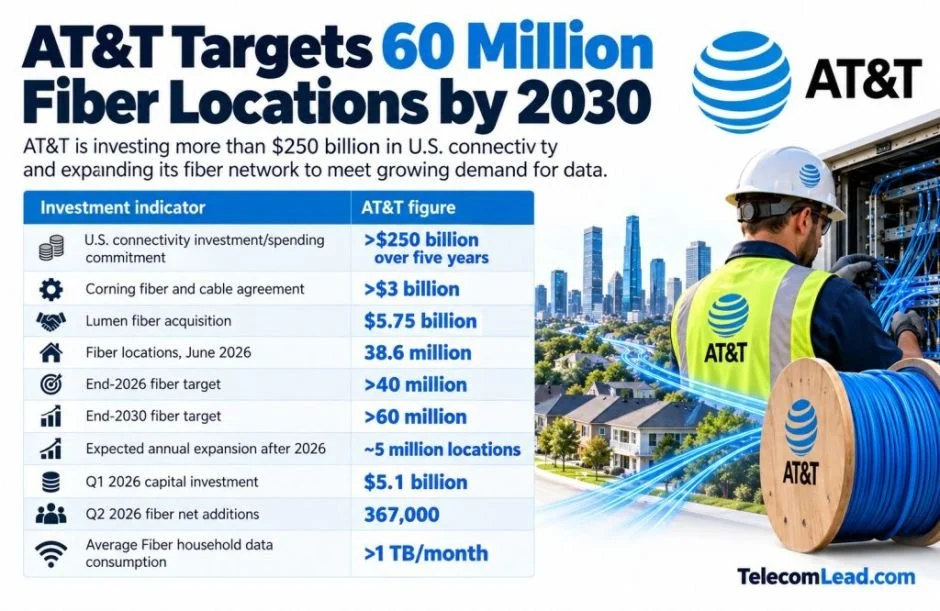
At the heart of this transformative undertaking lies a significant, multi-year procurement agreement between AT&T and Corning Incorporated. Valued at more than $3 billion, this deal ensures AT&T’s access to the high-quality fiber and cable essential for expanding its high-speed broadband network. This strategic sourcing is not merely an acquisition of materials; it is a foundational element of AT&T’s ambitious plan to significantly enhance broadband capacity across the United States. The agreement directly supports AT&T’s stated goal of extending fiber connectivity to over 60 million consumer and business locations by the end of 2030.
For AT&T, this partnership with Corning offers more than just a reliable supply chain. It guarantees access to domestically manufactured fiber and cable, aligning with national interests in strengthening domestic manufacturing and supply chain resilience. The sheer scale of this procurement highlights the immense undertaking involved in modern fiber deployment. It necessitates not only the laying of new fiber optic lines but also the intricate process of connecting individual homes and businesses, all while continuously upgrading the density and capacity of the underlying network infrastructure. This agreement, therefore, represents a critical supply chain component for a multi-year, large-scale infrastructure build.
A Broader Vision: The $250 Billion Connectivity Investment Cycle
The Corning agreement is not an isolated event but a pivotal piece within AT&T’s much larger investment cycle. The company has pledged a staggering sum of over $250 billion in investment and spending over the next five years, aimed at fortifying America’s connectivity infrastructure. This comprehensive commitment extends across a wide spectrum of crucial areas, including the widespread deployment of fiber optics, the expansion of its 5G wireless network, the integration of satellite connectivity for broader reach, the modernization of its entire network architecture, and a robust focus on network resilience and security.
This overarching strategy is designed to create a converged, resilient, and high-capacity network capable of supporting the nation’s burgeoning digital economy. It acknowledges that future connectivity needs will be driven by a confluence of technologies and services, requiring a holistic approach to infrastructure development.
Accelerating Growth: Acquisitions Bolster Fiber Footprint
Complementing its organic network construction, AT&T is strategically leveraging acquisitions to rapidly expand its fiber footprint. A significant development in this arena was the completion of its $5.75 billion acquisition of substantially all of Lumen Technologies’ Mass Markets fiber business in February 2026. This transaction was a game-changer, adding more than 4 million fiber-ready locations to AT&T’s network.
The Lumen acquisition not only increased AT&T’s physical fiber footprint but also brought with it valuable fiber construction capabilities in new metropolitan markets, including Denver, Seattle, and Salt Lake City. Furthermore, the acquired network presented a significant opportunity for subscriber growth, as AT&T noted that fiber penetration within the acquired footprint was approximately 25 percent at the time of closing. By increasing this penetration closer to levels achieved in AT&T’s established fiber markets, the company can drive substantial broadband revenue growth without a commensurate expansion in the number of locations passed.
The Convergence Strategy: Fiber and Wireless Synergy
AT&T’s fiber expansion strategy is inextricably linked to its wireless business, particularly its 5G network. The company is increasingly pursuing a converged network approach, aiming to offer customers a seamless integration of both high-speed fiber broadband and robust wireless services. This strategy is proving to be highly effective. In the second quarter of 2026, a significant 42.5 percent of households utilizing AT&T’s advanced home internet services were also AT&T wireless subscribers.
The benefits of this convergence are clear: customers who bundle fiber broadband and wireless services tend to be more loyal, more likely to recommend AT&T, and generate stronger long-term returns. Consequently, every new fiber-ready location expands the potential market for AT&T’s integrated fiber-and-5G offering, making fiber footprint expansion a strategic imperative that extends beyond mere broadband revenue generation. This synergy between fiber and wireless is a crucial economic driver supporting AT&T’s sustained network investment.
The Data Deluge: Fueling the Fiber Imperative
The relentless surge in household data consumption is a primary catalyst behind AT&T’s massive fiber investment. Current AT&T Fiber households are now consuming an average of over 1 terabyte of data per month, a fivefold increase compared to 2016. Projections indicate this trend will continue, with monthly consumption expected to reach approximately 2-2.5 terabytes by 2030. This exponential growth in data usage is being fueled by a variety of factors, including the increasing popularity of high-definition streaming video, immersive online gaming, sophisticated cloud-based applications, ubiquitous video conferencing, and the proliferation of smart home devices.
The advent of Artificial Intelligence (AI) applications is poised to add another significant layer of demand. AI workloads, particularly those involving large language models and complex data processing, are inherently data-intensive, requiring high-capacity, low-latency connections. Fiber optic technology, with its inherent scalability and superior upstream and downstream speeds, is uniquely positioned to address these escalating demands. AT&T’s investment strategy, therefore, is not just about connecting more homes but about building an infrastructure capable of accommodating substantially higher data consumption over the lifespan of the network.
A Chronology of Expansion: Milestones in AT&T’s Fiber Journey
AT&T’s aggressive fiber expansion is a well-orchestrated, multi-faceted strategy that can be traced through several key milestones:
- February 2026: AT&T completes its $5.75 billion acquisition of Lumen Technologies’ Mass Markets fiber business, adding over 4 million fiber locations and expanding its reach into key metropolitan areas. This acquisition also brings valuable fiber construction capabilities.
- First Quarter 2026: AT&T reports significant capital expenditures and investment, totaling $4.9 billion and $5.1 billion respectively. The company attributes a portion of its lower year-on-year free cash flow to these accelerated infrastructure investments, particularly in fiber deployment.
- Second Quarter 2026: AT&T reports substantial growth in its fiber internet customer base, adding 367,000 new fiber internet customers. This contributes to a total of 646,000 advanced-connectivity internet net additions. The company’s Advanced Connectivity business demonstrates strong financial performance, with service revenue up 5.1 percent and operating income increasing by 20.3 percent.
- Mid-2026 (June): AT&T’s fiber network reaches an impressive 38.6 million consumer and business locations, a notable increase from the more than 36 million locations following the Lumen transaction earlier in the year. This represents the addition of over 1 million fiber locations in the second quarter alone.
- Ongoing (Post-2026): AT&T is on track to surpass 40 million fiber locations by the end of 2026 and is targeting over 60 million by the end of 2030. The company anticipates expanding fiber coverage by approximately 5 million additional locations annually after 2026, underscoring the rapid pace required to achieve its long-term objectives.
- Current (Announced): AT&T signs a multi-year agreement with Corning for fiber and cable, valued at over $3 billion, to further accelerate its broadband capacity expansion and support surging demand from emerging technologies.
Supporting Data and Financial Indicators: The Investment in Action
The tangible impact of AT&T’s investment strategy is evident in its financial performance and operational metrics:
- Capital Expenditures and Investment: In Q1 2026, AT&T reported $4.9 billion in capital expenditures and $5.1 billion in capital investment. This significant outlay directly reflects the accelerated pace of network build-out.
- Fiber Customer Growth: The company added 367,000 fiber internet customers in Q2 2026, contributing to a strong overall growth in its advanced connectivity offerings.
- Revenue and Operating Income: AT&T’s Advanced Connectivity business generated $23.5 billion in service revenue in Q2 2026, a 5.1 percent increase year-over-year. Operating income for this segment surged by 20.3 percent to $7.3 billion, demonstrating the profitability of its expanded network services.
- Fiber Penetration: The Lumen acquisition provided a base with approximately 25 percent fiber penetration, offering a significant opportunity for revenue growth by increasing subscriber adoption.
- Data Consumption Growth: The average AT&T Fiber household now consumes over 1 terabyte of data monthly, a fivefold increase since 2016, highlighting the growing demand for high-bandwidth services. Projections indicate this figure will double by 2030.
- Converged Service Adoption: 42.5 percent of households using AT&T’s advanced home internet services also subscribe to AT&T wireless, showcasing the success of its convergent offering.
Official Responses and Strategic Rationale
While specific direct quotes from AT&T executives regarding the Corning deal were not provided in the original text, the company’s actions and stated investment priorities speak volumes about its strategic rationale. The $250 billion commitment, the aggressive fiber expansion targets, and the strategic acquisitions all point towards a deliberate and ambitious plan to lead the next wave of digital infrastructure development.
AT&T’s strategy is rooted in the understanding that robust and reliable connectivity is no longer a luxury but a fundamental necessity for economic growth and societal advancement. The company is positioning itself to be the provider of choice for the ever-increasing demands of a digitally driven world, fueled by emerging technologies like AI and the continued evolution of cloud computing and digital services. The investment in a converged fiber and wireless network is a testament to this forward-looking approach, aiming to create a sticky customer base and a resilient, high-performance network for the long term.
Implications for the Future of U.S. Connectivity
The implications of AT&T’s aggressive fiber expansion, underscored by the significant Corning agreement, are far-reaching and transformative for the United States:
- Bridging the Digital Divide: Enhanced fiber deployment will bring high-speed internet to more communities, including underserved and rural areas, helping to bridge the persistent digital divide and ensure equitable access to information and opportunities.
- Economic Growth and Innovation: A robust fiber infrastructure is a critical enabler of innovation. It will support the growth of AI-driven industries, facilitate the expansion of cloud services, and empower businesses of all sizes to compete in the global digital economy.
- Enhanced Public Services: Improved connectivity will benefit public services, including education, healthcare, and emergency response, enabling more efficient and effective delivery of essential services.
- National Security and Resilience: The investment in modern, resilient network infrastructure is vital for national security. A robust and secure network is essential for critical infrastructure, government operations, and defense capabilities.
- Consumer Benefits: Consumers will benefit from faster speeds, more reliable connections, and a wider range of high-bandwidth applications and services, from immersive entertainment to advanced remote work capabilities.
- Competitive Landscape: AT&T’s aggressive moves will likely intensify competition in the broadband market, potentially driving further investment and innovation from other telecommunications providers.
In conclusion, AT&T’s substantial investment in fiber optic infrastructure, exemplified by its multi-billion dollar agreement with Corning and its broader $250 billion commitment, represents a pivotal moment in the evolution of American digital connectivity. This strategic offensive is not merely about expanding broadband capacity; it is about building the foundational network infrastructure necessary to power the nation’s digital future, driven by the insatiable demands of AI, cloud computing, and an increasingly connected world. The company’s integrated approach, combining organic growth with strategic acquisitions and a focus on converged services, positions it to capitalize on the escalating demand for high-speed, reliable connectivity for years to come.