New Delhi, India – October 12, 2026 – Apple has sent a significant jolt through the Indian smartphone market, implementing a series of substantial price increases on its existing iPhone lineup, with some models seeing a staggering jump of up to 41 percent. This aggressive pricing strategy directly contradicts the traditional consumer expectation that older iPhone models would become more affordable following the launch of newer generations. The move places India among the markets experiencing the most dramatic iPhone price escalations worldwide in 2026, a development that is particularly impactful as it precedes the nation’s crucial festive shopping season, a period typically characterized by aggressive discounts and promotional offers from smartphone manufacturers and retailers.
The price revisions have left many Indian consumers questioning the value proposition of an iPhone, especially when even previous-generation devices are now firmly entrenched in the premium and ultra-premium segments. This strategic pricing adjustment by Apple appears to be redefining the accessibility of its popular devices in one of the world’s fastest-growing smartphone markets.
The Unprecedented Price Surge: A Detailed Look
The most conspicuous price adjustments have been observed across Apple’s recent iPhone models, with older generations also feeling the pinch. This deviates sharply from the usual product cycle where discounts are expected to make devices more accessible as newer models debut.
iPhone 17 Series: A Significant Leap in Affordability
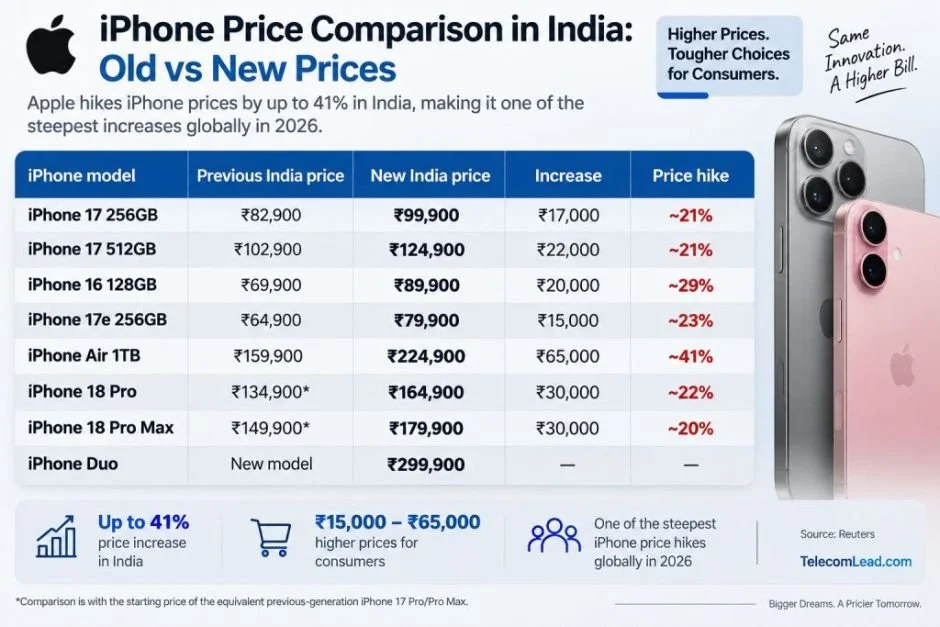
The iPhone 17 has experienced a considerable price hike, a move that directly impacts consumers who were anticipating a price drop. The base model, with 256GB of storage, has seen its price climb from ₹82,900 to ₹99,900, marking an increase of ₹17,000, or nearly 21 percent. For the 512GB variant, the jump is even more pronounced, moving from ₹102,900 to ₹124,900, an additional ₹22,000, representing a surge of over 21 percent.
This price escalation means that for a consumer considering the entry-level iPhone 17, the ₹17,000 price increase alone is substantial enough to purchase an entire budget Android smartphone. This fundamentally alters the purchasing decision for many, pushing the iPhone 17 further into a luxury purchase category for a significant segment of the Indian market.
iPhone Air 1TB: A Shocking 41% Increase
At the higher end of Apple’s existing portfolio, the 1TB iPhone Air has witnessed the most dramatic percentage increase. Previously retailing at ₹159,900, this model now commands a price of ₹224,900. This represents a staggering ₹65,000 increase, an equivalent of approximately 41 percent. This price hike dramatically shifts the device’s market positioning. At over ₹2.2 lakh, the 1TB iPhone Air is no longer just a premium smartphone; its price point invites comparisons with high-end laptops, tablets, and other sophisticated electronic devices, rather than solely competing smartphones.
iPhone 16 and iPhone 17e: Widening the Accessibility Gap
The price pressure is not confined to Apple’s most expensive offerings. Even models designed to offer a more accessible entry into the Apple ecosystem have seen significant price increases. The iPhone 16 128GB is reported to have jumped from ₹69,900 to ₹89,900, an increase of ₹20,000. Similarly, the iPhone 17e 256GB has risen from ₹64,900 to ₹79,900, a hike of ₹15,000.
These increases are particularly noteworthy as these models are intended to serve as relatively more affordable gateways into Apple’s ecosystem. The iPhone 17e now approaching the ₹80,000 mark and the iPhone 16 nearing ₹90,000 makes the value proposition considerably more challenging for price-sensitive Indian consumers who might have previously considered these devices as attainable upgrades.
New Flagships: Setting a New Premium Benchmark
Apple’s latest premium models, the iPhone 18 Pro and iPhone 18 Pro Max, have also debuted at substantially higher price points than their predecessors. The iPhone 18 Pro starts at ₹164,900, a significant increase from the ₹134,900 starting price of the iPhone 17 Pro – a difference of ₹30,000, or roughly 22 percent. The iPhone 18 Pro Max begins at ₹179,900, up from ₹149,900 for the iPhone 17 Pro Max, another ₹30,000 increase, or approximately 20 percent. This means consumers are facing higher prices across the entire spectrum, from older models becoming more expensive to the newest flagship devices entering the market at significantly elevated costs.
The iPhone Duo: Pushing Boundaries into the Ultra-Luxury Segment
Apple’s foray into the foldable smartphone market with the iPhone Duo has propelled pricing into an entirely new stratosphere. The device starts at a remarkable ₹299,900 in India, positioning it as one of Apple’s most expensive mainstream consumer devices. This nearly ₹3 lakh price tag is further highlighted by a significant international price disparity. Reports indicate that the Indian price of Apple’s foldable is approximately $1,100 higher than its U.S. counterpart, underscoring the unique pricing dynamics at play in the Indian market.
Chronology of Price Adjustments and Market Expectations
Historically, the Indian smartphone market, particularly for premium devices like iPhones, has operated on a predictable cycle. Upon the launch of a new iPhone generation, older models typically see a reduction in price. This allows Apple to cater to a broader range of consumers and ensures that its previous-generation devices remain competitive. Retailers and consumers alike anticipate these price adjustments, factoring them into their purchasing decisions, especially during peak sales periods.
However, the recent price hikes have disrupted this established pattern. Instead of becoming more accessible, previous-generation iPhones, including the iPhone 16, iPhone 17, and even the iPhone 17e, have seen their prices rise substantially. This has caught many consumers by surprise, particularly those who intentionally delayed their purchase of an iPhone 17, expecting its price to decrease post the arrival of newer models. The current scenario presents them with a significantly higher bill, a direct inversion of their expected market behavior.
The introduction of the iPhone 18 series and the iPhone Duo at considerably higher entry points further solidifies this shift. The overall pricing strategy suggests Apple is aiming to elevate the perceived value and exclusivity of its entire product range in India, irrespective of the generation.
Supporting Data: Global Comparison and Local Factors
The magnitude of the price increases in India is stark when compared to other major markets. According to Reuters’ analysis, the price hikes in India are substantially higher than the 10 percent to 21 percent increases observed in the United States. This suggests that India is facing a disproportionately higher escalation in iPhone pricing.
Several factors contribute to this pricing anomaly:
- Global Memory and Storage Cost Increases: Apple has previously indicated that rising costs of memory and storage chips are a global factor impacting iPhone prices. This trend likely affects all markets, but its impact is amplified in India due to other contributing elements.
- Import Duties and Taxes: India’s tax structure plays a significant role. The 18 percent Goods and Services Tax (GST) on smartphones, coupled with duties on imported components, contributes to higher retail prices. Despite India becoming a major hub for iPhone manufacturing and assembly, the benefits of this localized production are not fully translating into lower retail prices due to these import-related charges.
- Currency Fluctuations: While not explicitly detailed in the provided text, currency exchange rates between the Indian Rupee and the US Dollar can also influence the final retail price of imported goods, including iPhones.
Official Responses and Future Implications
Apple has not issued a specific public statement detailing the reasons behind the dramatic price increases in India. However, the company’s earlier pronouncements about global cost pressures on components provide a general context. The lack of a direct, localized explanation leaves consumers to infer the motivations behind this aggressive pricing strategy.
The implications of these price hikes for Apple’s market share and consumer behavior in India are potentially far-reaching:
- Shift in Consumer Behavior: Indian consumers, known for their price sensitivity, may increasingly delay upgrades or seek more affordable alternatives. The significant increase in prices for even older models could lead to extended replacement cycles for existing iPhone users. The emphasis on financing options, such as EMI schemes, by Apple on its online store indicates an acknowledgement of this affordability challenge.
- Boost for Android Competitors: The rising cost of entry into the Apple ecosystem creates a significant opportunity for premium Android manufacturers like Samsung, Google, OnePlus, Vivo, and Oppo. As entry-level iPhones creep closer to the ₹1 lakh mark, consumers who are not deeply invested in Apple’s ecosystem will find a wider and more compelling range of high-end Android alternatives.
- Redefined Value Proposition: The question of whether an iPhone still offers sufficient value at these elevated price points will be central to consumer decision-making. For many, the premium associated with an iPhone may now be weighed against the purchase of other high-value electronics or even significant investments in non-tech goods.
- Impact on Festive Sales: The timing of these price hikes, just before the crucial festive shopping season, could dampen consumer enthusiasm for iPhone purchases. While retailers typically offer aggressive discounts and promotions during this period, the higher base prices might render these offers less impactful in making iPhones truly accessible.
In conclusion, Apple’s bold pricing strategy in India presents a complex scenario. While the company may be aiming to reinforce the premium image and exclusivity of its products, it risks alienating a significant segment of its price-conscious Indian customer base. The coming months will be critical in observing how these price adjustments influence purchasing decisions, market dynamics, and the overall competitive landscape of the Indian smartphone industry. The move signals a potential recalibration of Apple’s strategy in India, where accessibility has historically been a key factor in its growth.