WASHINGTON — The U.S. Air Force is currently undertaking the most significant transformation of its command and control (C2) and edge communications architecture in a generation. Driven by the harsh, real-world lessons of Operation Epic Fury, the service is systematically abandoning the cumbersome, legacy infrastructure that defined its operations for the last two decades.
Brig. Gen. Jeffrey Phillips, the Air Force’s deputy chief of staff for warfighter communications and cyber systems—a role established in July 2025—is spearheading this pivot. The directive is clear: the Air Force must transition from a model of static, massive, and vulnerable communications packages to a hyper-agile, distributed, and resilient network capable of withstanding the sophisticated electronic warfare environments posed by peer competitors like China.
The Main Facts: Abandoning the 20-Ton Burden
For over a decade, the Air Force relied on a "big comm" model. When troops deployed to a theater of operations, they brought with them massive communications packages that required 10 pallets, weighed approximately 20 tons, and necessitated a 40-person team to stand up and maintain. In the permissive, low-threat environments of the Global War on Terror, this was an inconvenience; in a potential fight against a sophisticated adversary, it is a liability.
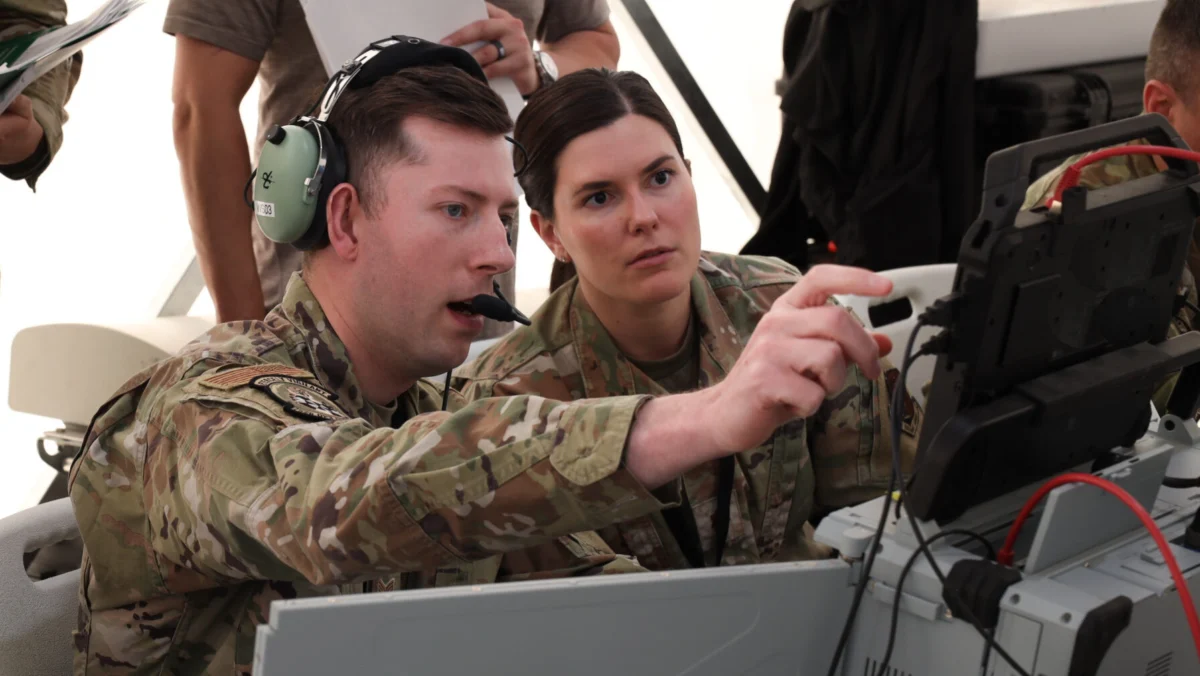
"We were operating under a model where we deploy big comm packages that took 10 pallets, about 20 tons, and about 40 people to deploy," Phillips explained in an exclusive interview with Breaking Defense. "We can’t do that anymore. We have to be more agile and mobile, and we need a case that is carriable by one person and can be run by one or two people."
This shift is not merely about downsizing; it is about survivability. By moving away from massive, fixed, and easily detectable communications hubs, the Air Force aims to increase its "signature management" and maneuverability, ensuring that command nodes remain functional even when their primary locations are targeted.
Chronology: From Operation Epic Fury to Organizational Reform
The Catalyst: Operation Epic Fury
Operation Epic Fury served as the crucible for these reforms. During the operation, the limitations of the existing communications infrastructure were laid bare. The Air Force discovered that it possessed only a "Primary" communications link. In the military’s "PACE" planning methodology—which stands for Primary, Alternate, Contingency, and Emergency—the Air Force found it had failed to provide the "A," "C," or "E."
When the primary link failed or was compromised, the service was forced to build alternate and contingency plans on the fly. This lack of institutional redundancy, while manageable in a permissive environment, highlighted a critical vulnerability that senior leadership could no longer ignore.
The A6 Reorganization (July 2025)
Recognizing that communications and cyber systems required dedicated, high-level oversight, the Air Force took the radical step of splitting its A/26 directorate—previously responsible for a mix of intelligence, cyber effects, and IT. The result was the creation of a standalone A6 office, dedicated solely to warfighter communications and enterprise IT. This structural change ensured that there was a dedicated general officer capable of offering direct guidance to the Secretary of the Air Force, effectively prioritizing communications as a core warfighting function rather than a support utility.
The "Pizza Room" Lessons
In the aftermath of Epic Fury, the Air Force convened a team of combat communications experts from European Command and Central Command at Shaw Air Force Base. Their mandate was simple: analyze the systemic failures of the operation. The resulting report confirmed that the service’s reliance on "primary-only" communication models was an institutional failure that needed immediate rectification.
Supporting Data: Integrating Bandwidth and Transport-Agnostic Networks
A core component of this transformation is treating bandwidth not as an infinite utility, but as a critical commodity—no different from fuel, ammunition, or food.
The Shift from MILSATCOM to Hybrid Transport
Historically, the Air Force relied heavily on Military Satellite Communications (MILSATCOM). However, current operations have shown that MILSATCOM bandwidth is insufficient to support modern, data-heavy C2 at the edge. To bridge this gap, the Air Force is looking toward a "transport-agnostic" approach.
"I want to be able to use whatever transport we need that’s available to us," Phillips noted. "It could be 5G, it could be commercial SATCOM, it could be MILSATCOM, or it could be terrestrial."
By leveraging commercial satellite constellations and terrestrial 5G, the Air Force hopes to achieve a level of redundancy that was previously impossible. This strategy also includes the proliferation of beyond-line-of-sight communication kits across the entire aircraft inventory, ensuring that aviators are not tethered to local, potentially compromised, network nodes.
Software-Defined Networking
The Air Force is currently working to collapse four or five independent, siloed networks into a single, seamless, classification-agnostic environment. By utilizing software-defined networking, the goal is to provide a user experience that allows operators to move between secure and unclassified environments without the need for redundant, heavy hardware.
Official Responses and Strategic Vision
Brig. Gen. Phillips emphasizes that the cultural shift is as important as the technological one. The Air Force is training its personnel to "be comfortable being uncomfortable." This means moving away from the "base-centric" culture of the last 20 years, where personnel worked in fixed airbases with regular amenities and predictable schedules.
"We have to train our airmen to operate in some really stressful conditions," Phillips said. "There might be a day where you’re operating out of one location and then that location is not viable anymore, so you have to move to a new location. We have to get comfortable in a new way of employing our forces."
The creation of the A6 office has allowed these strategic goals to gain traction with senior leadership. By having a dedicated office for communications, the Air Force ensures that "resilient and reliable communications" are baked into the requirements for every new platform, rather than being treated as an afterthought.
Implications: Preparing for a Sophisticated Adversary
The urgency behind these reforms is largely driven by the changing character of global conflict. Unlike the War on Terror, where the U.S. enjoyed uncontested spectrum superiority, a conflict with a peer adversary like China would be defined by electronic warfare and the systematic targeting of communication lines.
The China Threat
Chinese military doctrine explicitly identifies U.S. communication networks as a "center of gravity"—a primary target in the opening stages of a conflict. If the U.S. relies on the legacy, "big comm" model, a single strike or electronic attack could effectively blind a theater of operations. By decentralizing its C2 nodes and embracing a PACE-compliant, redundant communications architecture, the Air Force is attempting to make itself a "hard target."
The "Small Kit" Success
The effectiveness of smaller, more agile kits was proven during recent operations, where Air Force units were forced to borrow Joint Worldwide Intelligence Communications System (JWICS) kits from the intelligence community. These kits, smaller and more easily deployable than standard Air Force equipment, provided the necessary connectivity when the primary Air Force systems were unavailable or too slow to deploy. This has served as a proof-of-concept for the new, smaller, more mobile hardware requirements now being prioritized by the A6 office.
Looking Ahead
The path forward is clear: the Air Force must continue to shrink its footprint while expanding its connectivity. By treating bandwidth as a commodity, shifting to hybrid transport, and enforcing rigorous PACE planning, the service aims to build a network that is as resilient as the pilots and ground crews who rely on it.
As the Air Force continues to integrate these recommendations into its exercises, the message to the force is one of adaptation. The era of static, 20-ton communications packages is ending, replaced by a doctrine of mobility, resilience, and constant evolution. For the modern Air Force, the ability to communicate under fire is no longer just a technical requirement—it is the bedrock of future victory.