Manila, Philippines – August 15, 2026 – The Philippine smartphone market, long a bastion of affordable Android devices, is undergoing a significant transformation. Faced with escalating component costs, particularly for memory, smartphone vendors are strategically nudging consumers towards higher price brackets. This shift is reshaping the competitive landscape, with Transsion maintaining a dominant market share but confronting the inherent challenges of its budget-focused brand portfolio.
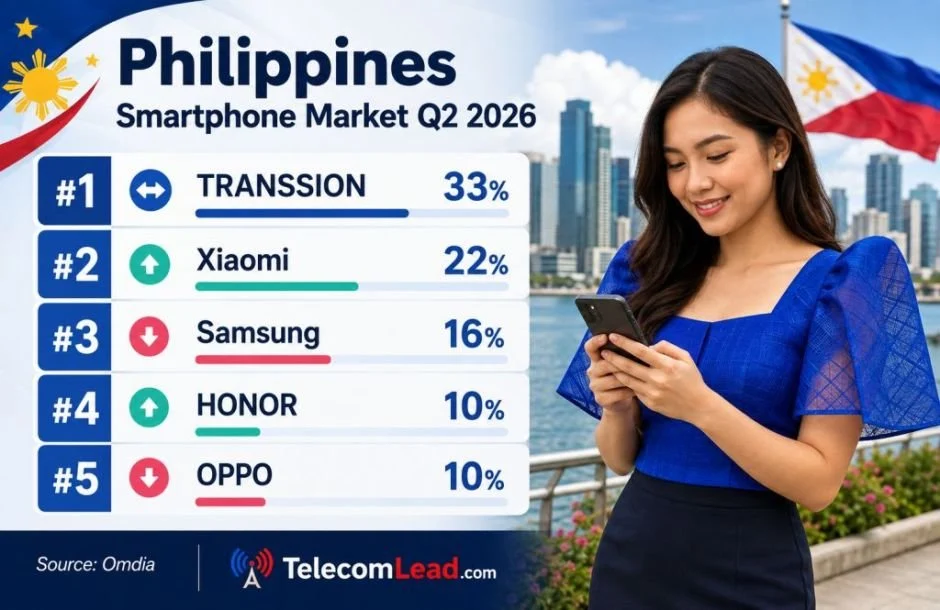
According to the latest data from Omdia, a leading market research firm, Transsion, a conglomerate behind brands like TECNO, Infinix, and itel, commanded an impressive 33 percent of the Philippine smartphone market in the second quarter of 2026. This substantial lead positions the company significantly ahead of its rivals. Xiaomi secured a strong second place with a 22 percent shipment share, followed by Samsung at 16 percent. The combined market share of these top three vendors underscores their considerable influence in shaping consumer choices.
The dominance of these leading players is further amplified by the collective market control exercised by the top five vendors. Xiaomi, Samsung, HONOR, and OPPO, alongside Transsion, collectively accounted for a staggering 91 percent of all smartphone shipments in the Philippines during the second quarter. This leaves a mere 9 percent of the market for Apple, vivo, and a host of other smaller brands, highlighting the intense consolidation within the sector.
Transsion’s Commanding Lead: A Balancing Act in the Face of Rising Costs
Transsion’s commanding 33 percent market share in the Philippines is a testament to its effective multi-brand strategy, allowing it to cater to diverse consumer segments through TECNO, Infinix, and itel. This approach has historically enabled the company to build a loyal customer base deeply rooted in affordability. However, this very reliance on price-sensitive consumers presents a significant challenge as global component prices, especially for memory modules, continue their upward trajectory.
Omdia’s broader analysis of the Southeast Asian smartphone market reveals the scale of this affordability challenge. Transsion’s regional shipments saw a notable decline of 25 percent in the second quarter of 2026, dropping to 3.4 million units from 4.6 million units in the same period of the previous year. Despite this volume contraction, Transsion managed to maintain its regional market share at 18 percent, a testament to the overall sharp contraction of the entire market.
Digging deeper into Transsion’s regional performance, the data reveals a significant shift in its sales composition. Shipments of devices priced below $100 experienced a sharp decline of 47 percent. Conversely, sales within the $100 to $199 price bracket saw a healthy increase of 12 percent, emerging as the company’s largest and most profitable segment. This trend indicates a successful, albeit necessary, effort by Transsion to retain some of its price-conscious customers by migrating them towards slightly more expensive, yet still accessible, devices.
The introduction of new models like the Infinix HOT 70 and TECNO SPARK 50 4G exemplifies this strategic pivot. These devices have been launched at higher price points than their predecessors, incorporating enhanced features to justify the increased cost. The TECNO SPARK 50, for instance, boasts a 120Hz display, a 50MP camera, and advanced AI capabilities, with its 5G variant further enhanced by 45W fast charging. Similarly, the Infinix HOT 70 offers a robust 6,000mAh battery, 45W charging, and attractive bundled promotions for local services like Google AI and Viu Premium.
Transsion’s core challenge lies in preserving its market leadership while simultaneously navigating the erosion of its traditional affordability advantage due to component inflation. The company’s ability to balance aggressive pricing with the introduction of value-added features will be crucial in maintaining its dominance in the Philippine market.
Xiaomi’s Ascendancy: Bridging the Gap with a Diverse Portfolio
Xiaomi has solidified its position as the second-largest player in the Philippine smartphone market, capturing a significant 22 percent of shipments in Q2 2026. This represents a substantial lead of six percentage points over Samsung and more than double the market share of HONOR and OPPO. Xiaomi’s success can be attributed to its strategic dual-brand approach, leveraging the high-volume appeal of its Redmi and POCO lines while also offering more premium Xiaomi-branded devices. This diversified portfolio allows the company to cater to a wider spectrum of consumer needs and price points, providing a competitive edge against vendors focusing exclusively on either the entry-level or premium segments.
Across Southeast Asia, Xiaomi’s performance mirrors the broader market trend of contraction, with shipments falling 21 percent year-on-year to 3.7 million units in Q2 2026. Despite this decline, Xiaomi managed to maintain its regional market share at 19 percent, demonstrating resilience in a challenging environment.
A striking indicator of Xiaomi’s evolving strategy is the significant 43.5 percent increase in its average selling price (ASP) across the region, the second-highest surge among the top five vendors. This upward trend is further corroborated by a substantial 69 percent decrease in its sub-$100 shipments, juxtaposed with an impressive 55 percent surge in shipments within the $100-$199 price category. This data clearly illustrates Xiaomi’s success in migrating a portion of its customer base towards higher-priced devices, a strategy that has helped to partially offset the loss of ultra-affordable segment sales.
To further bolster demand in the Philippines, Xiaomi actively employs aggressive online promotional tactics. Flash sales, online coupons, and dedicated campaigns like the "POCO Carnival" are instrumental in capturing consumer attention in the highly competitive open-market retail environment, where price comparisons across multiple brands and e-commerce platforms are readily available.
Samsung’s Strategic Maneuvers: Resilience and Premium Focus in Southeast Asia
Samsung, a perennial powerhouse in the global smartphone arena, holds a respectable 16 percent share of the Philippine market, ranking third among the leading vendors. While trailing Transsion and Xiaomi in the Philippines, Samsung’s performance across the broader Southeast Asian region paints a more optimistic picture. Its regional shipments experienced a more moderate decline of 11 percent in Q2 2026, reaching 3.9 million units, a considerably better outcome compared to the steeper declines faced by Xiaomi (21 percent), Transsion (25 percent), and OPPO (41 percent). This relative resilience allowed Samsung to expand its regional market share from 17 percent to 20 percent.
Samsung’s strategic focus on higher-value segments is evident in its performance within the $200-$299 price bracket in Southeast Asia, where its market share surged from 18 percent in Q2 2025 to an impressive 32 percent in Q2 2026, marking a significant gain of 14 percentage points. This growth extended across the broader sub-$300 market, as Samsung capitalized on competitors’ reduced presence in these segments.
In the Philippines, Samsung employs a multifaceted strategy that balances its affordable Galaxy A series with its flagship Galaxy S and innovative foldable devices. The company leverages a suite of attractive consumer incentives, including discounts, trade-in programs, flexible installment plans, and bundled accessory offers. These initiatives enable Samsung to effectively compete against lower-priced Chinese vendors without resorting to perpetual handset price reductions, thereby preserving its brand value and profitability.
HONOR and OPPO: Emerging Challengers and Strategic Realignment
HONOR’s Rapid Ascent:
HONOR has emerged as a significant challenger, capturing a 10 percent share of the Philippine smartphone market in Q2 2026, matching OPPO’s performance and securing fourth place in Omdia’s rankings. The company’s momentum extends beyond the Philippines, with its Southeast Asian shipments experiencing a robust 15 percent increase in the first half of 2026, a remarkable feat in a contracting regional market. HONOR has been identified as the fastest-growing major smartphone brand in both the Philippines and Malaysia during Q2 2026, underscoring its aggressive expansion strategy.
This growth trajectory is further evidenced by a substantial 53 percent increase in HONOR’s shipments across Africa in the first half of the year, and a global shipment growth of 9 percent. In 2025, the company witnessed a doubling of its Southeast Asian shipments, driven by successful market penetration in key countries like the Philippines, Singapore, Thailand, and Vietnam.
HONOR’s strategy involves utilizing mainstream devices to drive volume while simultaneously employing premium products to enhance brand recognition. The introduction of the HONOR Magic V6 in the Philippines, priced at PHP119,999, accompanied by pre-order bonuses like an HONOR Pad X8b (valued at PHP12,999), exemplifies this approach. While a high-end foldable device will contribute limited mass-market volume, it serves to elevate HONOR’s premium credentials and attract higher-value consumers. The more accessible HONOR 600 series provides a platform for increasing overall Philippine shipment share.
OPPO’s Strategic Pivot:
OPPO also holds a 10 percent market share in the Philippines, placing it level with HONOR. However, their market trajectories diverge significantly. OPPO’s regional performance highlights a strategic shift away from low-cost devices towards its more premium Reno series. Southeast Asian shipments, excluding OnePlus but including realme, saw a sharp decline of 41 percent to 3.1 million units, resulting in a market share contraction from 21 percent to 16 percent.
The collapse of OPPO’s sub-$100 shipments, which plummeted by a staggering 96 percent, represents the most severe contraction among the leading vendors. Shipments in the $100-$199 category also experienced a decline of 25 percent. Unlike Xiaomi and Transsion, OPPO has struggled to generate sufficient growth in the subsequent price bands to compensate for the lost entry-level volume. Consequently, the company is increasingly focusing on its strengths in imaging technology, AI capabilities, battery performance, and the higher-value Reno smartphones.
The Reno16 5G, priced at PHP54,999 in the Philippines, is supported by pre-order campaigns, promotional bundles, and local launch events. While OPPO maintains a 10 percent market share, its current strategy is geared towards stabilizing volume after a significant withdrawal from the ultra-affordable segment, a stark contrast to HONOR’s expansive growth.
Southeast Asia’s Market Contraction: A Wider Economic Headwind
The dynamics observed in the Philippines are symptomatic of a broader regional contraction in the Southeast Asian smartphone market. In Q2 2026, total smartphone shipments across the region plummeted by 23 percent, falling from 25 million units in Q2 2025 to 19.3 million units, representing a substantial decrease of approximately 5.7 million devices in a single quarter.
Despite this significant volume decline, the market value reached $6.6 billion, driven by a notable 31 percent increase in the average selling price (ASP) to $342. This indicates a clear trend of consumers, when purchasing, opting for more expensive devices, or vendors successfully pushing higher-priced models.
The $100-$199 price category saw its share of regional shipments grow from 32 percent to 39 percent, accounting for roughly 7.5 million of the 19.3 million smartphones shipped during the quarter. However, even shipments above $100 experienced a 2 percent decline, suggesting that the increased ASP and the shift to higher price brackets did not fully absorb the demand lost from the sub-$100 segment. This implies that many consumers are opting to delay their smartphone replacements rather than automatically purchasing more expensive devices.
Omdia forecasts a continued decline for Southeast Asian smartphone shipments, projecting a 25 percent drop to 75.3 million units for the full year 2026. This forecast suggests that the region shipped approximately 100.4 million devices in 2025 and could see a reduction of around 25.1 million shipments in 2026, underscoring the significant economic headwinds impacting the consumer electronics sector in the region.
Implications for the Philippine Market: A New Era of Competition
The Philippine smartphone market, while historically volume-driven, is demonstrably evolving. Transsion’s continued leadership, built on its affordable Android offerings, is being tested by rising component costs. Xiaomi’s strategic move into higher price segments has cemented its strong second position, effectively bridging the gap for consumers transitioning from ultra-budget devices.
Samsung’s robust regional performance and its focus on value-added incentives and a diverse product portfolio, ranging from the accessible Galaxy A series to premium foldables, position it as a resilient contender. HONOR’s impressive growth, driven by a combination of mainstream and premium offerings, signals its emergence as a significant disruptive force in the market. Conversely, OPPO faces the considerable challenge of rebuilding its market share by successfully transitioning its customer base to higher-priced Reno devices after its withdrawal from the low-cost segment.
As memory costs continue to rise, the competitive battleground in the Philippines is undeniably shifting towards devices priced above $100. Success will increasingly depend on a vendor’s ability to offer compelling value propositions that extend beyond mere price points. This includes strategic online promotions, attractive installment plans, innovative financing options, and demonstrable improvements in key consumer-centric features such as battery capacity, AI integration, camera capabilities, and long-term software support. The era of purely price-driven competition is waning, giving way to a more nuanced and value-conscious consumer landscape.