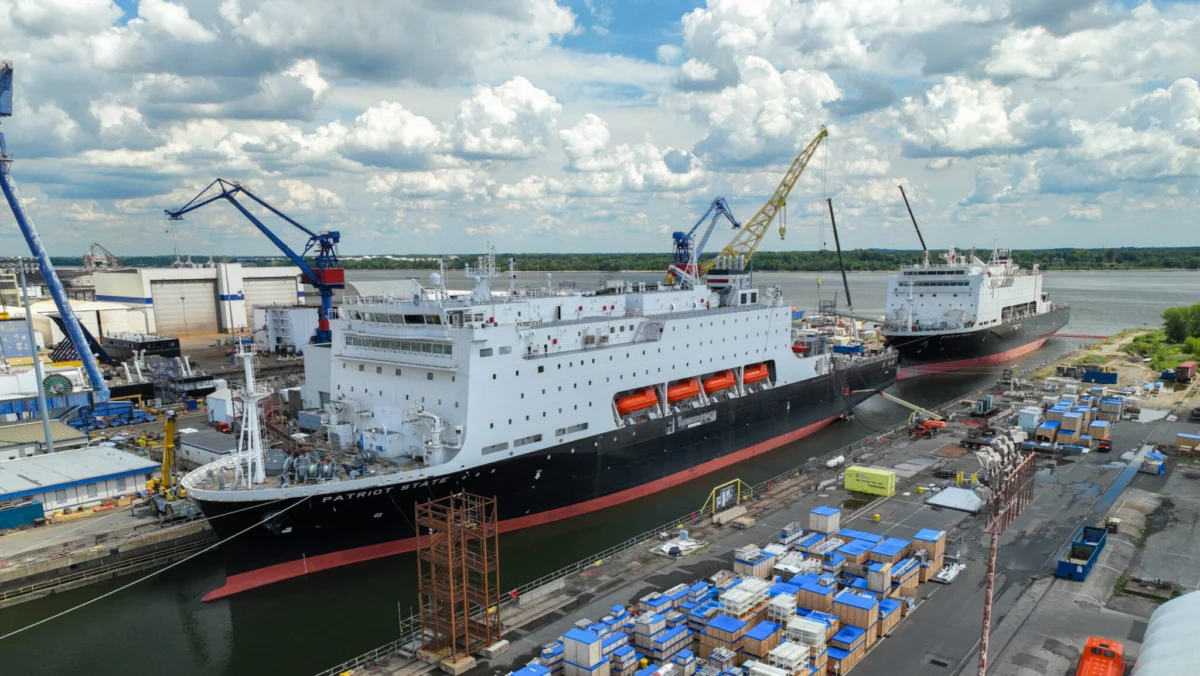
PHILADELPHIA — In a move signaling a major shift in the Pentagon’s domestic industrial strategy, the Office of Management and Budget (OMB) announced today that Hanwha Philly Shipyard has been awarded a critical contract to construct the Golden Defender. This specialized missile range instrumentation vessel is set to serve as a cornerstone for the administration’s "Golden Dome," a sprawling, multi-layered missile shield designed to protect the United States from an increasingly complex array of global airborne threats.
The announcement, delivered by OMB Director Russell Vought during a ceremony to christen the Lone Star State—an existing National Security Multi-Mission Vessel (NSMV)—underscores the administration’s focus on leveraging proven commercial designs to accelerate military readiness. By utilizing the “hot production line” currently established in Philadelphia, the government aims to bypass traditional, sluggish procurement timelines in favor of a model that prioritizes existing infrastructure and an experienced, active workforce.
The Genesis of the Golden Defender
The Golden Defender project represents a pragmatic evolution of the NSMV platform. Originally designed for the U.S. Maritime Administration (MARAD) as training ships for state maritime academies, the NSMV design proved to be unexpectedly versatile.
According to Director Vought, the OMB’s shipbuilding team identified that the robust architecture of the NSMV could be adapted to meet the emergent requirements of the Missile Defense Agency (MDA). “We quickly realized that there was an emergent need that the NSMV design naturally lent itself to,” Vought stated. “With a hot production line here in Philly, we worked with our partners across government to identify the resources to support additional construction, leveraging Hanwha’s facility and its deep talent pool.”
The vessel will be tasked with monitoring and tracking missile launches, providing real-time data to the Golden Dome system. These ships are essential for telemetry, radar tracking, and the observation of foreign weapons tests, serving as the eyes and ears of the nation’s defensive umbrella.
A Chronology of Expansion
The path to this contract has been marked by a rapid succession of investment and policy shifts over the last 24 months:
- 2024: Hanwha Systems and Hanwha Ocean complete the acquisition of the Philly Shipyard, marking a significant entry of South Korean industrial expertise into the U.S. domestic shipbuilding market.
- August 2025: Hanwha announces a $5 billion investment initiative aimed at modernizing and expanding the infrastructure of the Philadelphia shipyard to accommodate larger and more complex naval vessels.
- October 2025: Industry reports confirm that Hanwha is actively seeking further acquisitions in the U.S. shipyard sector, signaling a long-term commitment to U.S. maritime manufacturing.
- April 2026: Michael Coulter, CEO of Hanwha Defense USA, publicly signals the company’s intent to pivot from purely commercial and MARAD-based projects to naval auxiliary and combatant vessels, specifically targeting the Landing Ship Medium (LSM) program.
- June 2026: Director Vought calls for the establishment of a fifth public shipyard, setting the stage for the current expansion of fleet capacity.
- July 2026 (Wednesday): President Trump and Senator Dave McCormick (R-Pa.) announce at the Defense Innovation Summit that two additional NSMVs will be built in Philadelphia.
- July 2026 (Today): The official award of the Golden Defender contract is confirmed, solidifying the shipyard’s role in the national security apparatus.
Supporting Data and Production Capacity
The decision to utilize the Hanwha Philly Shipyard is rooted in data regarding efficiency and scalability. Under the guidance of Michael Coulter, Hanwha has set an ambitious target to scale the facility’s output from three vessels annually—the current pace for 2026—to a capacity of ten to 20 ships per year.
This rapid scaling is supported by the Vessel Construction Manager (VCM) framework. TOTE Services, which has managed the construction of the NSMV fleet for MARAD, will oversee the Golden Defender project. The synergy between Hanwha’s production capabilities and TOTE’s management expertise creates a "turnkey" solution for the Pentagon, minimizing administrative friction.
The Navy’s recent decision to tap TOTE Services for the Landing Ship Medium (LSM) program reinforces the government’s growing reliance on this specific public-private partnership model. By consolidating construction management across the NSMV, the LSM, and now the Golden Defender, the Department of Defense is creating a unified supply chain that can be surged during national emergencies.

The Strategic Role of the ‘Golden Dome’
The Golden Defender is not merely an instrumentation ship; it is a vital node in the "Golden Dome." President Trump’s signature defense project is envisioned as a comprehensive shield, integrating traditional kinetic interceptors, advanced radar systems, and potential space-based interceptor platforms.
As the "Golden Dome Czar" has previously signaled, the integration of space-based assets into the shield is a subject of intense fiscal and technical scrutiny. The Golden Defender, by providing high-fidelity data from the maritime theater, will likely act as a critical verification tool for the efficacy of these space-based systems. By tracking incoming threats and relaying telemetry to the command-and-control hubs of the MDA, the vessel ensures that the "Dome" remains dynamic and responsive to evolving hypersonic and ballistic threats.
Implications for U.S. Shipbuilding and Geopolitics
The integration of Hanwha—a South Korean powerhouse—into the U.S. shipbuilding industrial base is a transformative development. Historically, the U.S. has struggled with a shrinking industrial base and a lack of available slips for naval construction. The influx of South Korean technology and management techniques is being viewed by some analysts as the "re-industrialization" of the Delaware River waterfront.
However, the shift is not without its critics. The reliance on a foreign-owned entity for critical national security infrastructure has sparked debates regarding domestic sovereignty and the long-term sustainability of the U.S. maritime workforce. Despite this, the current administration views the Hanwha partnership as a necessity to achieve the goal of "restoring American maritime dominance."
The implications for the broader Navy are significant. As Coulter noted, the Navy is increasingly looking for partners who can transition from commercial builds to combatants. If the Golden Defender project proves successful, it will likely serve as the blueprint for future naval procurement, where modular commercial designs are hardened and militarized for specific mission sets, rather than building bespoke, high-cost platforms from scratch.
Looking Ahead: The Road to 2030
As of this writing, the Missile Defense Agency has yet to provide specific technical specifications regarding the Golden Defender’s radar suite or its expected deployment timeline. Nevertheless, the announcement has already sent ripples through the defense industry, with competitors now watching to see how quickly the Philadelphia facility can integrate these new mission requirements.
The expansion of the Philly Shipyard is part of a broader, national-level initiative to reclaim the industrial capacity lost over the past several decades. With the combined efforts of the White House, the Missile Defense Agency, and a revitalized private sector, the Golden Defender stands as a test case for whether the U.S. can successfully integrate high-speed commercial production techniques into its defense strategy.
For the city of Philadelphia, the project promises sustained job growth and a central role in the nation’s defense. For the Pentagon, it represents the potential for a more flexible, responsive, and efficient method of fleet expansion. As the keel-laying for the Golden Defender approaches, all eyes will be on the Delaware River to see if this marriage of South Korean engineering and American maritime tradition can truly deliver the shield that the administration has promised to the American people.