WASHINGTON — In a significant escalation of the U.S. military’s role in domestic border security, the Joint Task Force – Southern Border (JTF-SB) confirmed this week that it has successfully neutralized three "hostile" unmanned aircraft systems (UAS) operating along the U.S.-Mexico border. The engagement marks a milestone in the deployment of advanced directed-energy weapons, signaling a transition from experimental testing to active, kinetic defense against evolving threats posed by transnational criminal organizations.
The operation, which utilized a high-energy laser system developed by defense contractor AeroVironment (AV), represents a tactical pivot in how the Department of Defense (DoD) addresses the growing proliferation of surveillance drones operated by drug cartels.
The Engagement: A Shift in Border Security Dynamics
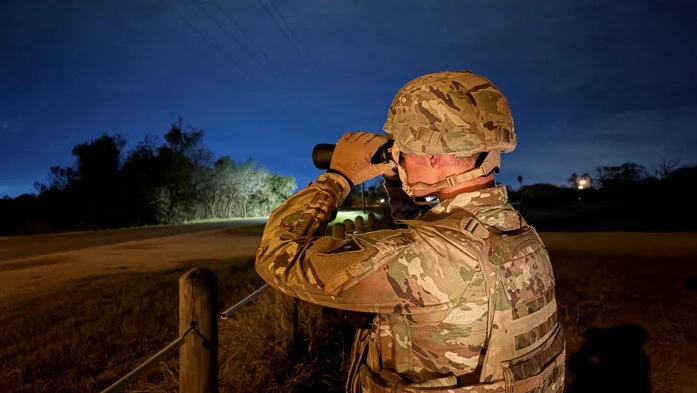
According to an official release from JTF-SB, the incident involved a series of encounters where unidentified UAS were identified as posing a "physical threat" to both U.S. military personnel and agents from U.S. Customs and Border Protection (CBP). While the task force remained tight-lipped regarding the specific geographic coordinates of the engagements, the nature of the threat—reconnaissance and illicit smuggling facilitation—has become a primary concern for North American security planners.
The system employed, identified as an Army Multipurpose High Energy Laser (AMP-HEL), represents the bleeding edge of current counter-UAS (C-UAS) technology. Unlike traditional surface-to-air missiles or electronic jamming systems, which can be costly or cause significant collateral interference with civilian communications, the high-energy laser provides a silent, precision-based "hard kill" capability.
Maj. Gen. Curtis Taylor, commander of JTF-SB, underscored the gravity of the situation in his official statement. "Cartel networks are increasingly employing unmanned aircraft systems to facilitate illicit human-smuggling and actively spy on our personnel and law enforcement partners," Taylor stated. "By integrating layered countermeasures alongside advanced directed-energy capabilities like this laser system, we have made it clear that we will not tolerate hostile surveillance."
Chronology of Technological Integration
The transition of the southern border into a "sandbox" for military innovation did not happen overnight. The following timeline outlines the rapid development and deployment of these systems:
- December 2025: AeroVironment announces the delivery of its prototype 20kW-class LOCUST (Laser Optimized Counter-UAS System) to the U.S. Army. This system, designed for high-mobility applications, was engineered specifically to address the need for a cost-effective, magazine-deep solution to the swarm-drone threat.
- January 2026: Military personnel assigned to JTF-SB begin intensive training with the AMP-HEL systems in the vicinity of McAllen, Texas. The focus during this period was on integrating the laser platform with existing surveillance grids managed by NORTHCOM.
- January 11, 2026: The recorded date of the recent engagement where the three hostile drones were successfully downed.
- August 2026: Following a period of data analysis and performance assessment, the Pentagon officially acknowledges the success of the mission, confirming that the technology has transitioned from a developmental test phase to operational deployment.
Supporting Data: The Case for Directed Energy
The choice of a 20kW-class laser for the border environment is driven by economic and tactical necessity. For years, the military has relied on missiles or interceptors that can cost hundreds of thousands of dollars per shot—a prohibitive ratio when facing "off-the-shelf" commercial drones that cost only a few hundred dollars.
Cost-Per-Engagement
The laser system changes the math of modern attrition warfare. Once the initial investment in the platform is made, the cost-per-engagement is limited to the price of the electricity used to fire the laser, making it one of the most cost-effective solutions in the DoD inventory.
Mitigation of Collateral Damage
In densely populated border regions, the use of kinetic interceptors (bullets or missiles) creates significant risks to civilians on the ground. Directed energy offers a "line-of-sight" solution that minimizes the risk of debris or stray projectiles. Furthermore, because the laser operates in the invisible spectrum, it minimizes the psychological disruption often associated with overt military engagement in civilian spaces.
Official Responses and Industry Context
AeroVironment has remained largely guarded about the specific technical configurations deployed by JTF-SB, citing both security protocols and ongoing proprietary development. While an AV spokesperson confirmed that the system is a product of the Army’s AMP-HEL program, they declined to clarify if the laser was vehicle-mounted or deployed as a static site defense.
Industry analysts suggest that the system is likely integrated into a Joint Light Tactical Vehicle (JLTV) chassis, which would allow the task force to move the capability rapidly along the border to respond to intelligence regarding cartel drone activity.
However, the rapid rollout has not been without its critics. Past efforts to coordinate drone defense on the border have been marred by jurisdictional disputes and failures to communicate effectively with the Federal Aviation Administration (FAA) and local civilian law enforcement agencies. Critics argue that the "sandbox" approach, while technically innovative, risks creating a fragmented airspace environment where the military, border patrol, and commercial aircraft operate under conflicting rules of engagement.
Implications: The Border as a Modern Battlefield
The deployment of laser weapons at the southern border has profound implications for both domestic policy and international relations.
1. The Normalization of Military Technology in Domestic Law Enforcement
The use of high-energy weapons by the military to support domestic border agencies suggests a long-term shift in the Pentagon’s mission set. As the line between "national defense" and "border security" continues to blur, the DoD is increasingly serving as the R&D wing for domestic security agencies. This raises questions about the long-term oversight of such programs and the potential for "mission creep."
2. Escalation with Transnational Criminal Organizations
Cartels are adaptive actors. By neutralizing their reconnaissance capabilities, the U.S. military is forcing these organizations to innovate. Analysts expect that the next generation of cartel drones will feature hardened sensors, autonomous flight paths, or swarming capabilities designed to overwhelm or evade laser tracking. This creates a "technological arms race" that will likely necessitate constant upgrades to the U.S. counter-drone grid.
3. The Future of JIATF 401
The Joint Interagency Taskforce 401 (JIATF 401) has become the hub for this experimentation. By inviting industry partners to the border to test their technology in real-world conditions, JIATF 401 is shortening the "innovation cycle." This model of rapid testing and fielding is expected to be replicated in other theaters of operation, including the Indo-Pacific and Eastern Europe, where the counter-drone threat is similarly evolving.
4. Legal and Ethical Frameworks
The "shoot-down" of three drones by the military in a domestic context invites legal scrutiny. Questions regarding the Rules of Engagement (ROE) for these systems remain open: Under what specific conditions is a drone deemed a "physical threat" sufficient to justify a lethal engagement? As these systems become more prevalent, the Pentagon will need to establish clear, transparent protocols that balance operational security with the protection of civilian airspace and privacy.
Conclusion
The successful neutralization of cartel drones by the AMP-HEL system represents a watershed moment in U.S. border security. By leveraging high-energy lasers, the Pentagon has demonstrated that it can provide a precise, cost-effective, and low-collateral solution to a complex, multi-layered threat.
As the border continues to serve as a testing ground for next-generation defense technologies, the challenge for policymakers will be to ensure that these advancements are integrated into a cohesive, legal, and transparent framework. For now, the message from the border is clear: the era of uncontested cartel drone surveillance is coming to an end, replaced by a watchful, high-tech shield that is constantly learning, adapting, and firing.