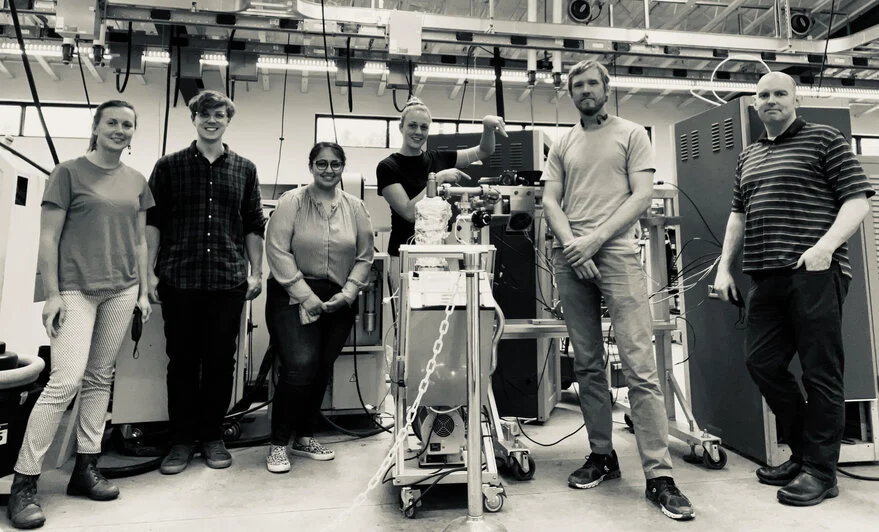
SAN FRANCISCO — In a development that could reshape the economics and capabilities of next-generation satellite constellations, California-based aerospace startup Elve has successfully space-qualified its 100-watt millimeter-wave (mmWave) Traveling Wave Tube Amplifier (TWTA) platform.
The achievement, which elevates the technology to Technology Readiness Level 8 (TRL 8), was completed in partnership with the U.S. Space Force through its Small Business Innovation Research (SBIR) program. Rather than qualifying a single, bespoke hardware unit, Elve has qualified an entire "family" of 100-watt amplifier products designed to withstand the harsh environmental conditions of spaceflight.
With space qualification secured, Elve is now preparing for an orbital debut. Company officials confirmed that the technology will be integrated into an active, operational spacecraft within the next twelve months, bypassing the traditional intermediate step of a dedicated technology demonstration satellite.
Main Facts: Breaking the High-Frequency Power Bottleneck
At the heart of Elve’s breakthrough is the commercialization of high-power amplifiers operating at millimeter-wave frequencies. As commercial and military satellite operators demand unprecedented data throughput, the industry is rapidly outgrowing traditional radio frequency (RF) bands, such as C-, Ku-, and Ka-bands. To support the massive data pipelines required by modern imaging, radar, and broadband communication constellations, operators are shifting to higher-frequency regimes, including Q-, V-, and E-bands.
However, operating at these millimeter-wave frequencies presents severe physics-based challenges. Higher frequencies suffer from significantly greater atmospheric attenuation—often referred to as "rain fade"—and free-space path loss. To punch through the Earth’s atmosphere and deliver high-speed data downlinks, satellites require high-power transmitters.
Historically, satellite developers have faced a difficult choice:
Solid-State Power Amplifiers (SSPAs): While compact, lightweight, and easy to mass-produce, SSPAs struggle with efficiency and power output at millimeter-wave frequencies.
Traveling Wave Tube Amplifiers (TWTAs): These vacuum electron devices are highly efficient and capable of generating immense power at high frequencies, but they have traditionally been hand-crafted, heavy, extremely expensive, and difficult to scale.
Elve’s newly qualified 100-watt mmWave TWTA platform addresses these limitations. By leveraging advanced manufacturing techniques, the startup has designed a modular, scalable TWTA platform that delivers the high-efficiency power of vacuum electronics at a price point and form factor compatible with proliferated Low Earth Orbit (pLEO) constellations.
Chronology: From Academic Research to Space Qualification
The road to Elve’s TRL 8 qualification represents a rapid transition from deep-tech academic research to commercial defense aerospace production:
[2020] Elve Founded by Dr. Diana Gamzina (UC Davis, SLAC, ESA background)
  │
  ▼
[2021] Development of early-stage millimeter-wave prototype architectures
  │
  ▼
[2024] Elve raises $15 Million Series A round to scale up manufacturing facility
  │
  ▼
[August 2026] Achieves TRL 8 Space Qualification under US Space Force SBIR contract
  │
  ▼
[2027 (Expected)] Launch of first operational mission carrying Elve's 100W TWTA
1. Founding and Academic Roots (2020)
Elve was founded in 2020 by Dr. Diana Gamzina, a leading expert in vacuum electronics and materials science. Dr. Gamzina’s academic and professional pedigree includes pivotal research at the University of California, Davis Millimeter-wave Research Center, the Stanford Linear Accelerator Center (SLAC) National Accelerator Laboratory, and the European Space Agency (ESA). Her goal was to solve the manufacturing bottlenecks that have historically kept vacuum electronics from being mass-produced.
2. Prototype Development and Early Milestones (2021–2023)
Between 2021 and 2023, Elve focused on validating its core manufacturing methodology. Traditional TWTAs require microscopic, ultra-precise internal geometries that are typically assembled by hand under microscopes. Elve introduced automated, high-precision micro-machining and advanced materials processing to eliminate manual assembly steps, successfully creating early-stage millimeter-wave prototype architectures.
3. Capital Infusion and Scale-Up (2024)
In early 2024, Elve secured $15 million in a Series A funding round. The capital was specifically earmarked to transition the company from low-volume prototyping to high-volume manufacturing, allowing Elve to build out its proprietary manufacturing facility and accelerate environmental testing of its spaceflight hardware.
4. Space Qualification and TRL 8 (August 2026)
On August 19, 2026, Elve officially announced that its 100-watt space TWTA platform had successfully achieved TRL 8. Supported by funding from the U.S. Space Force’s SBIR program, the hardware underwent rigorous environmental testing, including thermal vacuum (TVAC) cycling, random vibration, shock, and electromagnetic compatibility (EMC) testing, to simulate the extreme conditions of launch and orbital operations.
Supporting Data: The Physics and Economics of mmWave TWTAs
To appreciate the significance of Elve’s qualification, it is necessary to examine the technical parameters that govern satellite communications payload design: efficiency, thermal management, and bandwidth.
The Efficiency Gap: TWTA vs. SSPA
At frequencies above 30 GHz (where millimeter-wave bands begin), the efficiency of semiconductor-based SSPAs drops precipitously. A typical Gallium Nitride (GaN) SSPA operating in the Q- or V-band might achieve a Power Added Efficiency (PAE) of only 15% to 20%. The remaining 80% to 85% of the input electrical power is converted into waste heat.
In contrast, Elve’s Traveling Wave Tube Amplifiers utilize a vacuum envelope where an electron beam interacts with an RF circuit. Because electrons travel unimpeded through a vacuum rather than a solid semiconductor material, TWTAs can achieve efficiencies exceeding 50% to 60% at comparable high frequencies.
Metric
Solid-State Power Amplifiers (SSPAs)
Elve 100-Watt Space TWTA
Operating Frequency
Declining performance above 30 GHz
High efficiency across mmWave (Q/V/E-bands)
Power Added Efficiency (PAE)
~15% – 25%
>50%
Thermal Dissipation
High (demands heavy radiators)
Low (highly efficient power conversion)
Mass-to-Power Ratio
High at high-power levels
Low (optimized for small satellites)
Manufacturing Style
Semiconductor fabrication
Automated micro-machining (Elve proprietary)
Bandwidth and Data Rates
By utilizing the millimeter-wave spectrum, satellite operators can access gigahertz-wide blocks of continuous bandwidth. A standard Ka-band link might support data rates of several hundred megabits per second per channel. Moving to Q/V-band or E-band, combined with a high-power 100-watt transmitter, enables multi-gigabit-per-second backhaul links. This is essential for:
Proliferated LEO Constellations: Inter-satellite links and high-capacity gateway downlinks.
Earth Observation Satellites: Beaming down terabytes of high-resolution optical, hyperspectral, and Synthetic Aperture Radar (SAR) data in real time.
Official Responses: Industry and Investor Perspectives
The achievement of TRL 8 has drawn strong endorsements from Elve’s leadership, as well as the national security investment community.
Dr. Diana Gamzina, CEO of Elve, emphasized the transformative nature of high-power, high-frequency connectivity:
"To interconnect the world, you need a lot of data to be able to go up as well as down from our satellite constellations. Having amplifiers at high power levels available at these millimeter-wave frequencies gives you a lot of bandwidth and unlocks access to high-data-rate connectivity."
Gamzina also highlighted that the Space Force funding allowed the company to qualify a modular architecture rather than a single point design. This means Elve can quickly adapt the qualified platform to different frequency bands within the millimeter-wave spectrum depending on customer needs.
Jennifer Salmon, Elve’s Chief Product Officer, spoke to the rigorous nature of the qualification process and its implications for future space architectures:
"Reaching this operational benchmark represents a pivotal moment for Elve and our stakeholders. The qualification has validated our hardware for the harshest environments, making mmWave power accessible at scale for modern space architectures. Moving to the final orbital demonstration is a step we are eager to take."
The strategic importance of Elve’s technology to U.S. national security was highlighted by Abi Sivananthan, Vice President of Technology for In-Q-Tel—the non-profit venture capital firm that bridges the gap between commercial technology startups and the U.S. intelligence and defense communities:
"This space qualification readiness milestone positions Elve’s products for missions critical to the rapid, proliferated deployments required in space."
Implications: A New Era for Satellite Communications
The successful qualification of Elve’s 100-watt mmWave TWTA platform has deep implications for both the commercial space sector and national security space architectures.
1. Accelerating Commercial Mega-Constellations
Commercial satellite internet providers are currently locked in a race to deploy tens of thousands of satellites into Low Earth Orbit. As these networks grow, the radio spectrum is becoming increasingly crowded. Regulators like the Federal Communications Commission (FCC) and the International Telecommunication Union (ITU) are pushing operators to use higher-frequency allocations.
Until now, hardware limitations prevented the widespread adoption of Q- and V-band transmitters on small satellites. By offering a space-qualified, cost-effective, and mass-producible 100-watt TWTA, Elve removes a major hardware bottleneck, allowing commercial operators to design high-throughput satellites that utilize these advanced bands.
2. Enhancing Resiliency for National Security Space Architectures
The U.S. military is undergoing a major paradigm shift, transitioning from a small number of large, expensive, geosynchronous (GEO) satellites to the Proliferated Warfighter Space Architecture (PWSA) in Low Earth Orbit. Managed by the Space Development Agency (SDA) and the U.S. Space Force, this architecture relies on hundreds of interconnected, mass-produced small satellites.
For the PWSA to succeed, satellites must be able to securely transmit massive volumes of tactical data to ground stations, naval vessels, and airborne assets. Elve’s high-power millimeter-wave amplifiers provide the necessary power to maintain reliable communication links even in adverse weather conditions, ensuring that critical data reaches tactical operators without delay.
3. Enabling High-Volume Space Manufacturing
Perhaps the most lasting implication of Elve’s success is the validation of its manufacturing philosophy. Historically, the vacuum electronics industry operated like an artisanal craft, with highly specialized technicians manually assembling TWTAs. This kept production volumes low and unit costs high—often reaching hundreds of thousands of dollars per amplifier.
By applying modern automated manufacturing, silicon-style microfabrication, and scalable quality control to vacuum electronics, Elve has demonstrated that TWTAs can be produced at scale. This shift from custom engineering to volume manufacturing could fundamentally lower the barrier to entry for high-power space communications, making advanced millimeter-wave payloads a standard feature of future satellite platforms.