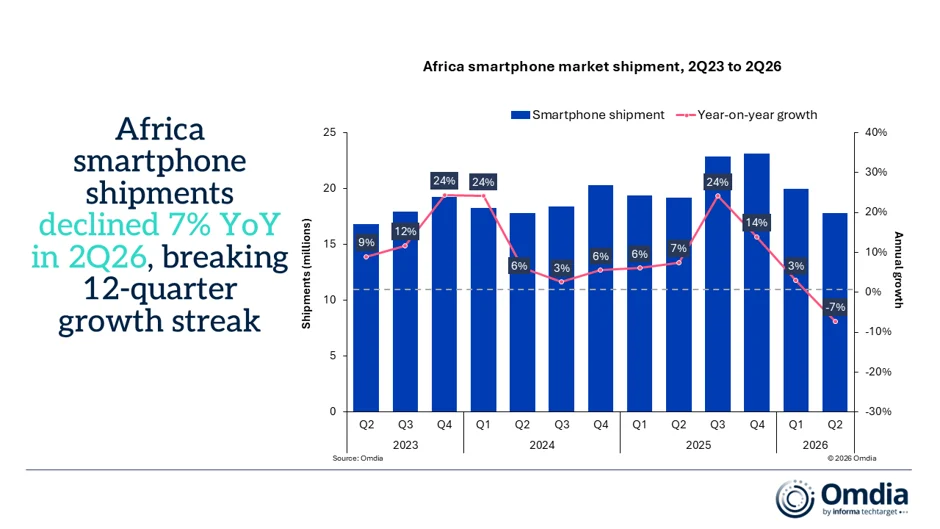
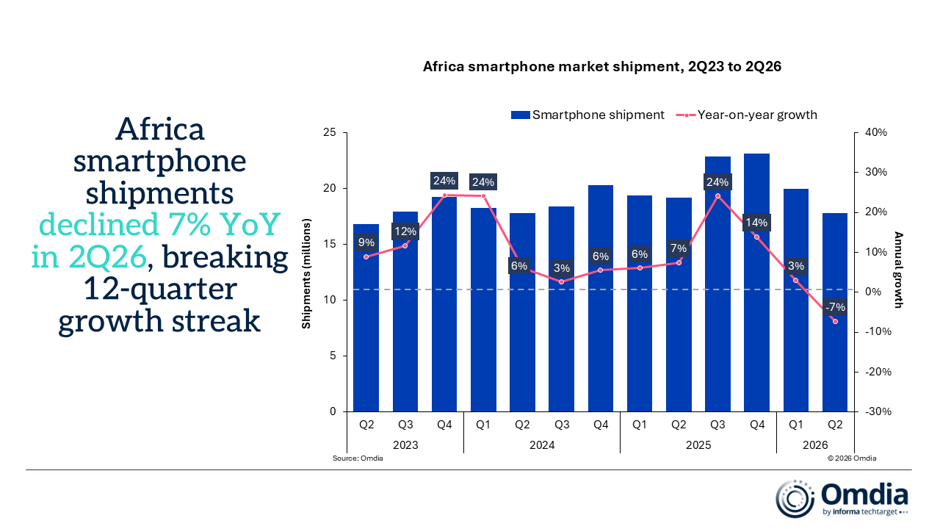
Nairobi, Kenya – August 15, 2026 – Africa’s once-booming smartphone market is poised for its first annual contraction in three years, signaling a dramatic shift in consumer behavior and industry dynamics. A new report from leading technology research firm Omdia forecasts a substantial 26% decline in African smartphone shipments for the full year 2026, a stark contrast to the sustained growth that has characterized the continent’s digital ascent. This projection follows a significant 7% year-over-year drop recorded in the second quarter of 2026, bringing shipments down to 17.8 million units from 19.2 million in the same period of the previous year.
This downturn marks a pivotal moment for a market that has historically been a beacon of growth, largely fueled by the widespread availability of affordable smartphones. However, a confluence of escalating device prices, rising component costs, and persistent affordability challenges are now fundamentally reshaping consumer demand, pushing the market into uncharted territory.
The Erosion of Affordability: A Deep Dive into Market Dynamics
The primary driver behind this market contraction is the increasing difficulty in manufacturing and acquiring ultra-low-cost smartphones. Omdia’s analysis highlights that rising memory costs, a critical component in smartphone production, are making devices priced below $100 increasingly unprofitable for manufacturers. This has led to a significant decline in this segment, with shipments of smartphones priced under $100 plunging by a dramatic 34% in Q2 2026, representing a loss of nearly 3 million units.
Consequently, the share of these entry-level devices in the overall African smartphone market has shrunk considerably. In Q3 2025, the sub-$100 segment accounted for a healthy 45% of shipments. By Q2 2026, this figure had plummeted to just 30%. In stark contrast, mid-range devices, priced between $100 and $199, have seen their market share grow to 41%, while the $200-$299 segment now represents 15% of shipments. This indicates a clear consumer shift towards higher-priced devices with improved specifications.
The ripple effect of these cost pressures is evident in the average selling price (ASP) of smartphones across Africa. For the first time in recent memory, the ASP has seen an increase, rising by $41 year-over-year to $202 in Q2 2026. This reverses the trend of price reductions observed in Q2 2025, underscoring the inability of manufacturers to absorb rising costs.
Manish Pravinkumar, Principal Analyst at Omdia, elaborated on the underlying issues: "The slowdown in Africa’s smartphone market indicates that the combination of higher production costs and weaker consumer purchasing power is having a profound impact on smartphone replacement and upgrade demand. Manufacturers can no longer profitably produce devices at the $75 price point, forcing both vendors and consumers to consider higher price tiers."
The critical role of memory components in this cost structure cannot be overstated. For smartphones priced below $400, memory constitutes nearly 60% of the bill of materials. This figure escalates to over 64% for devices priced below $99. This inherent cost structure severely curtails vendors’ ability to offset weakening demand through aggressive price cuts, creating a challenging environment for the entry-level segment.
A Shifting Landscape: Uneven Performance Across Key Markets
While the overall trend points towards contraction, the performance of Africa’s major smartphone markets exhibits significant regional variations.
South Africa stands out as a notable exception, registering a robust 17% year-over-year growth. This resilience is attributed to stronger consumer purchasing power within the country and a discernible trend towards the adoption of 5G-enabled smartphones.
In contrast, Nigeria, once a powerhouse of smartphone adoption, experienced an 11% decline. The report suggests that rising device prices are prompting Nigerian consumers to postpone their purchase decisions.
Egypt has been hit particularly hard, with a steep 26% contraction in its smartphone market. This sharp downturn is attributed to mid-quarter price increases implemented by smartphone manufacturers. Compounding the issue, local production input costs in Egypt have surged by 50% since January, placing immense pressure on device pricing.
Kenya also witnessed a decline, with smartphone shipments falling by 15%. The weakness in the Kenyan market is particularly pronounced in the highly price-sensitive sub-$150 segment, indicating that even moderate price increases are deterring consumers.
Vendor Dynamics: TRANSSION Dominates, Samsung Gains Ground
Despite the overall market contraction, TRANSSION, the parent company of popular brands TECNO, Infinix, and iTel, has maintained its leadership position in Africa. In Q2 2026, TRANSSION shipped 8.3 million smartphones, securing a commanding 47% market share. However, this leadership comes with a caveat, as the company’s shipments saw a 14% year-over-year decline.
Samsung has solidified its position as the second-largest vendor, with its smartphone shipments increasing by a significant 15% to 3.9 million units. This growth has expanded Samsung’s market share to 22%, bolstered by strong inventory levels for its popular Galaxy A07 and Galaxy A17 models.
Other major players have faced headwinds. Xiaomi shipments plummeted by 30% to 1.9 million units, while OPPO saw a 25% decline, shipping 0.9 million units. Both companies appear to be prioritizing profitability and adopting a more disciplined approach to participating in the entry-level segments.
In a more positive development, HONOR emerged as one of the stronger performers, with a 13% growth in shipments to 0.9 million units, capturing a 5% market share.
The Rise of Promotions and Financing: Adapting to a New Reality
In response to the evolving market conditions, smartphone vendors are increasingly leveraging promotions and financing options to stimulate demand and maintain market presence.
Samsung has been particularly active with aggressive promotional campaigns in South Africa. During its "Blue Tag Sale," the company offered significant discounts across its Galaxy A series, with the Galaxy A26 seeing a price reduction from R4,999 to R4,499, and the Galaxy A17 dropping from R3,999 to R3,499. Even the entry-level Galaxy A07 and A06 models received price adjustments. The premium Galaxy S25 FE also experienced a substantial price cut, falling from R13,999 to R9,999, representing savings of up to 40%.
At the high end, Samsung launched its Galaxy S26 series with competitive pricing and attractive pre-order incentives, including doubled storage capacity and savings of up to R5,000, signaling a continued push across all market segments.
HONOR, meanwhile, is strategically targeting the higher-value smartphone segment, with its growth driven by devices priced above $300. South Africa accounts for approximately 60% of HONOR’s African smartphone volumes. The company is heavily promoting its advanced HONOR 600 and HONOR 600 Pro models, which boast impressive specifications such as 200MP cameras, large batteries, rapid charging, and premium build quality. These devices are being offered with attractive financing plans and bundled with value-added services like accidental-damage protection and extended Google AI Pro storage.
The critical role of financing in driving future smartphone growth in Africa cannot be overstated. With outright device affordability deteriorating, vendors are increasingly recognizing financing as a key competitive tool. TRANSSION is actively expanding its financing initiatives, while Xiaomi is exploring strategic financing partnerships. This shift indicates that the future of competition in the African smartphone market will increasingly revolve around monthly affordability, accessible financing, compelling promotions, enhanced specifications, and perceived value, rather than solely focusing on reducing upfront handset prices.
Implications for the Future: A Structural Reset for Africa’s Smartphone Industry
Omdia’s projection of a 26% decline in African smartphone shipments for 2026 underscores a fundamental structural reset of the industry, rather than a mere cyclical downturn. The confluence of a 34% contraction in the sub-$100 smartphone segment, an escalating average selling price to $202, the decline in Q2 2026 shipments, and the persistent rise in memory costs are collectively reshaping the very fabric of the African smartphone landscape.
The market is visibly bifurcating into two distinct segments. On one hand, a segment of consumers is demonstrating the capacity and willingness to move towards smartphones priced at $200 and above, seeking enhanced features and longevity. On the other hand, a significant portion of price-sensitive buyers are being priced out of the market, delaying their purchases due to the diminishing availability of genuinely low-cost smartphones.
For smartphone vendors, navigating this new reality will require a delicate balancing act. Future growth in Africa will increasingly depend on their ability to effectively manage higher component costs while simultaneously offering compelling financing solutions, attractive promotions, robust specifications, and affordable monthly payment plans. Manufacturers heavily reliant on the ultra-low-cost smartphone segment will face mounting pressure, while those with established financing channels and a strong portfolio in the $100-plus categories are better positioned to adapt and thrive. The era of rapid, volume-driven growth in Africa’s smartphone market has given way to a more mature and challenging environment, demanding strategic innovation and a deep understanding of evolving consumer economics.