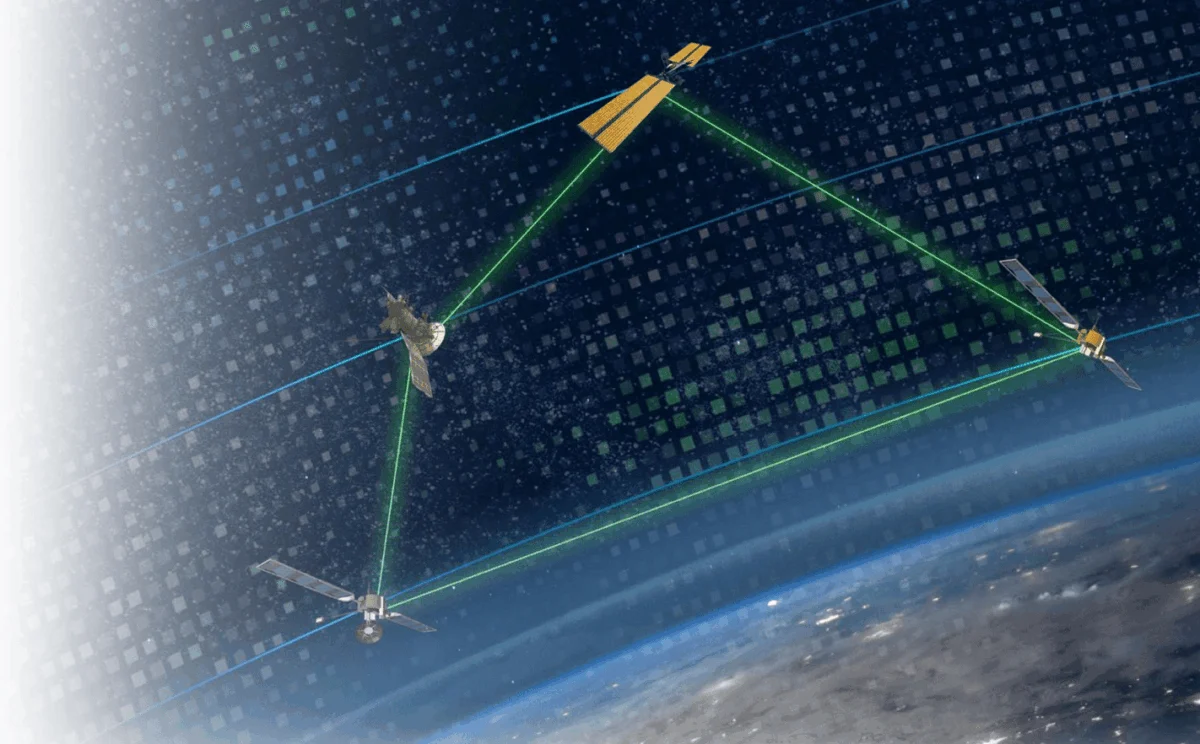
WASHINGTON — In a significant move to bolster the United States’ space-based communication infrastructure, the U.S. Space Force has awarded California-based satellite manufacturer K2 Space a $22.9 million contract. The project aims to test and validate advanced laser communication terminals designed to transmit high-bandwidth data directly between satellites operating in orbit.
Under the terms of the agreement, announced on July 31, K2 Space will procure, integrate, launch, and operate two Enterprise Space Terminals (ESTs). Each terminal will be integrated as a hosted payload on a separate K2 Space satellite bus. The orbital demonstration is scheduled to run through several phases, with full completion and data analysis projected by 2028.
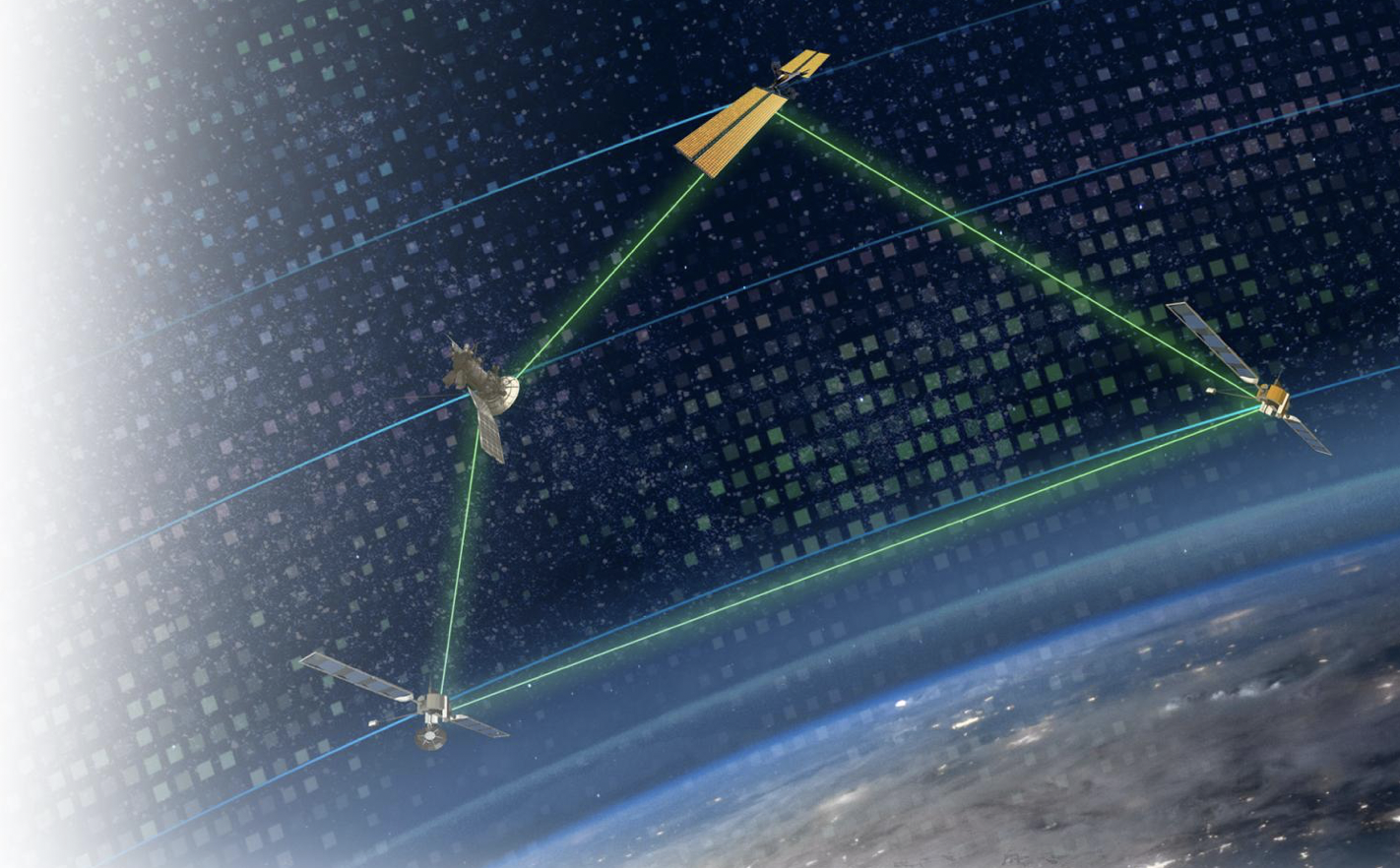
This flight demonstration represents a critical step in the Pentagon’s broader transition away from legacy radio-frequency (RF) communications toward highly secure, high-capacity optical inter-satellite links (OISLs). By utilizing laser-based systems, the military aims to establish an un-jammable, low-latency mesh network in space to support real-time tactical operations on the ground, in the air, and across the orbital commons.
Main Facts of the Contract
The $22.9 million contract represents a pivotal award for K2 Space, a fast-growing aerospace startup based in Torrance, California. The company, which specializes in developing high-power, cost-effective satellite platforms, will take on the role of primary mission integrator and operator for this technology demonstration.
+-------------------------------------------------------------------------+
|                      CONTRACT SUMMARY & KEY DETAILS                     |
+------------------------------------+------------------------------------+
| Awarding Agency                    | U.S. Space Force                   |
+------------------------------------+------------------------------------+
| Prime Contractor                   | K2 Space (Torrance, California)    |
+------------------------------------+------------------------------------+
| Contract Value                     | $22.9 Million                      |
+------------------------------------+------------------------------------+
| Core Objective                     | Procure, integrate, launch, and    |
|                                    | operate two Enterprise Space       |
|                                    | Terminals (ESTs)                   |
+------------------------------------+------------------------------------+
| Payload Architecture               | Hosted payloads on two separate    |
|                                    | K2 satellite buses                 |
+------------------------------------+------------------------------------+
| Projected Completion               | 2028                               |
+------------------------------------+------------------------------------+
| Contracting Vehicle                | FreeSol Broad Agency Announcement  |
+------------------------------------+------------------------------------+
The Hosted Payload Concept
Rather than building dedicated, bespoke military satellites to test the new hardware, the Space Force is leveraging K2 Space’s commercial satellite buses through a "hosted payload" arrangement.
In this configuration, the Enterprise Space Terminals will act as passenger equipment aboard K2’s spacecraft. The host satellites will provide the terminals with:
- Electrical Power: Sustained wattage required to drive the lasers and internal processors.
- Thermal Control: Active and passive cooling to protect sensitive optical components from the extreme temperature fluctuations of space.
- Precision Pointing and Attitude Control: The highly stable physical platform necessary to keep narrow laser beams locked onto target satellites over thousands of miles.
- Telemetry and Command Communications: The primary spacecraft link to route diagnostic data back to operators on Earth.
By utilizing commercial satellite buses, the Space Force significantly reduces the capital expenditure and lead time typically associated with military-grade satellite procurement.
Chronology of the Enterprise Space Terminal Program
The contract awarded to K2 Space is not an isolated initiative; rather, it is the culmination of a multi-year acquisition and development pipeline managed by Space Systems Command (SSC), the Space Force’s primary launch and procurement arm.
  2024: SSC launches the $100M Enterprise Space Terminal (EST) Program
    │
    ├── Phase 1 & 2: Conceptual design & technical standard alignment
    │
    └── Phase 3: Selection of CACI, General Atomics, and Viasat as hardware vendors
    │
  July 31, 2024: Space Force awards $22.9M flight demo contract to K2 Space
    │
  2024–2027: Payload procurement, bus integration, and environmental testing
    │
  2028: Projected launch, orbital insertion, and complete flight demonstration
1. Program Initiation (Early 2024)
Space Systems Command formally established the Enterprise Space Terminal program in early 2024. Backed by an estimated $100 million budget, the initiative was designed to address a critical vulnerability in military space architectures: the lack of interoperability among different satellite communication systems. Historically, defense contractors built proprietary optical systems, meaning a satellite built by Vendor A could not communicate with a satellite built by Vendor B. The EST program was created to establish and enforce common technical standards across the defense industrial base.
2. Phase 3 Vendor Selection (Mid-2024)
Following initial design phases, Space Systems Command narrowed the competitive field to three primary hardware suppliers for Phase 3 of the EST program:
- CACI International
- General Atomics
- Viasat
These three companies were tasked with developing flight-ready optical communication terminals that conform to standardized interoperability profiles. The Space Force has not yet disclosed which of these three vendors will supply the two flight units for K2 Space’s upcoming mission, nor whether K2 will procure both terminals from a single provider or split the order to test cross-vendor compatibility.
3. The Flight Demonstration Award (July 2024)
To transition these laboratory-tested terminals into operational environments, the Space Force leveraged the FreeSol Broad Agency Announcement (BAA). This contracting vehicle allows the military to bypass traditional, slow-moving procurement pipelines and directly solicit cutting-edge commercial solutions. K2 Space’s proposal to host the terminals on its high-power satellite buses was selected, resulting in the $22.9 million contract finalized on July 31.
4. Target Integration and Launch (2025–2028)
Over the next three years, K2 Space will work alongside the selected terminal hardware providers to resolve physical and electrical integration challenges. After rigorous thermal-vacuum and vibration testing, the two satellites will be launched into their target orbits. The Space Force expects the operational phase of the demonstration to be fully completed by 2028, providing the Pentagon with critical performance data on space-to-space laser crosslinks.
Supporting Data and Technological Specifications
The physics and engineering demands of optical communications in space are incredibly stringent, requiring a level of precision far exceeding traditional radio-frequency systems.
Optical vs. Radio-Frequency Communications
+------------------------+--------------------------+--------------------------+
| Feature                | Radio-Frequency (RF)     | Optical (Laser) Comm     |
+------------------------+--------------------------+--------------------------+
| Bandwidth / Data Rate  | Megabits per second (Mb) | Gigabits to Terabits (Gb)|
+------------------------+--------------------------+--------------------------+
| Beam Divergence        | Wide footprint (easy to  | Extremely narrow (arcsec)|
|                        | intercept/jam)           | virtually un-jammable    |
|                        |                          |                          |
+------------------------+--------------------------+--------------------------+
| Physical Size & Weight | Large antennas, heavy    | Compact optical lenses,  |
|                        | transmitters             | lower overall mass       |
+------------------------+--------------------------+--------------------------+
| Spectrum Regulation    | Heavily regulated by ITU | Unregulated spectrum     |
|                        | and national agencies    |                          |
+------------------------+--------------------------+--------------------------+
The Challenge of Pointing, Acquisition, and Tracking (PAT)
The primary technical hurdle for optical communication is the requirement for absolute geometric precision. Because a laser beam has an incredibly narrow divergence angle—often measured in microradians—two satellites traveling at speeds exceeding 17,000 miles per hour, separated by thousands of miles of vacuum, must align their optical telescopes with pinpoint accuracy.
The PAT sequence involves:
- Coarse Acquisition: Using GPS coordinates and orbital ephemeris data to point the telescopes in the general direction of the companion satellite.
- Fine Acquisition: Scanning the local area with a wider beacon laser until the receiving sensor detects the incoming signal.
- Active Tracking: Utilizing fast-steering mirrors (FSMs) and closed-loop feedback algorithms to continuously adjust the optics, compensating for spacecraft jitter, thruster firings, and orbital drift.
K2 Space’s satellite buses must provide an exceptionally stable "quiet" platform to prevent attitude control thrusters or reaction wheels from disrupting this delicate optical lock.
Strategic Context and Official Rationale
The K2 Space flight demonstration is funded and overseen by the Space Force’s Space-Based Sensing and Targeting portfolio. This organization is tasked with modernizing the Pentagon’s orbital intelligence, surveillance, and reconnaissance (ISR) capabilities.

       ┌────────────────────────────────────────────────────────┐
       │     Space-Based Sensing & Targeting Portfolio (SSC)     │
       └───────────────────────────┬────────────────────────────┘
                                   │
         ┌─────────────────────────┴─────────────────────────┐
         ▼                                                   ▼
┌─────────────────────────────────┐       ┌─────────────────────────────────┐
│     Space-Based Airborne        │       │       Space Data Network        │
│   Moving Target Indicator       │       │             (SDN)               │
│            (AMTI)               │       │                                 │
│                                 │       │ • High-speed orbital transport  │
│ • Persistent aerial tracking    │       │ • Low-latency tactical routing  │
│ • Massive radar data generation │       │ • Resilient mesh architecture   │
└─────────────────────────────────┘       └─────────────────────────────────┘
Supporting the Space-Based Airborne Moving Target Indicator (AMTI)
A primary driver behind the demand for high-capacity laser links is the Space Force’s Space-Based Airborne Moving Target Indicator (AMTI) program. Designed to track moving aircraft, ground vehicles, and maritime vessels from orbit, AMTI satellites will utilize high-power radar and electro-optical sensors.
These sensors generate massive, continuous streams of data. Traditional RF downlink networks lack the bandwidth to transmit this raw tactical data to ground stations without causing severe bottlenecks. By establishing a high-speed orbital highway via the Space Data Network, AMTI satellites can instantly route tracking data to optical relay nodes, which then beam the information directly to tactical commanders on the ground.
Integration with OPIR SMI
The contract with K2 Space also aligns with the company’s prior selection under the Pentagon’s Overhead Persistent Infrared Space Modernization Initiative (OPIR SMI). OPIR SMI is an ongoing research-and-development effort focused on upgrading the nation’s missile warning and tracking architecture.
In a scenario involving hypersonic glide vehicles or fractional orbital bombardment systems, every second of latency can decide the success of an interception. Standardizing optical terminals and proving their viability on agile, commercial buses ensures that missile detection data can bypass terrestrial relays entirely, traveling at the speed of light through space to interceptor batteries.
Implications for the Defense Space Sector
The $22.9 million award to K2 Space highlights several structural shifts occurring within the broader defense aerospace market.
1. The Rise of Commercial-Off-The-Shelf (COTS) Integration
The selection of K2 Space—a relatively young startup—over established aerospace giants underscores the military’s growing willingness to trust commercial innovators with critical defense payloads. By relying on K2’s standardized, high-power satellite buses, the Space Force is proving that it can field complex military payloads without the multi-billion-dollar price tags and decade-long development cycles of the past.
2. Forcing Interoperability Standards
Historically, defense contractors maintained high profit margins by locking the military into proprietary ecosystems. Under the Enterprise Space Terminal program, the Space Force is actively dismantling this model. By requiring vendors like CACI, General Atomics, and Viasat to conform to open, standardized technical baselines, the military ensures that its orbital network remains modular. If one terminal manufacturer suffers a supply chain disruption, another vendor’s terminal can be easily integrated onto the host satellite bus without requiring a complete redesign of the spacecraft.
3. Resilience Through Proliferation
The ultimate goal of these optical communications programs is the creation of a highly survivable, proliferated low-Earth orbit (pLEO) constellation. If an adversary attempts to disable American orbital communications—either through kinetic anti-satellite (ASAT) weapons, high-altitude nuclear detonations, or electronic warfare jamming—a highly connected, optically linked mesh network can dynamically reroute data around the damaged nodes.
By testing these capabilities on K2 Space’s highly capable platforms, the Space Force is laying the foundation for an orbital network that is not only faster and more secure but fundamentally resilient against modern peer-adversary threats.