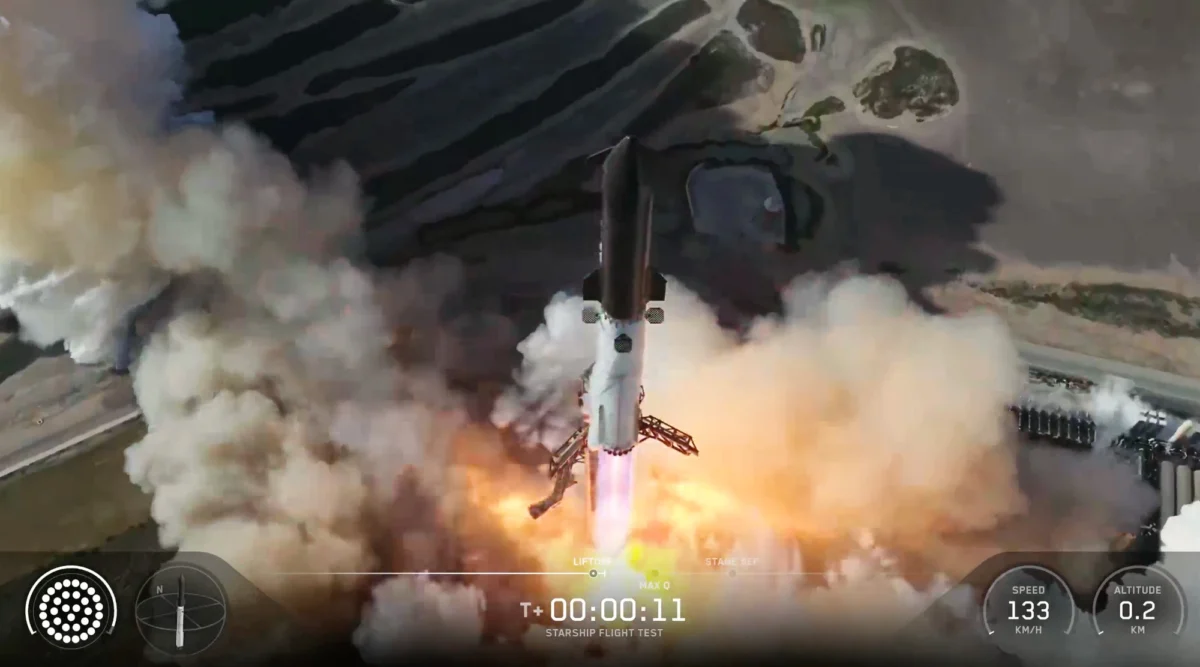
BOCA CHICA, Texas — In a pivotal moment for the future of space exploration, SpaceX successfully launched its Starship launch vehicle on its 13th suborbital test flight on July 24, 2026. Lifting off from the company’s Starbase facility in Boca Chica, Texas, at 6:51 p.m. Eastern, the massive rocket resolved critical engineering challenges from previous flights while achieving two historic firsts: the deployment of functioning operational satellites and the survival of the Starship upper stage through reentry to a complete, intact splashdown.
Flight 13 represents the second flight of the Starship V3, an upgraded, larger variant designed to serve as the workhorse for future orbital missions, deep-space exploration, and the deployment of SpaceX’s next-generation Starlink megaconstellation. While the mission experienced a partial setback with the loss of the Super Heavy booster during its landing sequence, the overall flight has been hailed as a major leap forward in SpaceX’s rapid, iterative development program.
Main Facts of the Flight 13 Mission
The primary objectives of Flight 13 were to validate engineering fixes implemented after Flight 12, test the deployment mechanism of the Starship V3 payload bay under flight conditions, and gather critical thermal protection system (TPS) data during reentry.
Key outcomes of the mission include:
- Successful Liftoff: After overcoming a dramatic launchpad abort on July 16 and a subsequent 24-hour weather delay, the 121-meter-tall rocket lifted off cleanly from Starbase.
- First Operational Payload Deployment: Unlike previous flights that carried mass simulators, Flight 13 successfully deployed 20 functioning Starlink V3 satellites into a temporary suborbital trajectory.
- Active Suborbital Satellite Testing: The deployed Starlink V3 satellites successfully conducted 20 minutes of active testing, establishing radio-frequency (RF) and laser communication links before reentering the atmosphere.
- Vacuum Raptor Relight: The Starship upper stage successfully restarted a vacuum-optimized Raptor engine in space for approximately 14 seconds, demonstrating a critical capability required for future orbital insertion and deorbit burns.
- Intact Upper Stage Splashdown: For the first time in the program’s history, the Starship upper stage survived reentry and completed a soft splashdown in the Indian Ocean, remaining structurally intact and transmitting live telemetry while floating on the water’s surface.
- Partial Booster Failure: The Super Heavy booster failed to ignite all required Raptor engines during its final landing burn, resulting in a high-velocity impact and destruction upon contact with the Gulf of Mexico.
Chronology of the Flight 13 Campaign
The path to Flight 13 was marked by intense engineering scrutiny, rapid troubleshooting, and operational adjustments.
[July 16: Launch Abort] ➔ [July 22: Static Fire Test] ➔ [July 23: Weather Delay] ➔ [July 24: Successful Liftoff] ➔ [T+2:42: Hot-Staging] ➔ [T+7:00: Booster Impact] ➔ [T+45:00: Payload Test] ➔ [T+65:30: Upper Stage Splashdown]The July 16 Abort and Engine Troubleshooting
SpaceX initially attempted to launch Flight 13 on July 16. However, immediately after the ignition sequence commenced, the flight computer triggered an automatic abort. The company later revealed that four of the 33 Raptor engines on the Super Heavy booster failed to ignite properly.
An investigation identified an "off-nominal spin response" in the liquid oxygen (LOX) turbopumps of six engines. The root cause was determined to be ambient moisture that had accumulated within the turbopumps during pad operations. When cryogenic propellants chilled the plumbing, this moisture froze, slowing or completely seizing the high-speed turbopumps and preventing engine ignition.

To resolve the issue, SpaceX technicians replaced the affected Raptor engines and implemented system-wide purging procedures to eliminate moisture. On July 22, SpaceX conducted a successful static fire test on the launchpad. To verify the integrity of the hardware, one of the removed Raptor engines was shipped to SpaceX’s development facility in McGregor, Texas, where it successfully completed a full-duration ascent burn test.
Launch Day: July 24
A final 24-hour delay was instituted on July 23 due to heavy cloud cover over the Boca Chica area. While the clouds did not present a safety risk to the vehicle itself, they would have severely degraded the optical tracking and high-altitude imaging systems crucial for engineering analysis.
On July 24, at 6:51 p.m. Eastern, the 33 Raptor engines of the Super Heavy booster ignited, generating 16.7 million pounds of thrust and propelling the vehicle through low-hanging clouds.
- Hot-Staging (T+2 minutes, 42 seconds): Starship successfully executed its signature "hot-staging" maneuver, where the upper stage engines ignited while still attached to the booster, allowing for a seamless separation.
- Booster Descent and Splashdown (T+7 minutes): The Super Heavy booster performed its boostback burn and targeted a soft splashdown in the Gulf of Mexico. However, during the final landing burn, several Raptor engines failed to restart. The booster struck the water at a high velocity, resulting in its immediate destruction.
- Orbital Coast and Payload Deployment: The Starship upper stage continued on its planned suborbital trajectory. Upon reaching space, the vehicle opened its payload dispenser door and successfully released 20 Starlink V3 satellites.
- Raptor Relight Test: Following payload deployment, Starship performed a 14-second relight of a vacuum Raptor engine. This test was significantly longer and more stable than the brief relight attempts conducted on prior flights.
- Reentry and Splashdown (T+65 minutes, 30 seconds): Utilizing its upgraded thermal protection tiles, Starship endured the extreme heat of atmospheric reentry over the Indian Ocean. The vehicle performed its landing flip maneuver and executed a soft splashdown. Rather than exploding upon impact, the vehicle tipped over and remained structurally intact, floating on the ocean surface.
Supporting Data and Technical Analysis
The transition to the Starship V3 architecture represents a substantial technological evolution, and Flight 13 provided invaluable empirical data to validate these design changes.
Starship V3 Structural and Propulsive Upgrades
The Starship V3 utilized for Flight 13 features several design modifications compared to the V1 and V2 prototypes:
- Stretched Propellant Tanks: The V3 vehicle is taller, allowing for an increased propellant capacity that maximizes payload performance.
- Raptor 3 Engines: Flight 13 utilized the latest iteration of the Raptor engine. Raptor 3 features a highly consolidated, clean design with internal propellant pathways, eliminating the need for complex external heat shielding and reducing overall vehicle dry mass.
- Upgraded Thermal Protection System (TPS): SpaceX redesigned the heat shield attachment mechanisms to prevent the tile loss that plagued earlier test flights. This modification was directly vindicated by the vehicle’s survival through reentry.
| Parameter | Starship V1/V2 | Starship V3 (Flight 13) |
|---|---|---|
| Height (Stack) | ~120 meters | ~121+ meters |
| Payload Capacity (to LEO) | ~100-150 metric tons | Up to 200 metric tons (fully reusable) |
| Engine Version | Raptor 1 / Raptor 2 | Raptor 3 |
| Splashdown Condition (Upper Stage) | Structural breakup/explosion | Intact, floating on water |
The Starlink V3 Suborbital Test Regime
The deployment of 20 functioning Starlink V3 satellites on a suborbital trajectory was a highly unusual operational profile. Because the satellites were released on a path that would inevitably lead to reentry and destruction within an hour, SpaceX had a narrow 20-minute window to conduct critical system checks.
During this brief spaceflight phase, the satellites successfully:

- Deployed their solar arrays and high-gain antennas.
- Established radio-frequency (RF) communication links with ground stations.
- Activated and tested laser inter-satellite links, transmitting telemetry directly to other operational Starlink satellites in orbit.
This test confirmed that the Starship V3’s payload deployment mechanism is fully operational and capable of releasing commercial payloads without damaging the satellite chassis or the launch vehicle’s dispenser door.
Official Responses and Statements
The success of Flight 13 drew immediate praise from SpaceX leadership, who emphasized the value of the telemetry recovered from the floating upper stage.
SpaceX spokesperson Dan Huot expressed the excitement of the engineering team during the live launch broadcast:
"This is the first time we’ve put an intact Starship in the water. This is a dream scenario for the team that’s trying to get this heat shield data."
Michael Nicolls, SpaceX Vice President of Starlink Engineering, confirmed the flawless performance of the payload on social media:
"We’ve successfully communicated with all sats using RF [radio-frequency] and laser links and been able to download key telemetry."
Though SpaceX has not officially published the exact timeline for its next launch, SpaceX President Gwynne Shotwell previously outlined the company’s strategic roadmap in a June interview. Shotwell indicated that if Flight 13 achieved its primary objectives, the company would look to transition to fully orbital flights:

"If Flight 13 goes well, we might attempt the first orbital Starship mission on Flight 14, followed by the first launch of the vehicle from Florida on Flight 15."
Implications and Future Outlook
The success of Flight 13 has profound implications for SpaceX’s commercial, civil, and military launch manifests.
Transitioning to Orbital Flights (Flight 14)
With the suborbital profile now thoroughly flight-proven, Flight 14 is widely expected to be Starship’s first true orbital attempt. To achieve orbit, the vehicle must reach a velocity of approximately 27,000 kilometers per hour (compared to the sub-orbital speeds of previous flights). Survival during an orbital reentry will subject the thermal protection system to significantly higher thermal and mechanical stresses, making the data gathered from Flight 13’s intact splashdown vital for final adjustments.
Expansion to Florida (Flight 15)
The successful deployment of functioning satellites brings SpaceX closer to launching Starship from the East Coast. Flight 15 is slated to launch from Launch Complex 39A at the Kennedy Space Center in Florida. Establishing a dual-coast launch capability will allow SpaceX to drastically increase its launch cadence and support high-inclination orbital insertions that are geographically restricted from the South Texas launch site.
Accelerating the Starlink Megaconstellation
Currently, SpaceX relies on its Falcon 9 fleet to deploy Starlink satellites, carrying roughly 23 "V2 Mini" satellites per launch. The operational deployment of Starlink V3 satellites via Starship will fundamentally change the economics of global connectivity. A single Starship V3 flight is projected to deploy over 100 next-generation satellites, significantly lowering the cost per gigabit of bandwidth and accelerating the deployment of direct-to-cell capabilities worldwide.
Supporting NASA’s Artemis Program
The rapid progress demonstrated in Flight 13 is also a positive signal for NASA’s Artemis program. SpaceX is under contract to provide a modified version of Starship to serve as the Human Landing System (HLS) for the Artemis III and IV missions, which aim to return astronauts to the lunar surface. The successful demonstration of vacuum engine relights and structural survivability are critical prerequisites for the complex propellant-transfer flights required to send Starship to the Moon.