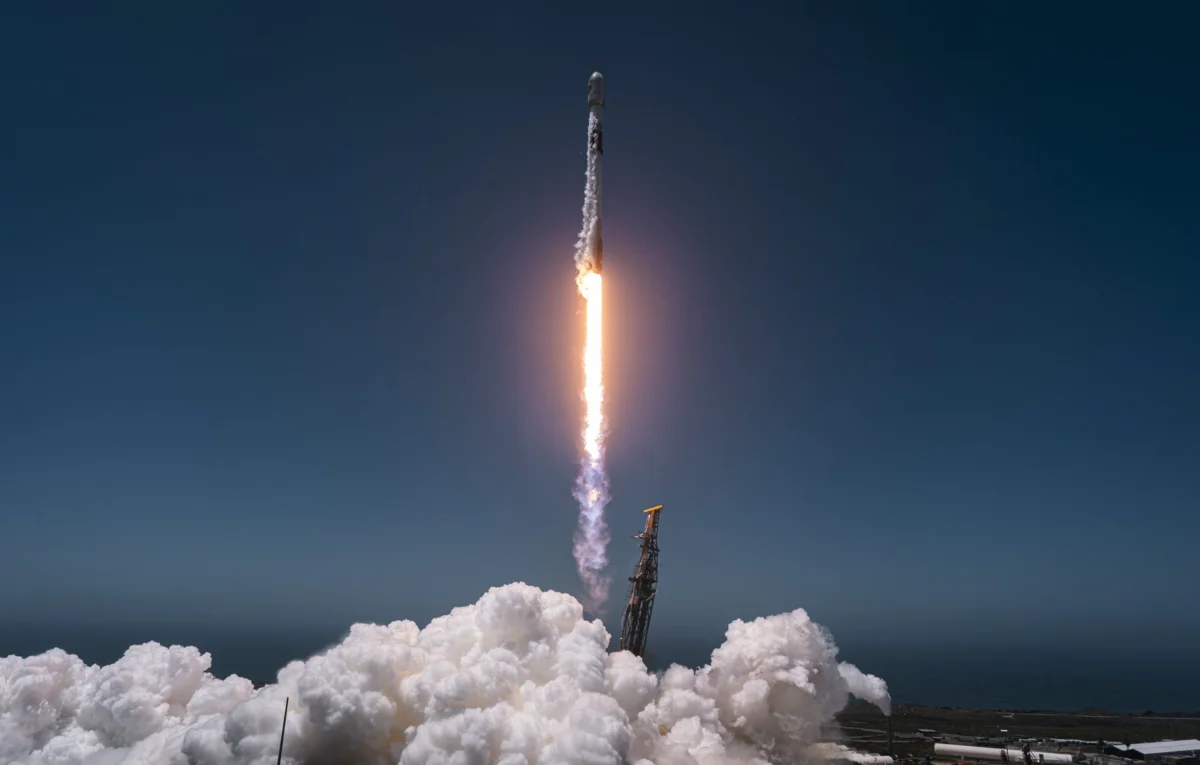
WASHINGTON — In a move that solidifies its dominance over both the launch services market and the military’s next-generation orbital architecture, SpaceX has been awarded two massive launch task orders worth $1.6 billion by the U.S. Space Force. The task orders will fund 18 Falcon 9 launches to deploy key military satellite constellations, representing the largest publicly announced batch of missions to date under the National Security Space Launch (NSSL) Phase 3 program.
The missions, scheduled to fly from Vandenberg Space Force Base in California through the end of 2027, will support the military’s Space Based Sensing and Targeting (SBST) portfolio. This portfolio represents a critical pillar of the Pentagon’s shift toward highly resilient, proliferated low Earth orbit (pLEO) constellations designed to track advanced threats and streamline tactical communications in real time.
1. Main Facts of the Award
The newly announced task orders represent a massive scale-up in the Space Force’s operational deployment timeline. Under the terms of the agreement, SpaceX will utilize its workhorse Falcon 9 rocket to carry out 18 dedicated launches over a roughly three-year window ending in December 2027.
Key parameters of the contract include:
- Total Value: $1.6 billion across two task orders.
- Launch Vehicle: SpaceX Falcon 9.
- Launch Site: Vandenberg Space Force Base, California (Space Launch Complex 4 East).
- Target Orbit: Low Earth Orbit (LEO), utilizing polar and high-inclination trajectories ideal for global reconnaissance and sensing.
- Timeline: Complete deployment by the end of 2027, necessitating a sustained launch cadence of approximately one mission per month from the West Coast.
- Primary Payload Portfolio: The Space Based Sensing and Targeting (SBST) portfolio, which integrates missile tracking, tactical data routing, and moving target indicator systems.
Beyond the sheer scale of the launch services, the award highlights a unique dynamic in modern defense procurement: SpaceX is not only acting as the transportation provider for these constellations but is also under contract to build a significant portion of the satellite hardware itself. This dual-role integration makes SpaceX a central pillar of the United States’ emerging military space architecture.
2. Chronology of Program Evolution
The road to this $1.6 billion award reflects a rapid, calculated restructuring of how the Department of Defense purchases space capabilities. Historically, national security space missions relied on expensive, exquisite satellites placed in high orbits by highly customized launch vehicles. The timeline below illustrates the transition toward the commercial-style, high-cadence model that enabled this landmark award:
[Late 2023] ----------------> [June 2024] -------------> [July 2024] -------------> [Early Oct 2024] ----------> [Late Oct 2024]
Space Force designs           NSSL Phase 3 Lane 1       SpaceX wins massive        Space Force triples         Space Force awards
NSSL Phase 3 Lane 1           contracts finalized;      SBST satellite contracts   Lane 1 contract ceiling     $1.6B task orders to
for commercial launches. 7 providers qualified. ($4.16B & $2.29B). from $5.6B to $17B. SpaceX for 18 launches.- Late 2023: Strategy Formulation: The Space Force designs the NSSL Phase 3 procurement framework, splitting missions into "Lane 1" (risk-tolerant, commercial-style launches with broader provider competition) and "Lane 2" (heavy, unique, high-value payloads requiring specialized military certification).
- June 2024: NSSL Phase 3 Lane 1 On-Ramps: The Space Force officially awards positions on the Lane 1 contract vehicle to seven launch providers, including SpaceX, United Launch Alliance (ULA), Blue Origin, Rocket Lab, and Firefly Aerospace. The contract is designed to allow rapid, competitive bidding for individual task orders.
- July 2024: Major Satellite Construction Awards: Under separate procurement efforts, the Space Force and the Space Development Agency (SDA) select SpaceX to build massive portions of the SBST architecture. This includes a $2.29 billion contract for the Space Data Network Backbone and a $4.16 billion contract for the Space-Based Airborne Moving Target Indicator (AMTI) system.
- October 2024: Ceiling Tripled: Anticipating a massive surge in launch requirements for these proliferated constellations, the Space Force officially increases the Phase 3 Lane 1 contract ceiling from $5.6 billion to $17 billion.
- October 2024 (Present): The $1.6 Billion Launch Award: Having identified the immediate deployment timeline for the SBST portfolio, the Space Force rapidly processes and awards the 18-launch task orders to SpaceX, utilizing the newly expanded Lane 1 vehicle.
3. Supporting Data and Program Breakdown
The Space Based Sensing and Targeting (SBST) portfolio is one of nine newly consolidated acquisition portfolios created during the Space Force’s recent procurement reorganization. SBST is designed to transition the military away from vulnerable, geostationary surveillance platforms to a highly redundant "mesh network" of hundreds of smaller satellites in low Earth orbit.
The $1.6 billion launch contract directly supports three key components of this integrated architecture:

| Program Component | Primary Mission | SpaceX Satellite Contract Value | Launch Vehicle & Site |
|---|---|---|---|
| SDA Tracking Layer | Infrared missile warning, tracking, and defense against advanced hypersonic glide vehicles. | Various (Shared with other builders) | Falcon 9 / Vandenberg SFB |
| Space Data Network Backbone | High-bandwidth, optically linked communications network to route tactical data across the Joint Force. | $2.29 Billion | Falcon 9 / Vandenberg SFB |
| Airborne Moving Target Indicator (AMTI) | Tracking enemy aircraft, ground vehicles, and moving targets from orbit, replacing aging airborne radar planes. | $4.16 Billion | Falcon 9 / Vandenberg SFB |
The Scale of the Deployment Challenge
Deploying 18 missions by the end of 2027 presents an unprecedented operational demand for national security launches from the West Coast. Vandenberg Space Force Base must support a steady, near-monthly cadence of Falcon 9 launches dedicated solely to this portfolio, in addition to SpaceX’s commercial Starlink missions and other civil, commercial, and national security launches.
This relentless tempo is made possible by SpaceX’s rapid booster refurbishment capabilities and its established autonomous flight safety systems, which significantly reduce the turnaround time required between launches.
4. Official Responses and Procurement Efficiency
Military leadership has highlighted the speed of the procurement process as a major victory for the Space Force’s efforts to outpace foreign adversaries, particularly China and Russia, in the space domain.
Col. Eric Zarybnisky, the Space Force’s acting portfolio acquisition executive for space access, emphasized how the streamlined structure of NSSL Phase 3 Lane 1 allowed the service to move from initial planning to contract execution in record time.
"The speed with which we executed these awards demonstrates the agility built into the Lane 1 contracting strategy," said Col. Zarybnisky. "We completed this entire procurement in roughly two months from identifying the requirement to making the award, including giving industry a full month to prepare their proposals. This is how we rapidly field capability to the warfighter."
Industry analysts note that this level of speed would have been impossible under legacy defense acquisition rules, which routinely required one to two years of negotiations, technical audits, and administrative reviews before a launch contract could be finalized.
5. Implications for the Defense Space Sector
The awarding of this massive contract has profound implications for the commercial space launch industry, the defense industrial base, and the geopolitical landscape of military space operations.
Vertical Integration and the Rise of a Defense Giant
With this award, SpaceX has achieved an unprecedented level of vertical integration within the defense sector. The company is now simultaneously:

- Designing and manufacturing the satellite buses and payloads for the Space Data Network Backbone and the AMTI system.
- Launching those same satellites into orbit using its own reusable Falcon 9 rockets.
- Operating the underlying launch infrastructure and integrating the spacecraft payloads.
This dual-role capability allows SpaceX to optimize its satellite designs for its own launch vehicles, reducing engineering overhead and driving down total mission costs. However, it also raises concerns among some defense policymakers regarding the Pentagon’s growing, near-total reliance on a single commercial entity for its most critical space assets.
The Competition Gap in Lane 1
When the Space Force designed the NSSL Phase 3 Lane 1 contract, the explicit goal was to foster robust competition among commercial launch providers. By lowering the barriers to entry and qualifying seven different companies, the military hoped to distribute launch awards across a diverse industrial base.
However, the reality of the current launch market has forced the Space Force’s hand. Of the seven qualified Lane 1 providers, only SpaceX possesses:
- A fully operational, highly reliable medium-to-heavy-lift rocket (Falcon 9).
- The high launch frequency necessary to support 18 missions in three years.
- Active, high-throughput launch pads at Vandenberg Space Force Base capable of reaching polar orbits.
Competitors like Blue Origin (with New Glenn) and United Launch Alliance (with Vulcan Centaur) are still ramping up their operational flight rates or completing certification flights. Smaller launch providers, such as Rocket Lab and Firefly Aerospace, are working on larger medium-lift vehicles (Neutron and Elytra/MLV) but are not yet ready to loft constellations of this scale.
Consequently, while the Space Force succeeded in creating a flexible contracting vehicle, the lack of operational alternatives means SpaceX remains the sole provider capable of executing high-cadence military campaigns today.
Geopolitical and Tactical Shift
From a strategic perspective, the deployment of these 18 launches will fundamentally change how the United States military operates. By replacing a small number of easily targeted, high-altitude satellites with thousands of low-cost, interconnected pLEO satellites, the Space Force is building an "indestructible" orbital network. If an adversary destroys one or two satellites, the rest of the mesh network will seamlessly reroute data, ensuring that American forces on the ground, in the air, and at sea maintain uninterrupted communications and targeting capabilities during a conflict.
As these 18 launches roll out through 2027, the global balance of military space power will increasingly shift toward this resilient, high-speed architecture—fully propelled by SpaceX’s Falcon 9 fleet.