São Paulo, Brazil – SpaceX’s Starlink has dramatically reshaped Brazil’s broadband landscape, transforming from a niche solution for remote areas into a significant national competitor. Leveraging an expansive satellite network that spans from bustling metropolises to the most isolated corners of the Amazon, Starlink has achieved remarkable subscriber growth, challenging established terrestrial providers and redefining connectivity for millions of Brazilians.
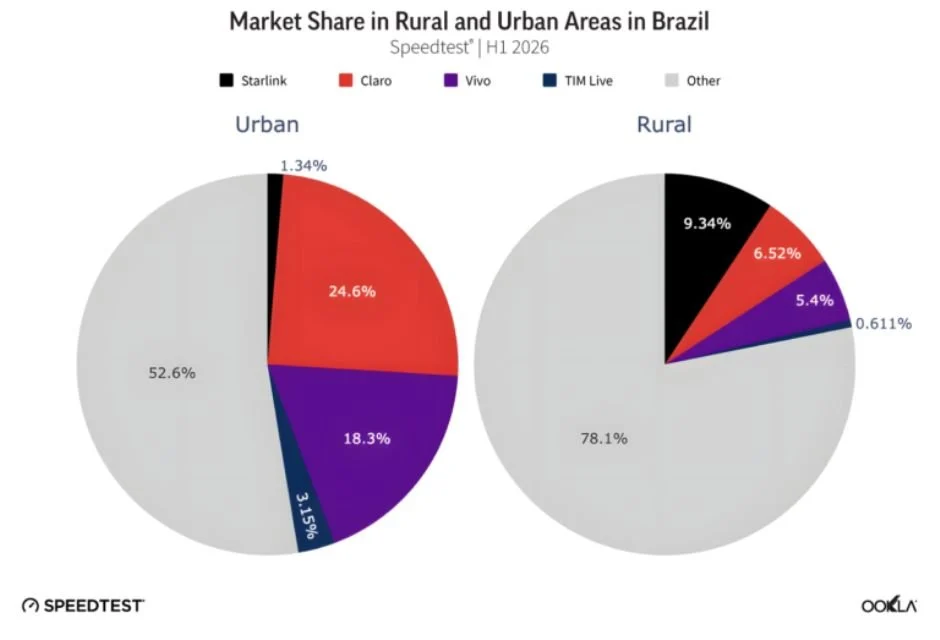
New network data reveals Starlink’s impressive trajectory. As of May 2026, the satellite internet service boasted 791,052 fixed broadband subscriptions, solidifying its position as Brazil’s 13th-largest provider. This achievement grants Starlink approximately 1.4 percent of the nation’s total fixed broadband market, a substantial foothold considering its relatively recent commercial launch. Brazil has rapidly become Starlink’s second-largest global market, underscored by the presence of over a dozen strategically important ground stations across the country.
This expansion is particularly noteworthy as Starlink is not solely catering to the traditionally underserved rural populations. It is actively competing in densely urbanized hubs like São Paulo, Rio de Janeiro, Recife, and Brasília, demonstrating a versatile market strategy. This broad appeal signifies a paradigm shift in how satellite broadband is perceived and utilized, moving beyond its historical association with remote connectivity to become a viable option for a diverse range of consumers.
The Engine of Growth: Explosive Subscriber Expansion
Starlink has demonstrated one of the most impressive growth rates among Brazil’s major broadband providers between January and May 2026. According to data compiled by Anatel, the Brazilian telecommunications regulatory agency, Starlink subscriptions surged from 656,413 in January 2026 to an impressive 791,052 by May 2026. This represents a remarkable increase of approximately 20 percent in just four months, translating to a net addition of 134,639 fixed broadband subscriptions during this period.
This rapid influx of new customers places Starlink in a competitive position relative to established giants. While Vivo added the most subscriptions during this timeframe with 253,974, and Claro followed closely with 128,826, Starlink’s growth outpaced many other providers. For context, by May 2026, Vivo held 8.4 million fixed broadband subscriptions, and market leader Claro commanded 10.8 million. It is worth noting that Starlink itself reported reaching 1 million subscribers in Brazil in January 2026, a figure higher than Anatel’s reported count. This discrepancy can likely be attributed to differing methodologies in classifying paying customers, subscriptions, and individual users.
Bridging the Digital Divide: A Nationwide Satellite Footprint
Brazil’s vast and geographically diverse terrain presents a unique and substantial opportunity for satellite broadband. Approximately 26 million Brazilians, representing about 12 percent of the nation’s population, reside in rural areas where traditional broadband infrastructure is often sparse or non-existent. The digital divide is particularly acute in the Amazon biome, where fixed or mobile broadband is available across a mere 3.5 percent of the region, and this figure plummets to a staggering 0.69 percent across indigenous territories.
Against this backdrop, Brazil’s total satellite internet subscriptions have witnessed an astronomical surge, climbing from a modest 43,164 in February 2011 to a remarkable 960,759 by May 2026. This exponential growth was significantly catalyzed by Starlink’s commercial launch in Brazil in May 2022. Concurrently, subscriptions on legacy copper and cable networks have seen a decline, with fiber remaining the only broadband access technology exhibiting faster growth than satellite in the country.
Beyond Rural: Starlink’s Urban Conquest
Challenging conventional wisdom, Starlink has cultivated a substantial presence not only in remote locations but also within Brazil’s highly urbanized centers. In areas classified as having a "high degree" of urbanization, Starlink recorded 347,990 subscriptions as of May 2026. Conversely, locations with a "low degree" of urbanization accounted for 213,291 subscriptions. These figures indicate that Starlink possesses more subscriptions in highly urbanized Brazilian locales than in less urbanized ones.
However, Starlink’s relative market strength remains significantly greater in rural areas. Here, its market share is approaching 10 percent, driven by limited fiber availability that creates a more fertile ground for satellite connectivity. Between May 2025 and May 2026, Starlink observed an 8.3 percent increase in net customers in these rural regions. In contrast, urban growth was considerably slower, registering at 1.32 percent over the same 12-month period. This disparity reflects the intense competition from Brazil’s extensive and often faster fiber broadband networks in urban environments.
Performance Profile: Speed, Consistency, and Congestion
Starlink’s broadband performance profile presents a distinct contrast to that of Brazil’s major fiber and fixed-network providers. Starlink users are predominantly concentrated in the speed range of 50 Mbps to 200 Mbps, with this band encompassing the largest proportion of users in both urban and rural settings. Speeds exceeding 400 Mbps remain uncommon on Starlink, and achieving gigabit speeds is virtually unheard of.
This performance tier differs markedly from the offerings of Claro, Vivo, and TIM, whose Speedtest results often peak at speeds associated with commercial broadband tiers ranging from 300 Mbps to 1 Gbps. Nevertheless, a notable aspect of Starlink’s performance is the remarkable similarity in its urban and rural speed distributions. This suggests a consistent performance level irrespective of geographical location, with satellite capacity rather than conventional wired last-mile infrastructure playing the pivotal role in determining network performance.
Starlink Speeds Under Load:
A key factor influencing Starlink’s performance in Brazil is network congestion. During the first quarter of 2026, Starlink’s median download speed peaked at 149.5 Mbps around 2 a.m., a period of low network utilization. However, performance saw a significant decline to a daily trough of 90.6 Mbps by approximately 1 p.m., representing a nearly 40 percent drop during peak business hours. On weekdays, this performance degradation could reach as high as 43 percent. This analysis, considering various speed percentiles, highlights the impact of increased user activity on download speeds.
It’s important to note that Starlink’s median download speeds in Brazil have experienced some dips in recent months, following a period in 2025 where the company nearly doubled its global customer base.
Improving Congestion Trends:
Despite subscriber growth and daytime congestion, the underlying trend in network congestion for Starlink is showing improvement. The gap between peak and trough download speeds has narrowed considerably, falling from 48.9 percent in the third quarter of 2025 to 29.6 percent in the second quarter of 2026. A broader analysis spanning from the first quarter of 2024 to the second quarter of 2026 also indicates improving network conditions, particularly after congestion appeared to reach its zenith toward the end of 2025. Encouragingly, this improvement occurred concurrently with a doubling of Speedtest samples in Brazil, signifying substantial growth in observed network activity.
Jitter and Network Consistency:
Network load also affects connection consistency, measured by jitter. In the first quarter of 2026, median jitter was approximately 6.5 milliseconds overnight, increasing to around 9.0 milliseconds during peak daytime hours (9 a.m. to 5 p.m.). Earlier measurements in the first quarter of 2025 showed a larger time-of-day variation in jitter, with a difference of around 2-3 milliseconds between overnight and daytime. By the third quarter of 2025 and onward, this gap had largely diminished, with most hourly jitter readings ranging between 7 and 9 milliseconds, regardless of the time of day.
The Portability Advantage: A Unique Differentiator
Portability stands out as another significant differentiator for Starlink when compared to conventional fixed broadband services. During the first half of 2026, over 12 percent of Starlink customers generated Speedtest results from more than two locations, and nearly 5 percent appeared in more than three locations. These figures are notably higher than those for Brazil’s other major fixed broadband providers, underscoring a fundamental advantage of satellite broadband: users can easily relocate their equipment and maintain connectivity across different places, a feat not easily replicated by traditional fixed fiber connections.
Wi-Fi Usage Patterns: Sharing the Connection
An analysis of unique identifiers connected through Wi-Fi access points offers insights into how broadband connections are shared among users. For Starlink, 90.29 percent of measured Wi-Fi access points showed a single user, with 9.71 percent indicating two users, 1.41 percent showing three users, and a small fraction (0.08 percent) reporting five or more users. These patterns are remarkably similar across other major providers like Vivo, Claro, and TIM, suggesting comparable usage habits in terms of the number of devices connected simultaneously within households or small businesses.
The Fiber Frontier: Starlink’s Primary Competitive Hurdle
The data emerging from Brazil paints a clear picture of a strong inverse relationship between Starlink adoption and fiber availability. Regions with higher Starlink penetration generally exhibit less developed fiber infrastructure, while areas boasting extensive fiber networks tend to show lower Starlink market share. This dynamic helps explain why Starlink’s rural net customer growth of 8.3 percent between May 2025 and May 2026 substantially outpaced its urban growth of 1.32 percent.
Implications and Future Outlook
Despite the challenges posed by intense competition from established fiber providers, Starlink has unequivocally demonstrated that satellite broadband is no longer confined to serving isolated communities. With 791,052 Anatel-reported subscriptions, a 1.4 percent national fixed broadband share, a rural market share approaching 10 percent, over a dozen Brazilian ground stations, and peak median download speeds of 149.5 Mbps, Starlink is firmly established as a nationwide broadband competitor.
The competitive landscape is becoming increasingly defined by distinct strengths. Fiber providers such as Claro, Vivo, and TIM maintain an advantage in delivering very high-speed packages, reaching up to 300 Mbps, 500 Mbps, 600 Mbps, and even 1 Gbps. Starlink’s core strengths, conversely, lie in its unparalleled nationwide availability, its relatively consistent performance across both urban and rural environments, and its inherent portability.
For Starlink, Brazil’s unique combination of densely populated cities, vast rural expanses, and significant broadband coverage gaps presents a critical proving ground. It is a test of whether satellite connectivity can transcend its origins as a solution for underserved markets and evolve into a mainstream alternative in one of the world’s largest and most dynamic broadband markets. The ongoing evolution of Starlink in Brazil will undoubtedly offer valuable insights into the future of global internet access and the role of satellite technology in bridging the digital divide.