WARSAW — In a landmark development for European collective security, Poland’s state-owned defense giant MESKO and the Polish Armaments Agency have finalized a monumental framework agreement to supply thousands of Piorun man-portable air-defense systems (MANPADS) to a four-nation international consortium. The deal, valued at approximately PLN 8 billion (over $2.16 billion), marks the largest procurement of these systems in Polish history and represents a significant milestone in the European Union’s efforts to synchronize defense acquisitions.
The consortium, operating under the European Defence Industry Reinforcement through common Procurement Act (EDIRPA), comprises Poland, Lithuania, Latvia, and Norway. This partnership serves as a definitive signal of the region’s commitment to bolstering its Very Short-Range Air Defense (VSHORAD) capabilities in the shadow of ongoing Russian aggression in Ukraine.
Main Facts: A New Paradigm in European Procurement
The framework agreement—a centerpiece of the broader EU SAFE (Strategic Air Defense) initiative—underscores a shift in how European nations approach military readiness. Unlike traditional contracts where private entities negotiate with suppliers, this deal is distinguished by the fact that the consortium is formed by sovereign states.
Under the terms of the agreement, the four nations will receive not only the Piorun missiles and their associated launch units but also comprehensive training packages, simulators, and long-term logistics support. While the exact quantity of units remains classified for security reasons, it is confirmed that the Polish Armed Forces will retain 80 percent of the total acquisition, with the remainder distributed among the Baltic states and Norway. Deliveries are scheduled to continue through 2030, ensuring a steady modernization of the VSHORAD tier across the northern and eastern reaches of the NATO alliance.
Chronology: The Evolution of the Piorun
The Piorun system did not emerge in a vacuum; it is the culmination of decades of Polish engineering refinement. To understand the gravity of this multi-billion dollar contract, one must look at the system’s developmental history:
- The Soviet Legacy (1980s-1990s): The Piorun’s lineage can be traced back to the Soviet-era 9K38 Igla. Post-Cold War, Poland sought to domesticate and modernize these capabilities, leading to the creation of the Grom MANPADS.
- The Transition (2000s-2010s): MESKO, a subsidiary of the Polish Armaments Group (PGZ), embarked on a rigorous modernization program to address the limitations of the original Soviet design. This effort culminated in the development of the Piorun, which offered significantly enhanced performance.
- The Baptism by Fire (2022): Ahead of the full-scale Russian invasion of Ukraine, Poland provided the Ukrainian Armed Forces with Piorun systems. The platform proved its mettle on the battlefield almost immediately, with Ukrainian operators reporting successful strikes against advanced Russian assets, including Su-34 and Su-25 ground-attack aircraft and Mi-24 and Ka-52 helicopters.
- The Global Expansion (2023-2024): Following its combat successes, the Piorun transitioned from a regional specialty to a global export hit. The system was adopted by a diverse range of nations, including Belgium, Estonia, Georgia, Moldova, Sweden, and even the United States.
- The EDIRPA Milestone (2025): The signing of the $2.16 billion framework agreement marks the largest international cooperation deal for the system to date, cementing its status as the premier VSHORAD solution for NATO’s eastern and northern flanks.
Technical Superiority: Why Piorun?
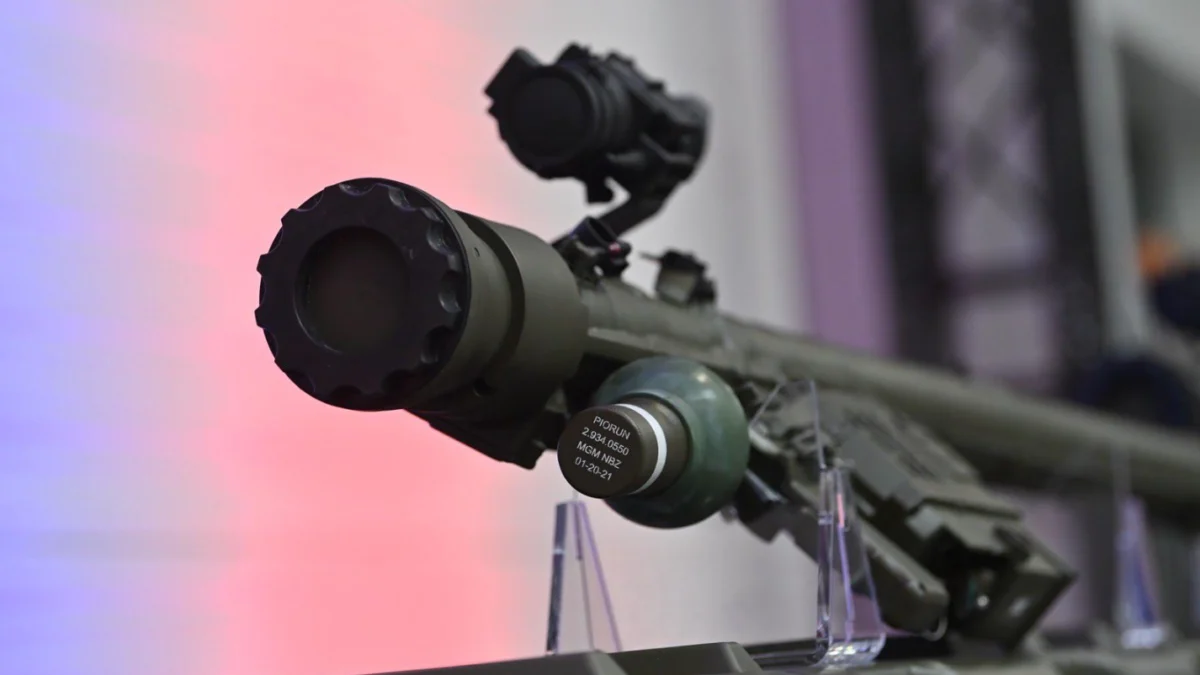
The Piorun is more than just a missile; it is an integrated sensor and engagement suite designed for the modern, complex aerial battlefield. Its technical specifications address the specific threats posed by drones and low-flying aircraft.
Key Enhancements
The Piorun’s evolution from the Grom includes several critical upgrades:
- Homing Head Sensitivity: A redesigned, highly sensitive seeker allows the missile to lock onto smaller heat signatures, significantly increasing the probability of kill (Pk) against modern aircraft.
- Jamming Resistance: Advanced digital signal processing allows the system to distinguish between actual targets and sophisticated infrared countermeasures (flares) deployed by enemy aircraft.
- Proximity and Directional Warhead: While the original design relied on an impact fuse, the Piorun incorporates a proximity fuse combined with a directional warhead. This is particularly lethal against small-to-medium Unmanned Aerial Vehicles (UAVs), which are often too small for traditional impact-fused missiles to neutralize effectively.
- Operational Versatility: The system now includes a user authorization mechanism—preventing unauthorized use—and a state-of-the-art optoelectronic sight, enabling effective engagement during nighttime operations.
Official Responses and Strategic Vision
The announcement ceremony, led by Poland’s Deputy Prime Minister and Minister of National Defense, Władysław Kosiniak-Kamysz, served as a platform to articulate the geopolitical importance of the deal.
"This contract is the largest in history for the purchase of Piorun MANPADS," Kosiniak-Kamysz stated. "It is the first agreement of this type where the consortium is formed not by a company, but by a state. We are setting a precedent for how European nations can and should cooperate to secure their skies."
Magdalena Sobkowiak-Czarnecka, Secretary of State at the Polish Ministry of National Defense, highlighted the international demand for the platform. "There is probably no country in the European Union where, during discussions about the SAFE mechanism, I haven’t been asked about the possibility of purchasing Piorun missiles," she noted. "The Piorun is our export hit. I can say that openly today, especially because this product is also being utilized by the US Army."
Implications: A New Era for European Defense
The significance of this agreement extends far beyond the number of missiles delivered. It represents a fundamental shift in the European defense industrial base (EDIB).
1. Strengthening the Eastern Flank
For Lithuania, Latvia, and Poland, the Piorun provides a vital defensive layer. As Russia continues to modernize its aerial and drone capabilities, the ability to deny airspace to low-flying threats is critical for both the protection of ground forces and the security of civilian infrastructure.
2. Standardization as a Force Multiplier
By procuring the same system, the EDIRPA consortium members can streamline logistics, training, and maintenance. This creates a "commonality effect" where soldiers from Poland, Lithuania, Latvia, and Norway can potentially operate within each other’s frameworks, significantly enhancing interoperability.
3. The Future of Naval Integration
The reach of the Piorun is expanding beyond ground operations. During the recent Eurosatory exposition in Paris, a collaboration between Naval Group, MESKO, and Telesystem demonstrated the potential for integrating Piorun missiles into Naval Group’s "Rampart" system. This could potentially allow for the deployment of Piorun on naval vessels, further increasing its utility as a versatile, multi-domain air defense solution.
4. Economic and Industrial Resilience
For the Polish Armaments Group (PGZ) and MESKO, the contract is a massive vote of confidence. It ensures the long-term viability of their production lines and signals to the global market that Poland is a reliable, high-tech partner in the defense sector.
Conclusion
The $2.16 billion Piorun procurement is more than a commercial transaction; it is a declaration of strategic intent. In an era where the security architecture of Europe is being challenged, the ability of four nations to jointly acquire and deploy a proven, high-performance defense system demonstrates the efficacy of the EU’s EDIRPA mechanism.
As deliveries proceed through 2030, the Piorun will undoubtedly remain a cornerstone of VSHORAD capabilities across the continent. By combining technological modernization with deep international cooperation, the EDIRPA consortium has sent a clear message: the protection of the European sky is a shared, industrialized, and non-negotiable priority.