Every data scientist has experienced the "too good to be true" moment. You finish training a model, check the metrics, and see a 99% accuracy rate. Instead of popping champagne, you feel a cold shiver down your spine. Nine times out of ten, that perfect score isn’t a breakthrough in machine learning; it is the manifestation of data leakage—a phenomenon where information from outside the training scope inadvertently sneaks into the model, creating a "shortcut" that makes the model appear far more capable than it actually is.
Data leakage is the silent killer of predictive modeling. It occurs when a feature—either by design or through an error in the preprocessing pipeline—acts as a proxy for the target variable, essentially giving the model the answers to the test before it even begins. While human intuition is the traditional defense against this, the increasing complexity of modern data pipelines makes it easy for even seasoned professionals to overlook subtle structural errors.

This raises a critical question in the age of generative AI: Can Large Language Models (LLMs) serve as an automated, objective auditor for our data pipelines? To find out, we conducted an experimental study across four real-world data science projects to see if Claude models could detect systemic leakage before a single line of code was executed.
The Experimental Framework
To move beyond theoretical discussions, we focused on two primary objectives. First, we sought to quantify the "accuracy jump" caused by leakage in realistic, non-toy datasets. Second, we wanted to determine whether an AI model, when provided with a plain-language description of a pipeline, could identify these flaws without any prior hint that the pipeline was compromised.
We selected four distinct projects, each featuring a common, well-known leakage pattern:
- Target-Defining Features: Information that mechanically defines the label.
- Temporal Foresight: Building features based on future data.
- Relational Misalignment: Ignoring the hierarchical or relational structure of data during splits.
- Incorrect Preprocessing Order: Performing data transformations before the training/test split.
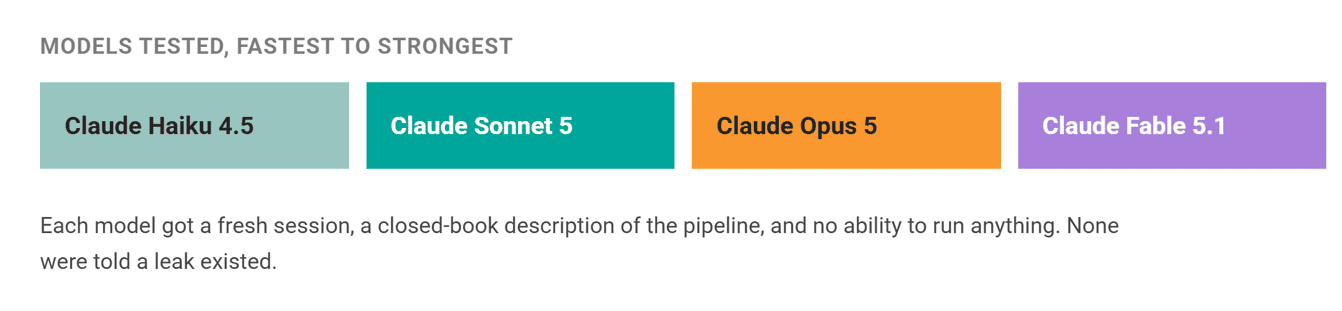
We evaluated four models from the Anthropic Claude family—Haiku 4.5, Sonnet 5, Opus 5, and Fable 5.1—ranging from high-speed, cost-efficient models to the most robust, high-reasoning capabilities available. To ensure the integrity of the experiment, each model was given a "closed-book" prompt: a fresh session, zero prior knowledge of the leakage, and no ability to execute code. They were asked only one thing: "Review this pipeline and identify any issues that would make these results untrustworthy."
Chronology of the Leakage Experiments
Case 1: The "Answer Key" Feature
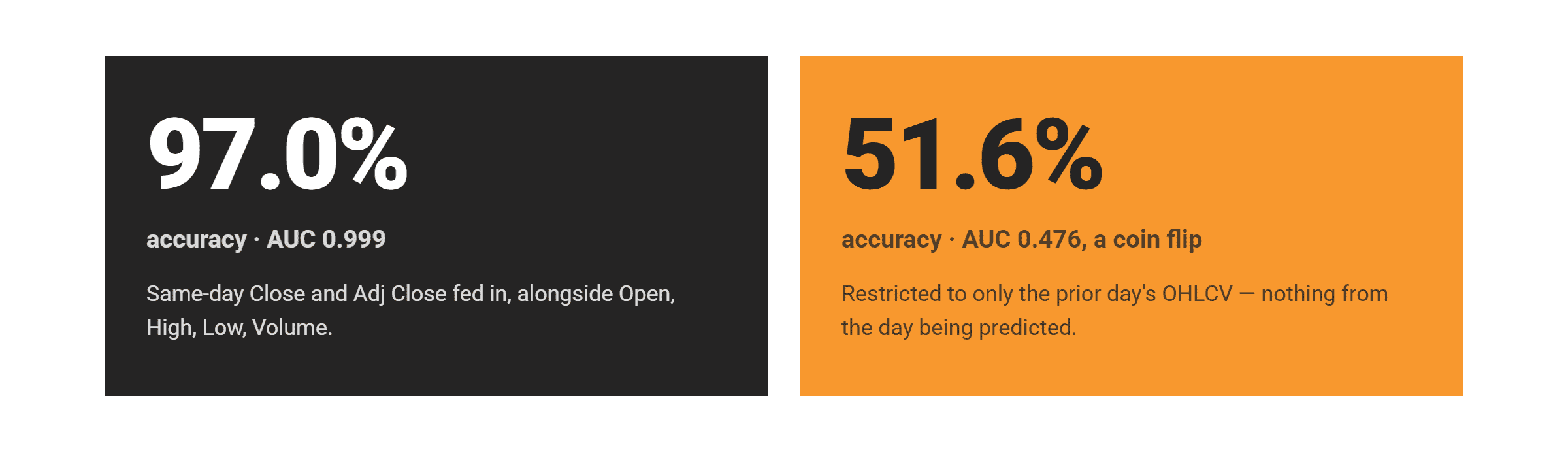
Our first project involved predicting stock price direction for Amazon. The task was simple: determine if the closing price would be higher than the opening price for a given day. In the "leaked" version, we included the day’s Close and Adj Close as features.
The results were staggering. With the leak included, the model achieved 97% accuracy and an AUC of 0.999. When the leak was removed—restricting the model to only historical, prior-day data—the accuracy plummeted to 51.6%, effectively a coin flip. This massive delta illustrates the danger of features that act as direct components of the label. Every AI model tested correctly identified this as "circular," with Opus 5 even correctly predicting that an honest model should hover around 50% accuracy.

Case 2: The Temporal Shuffle
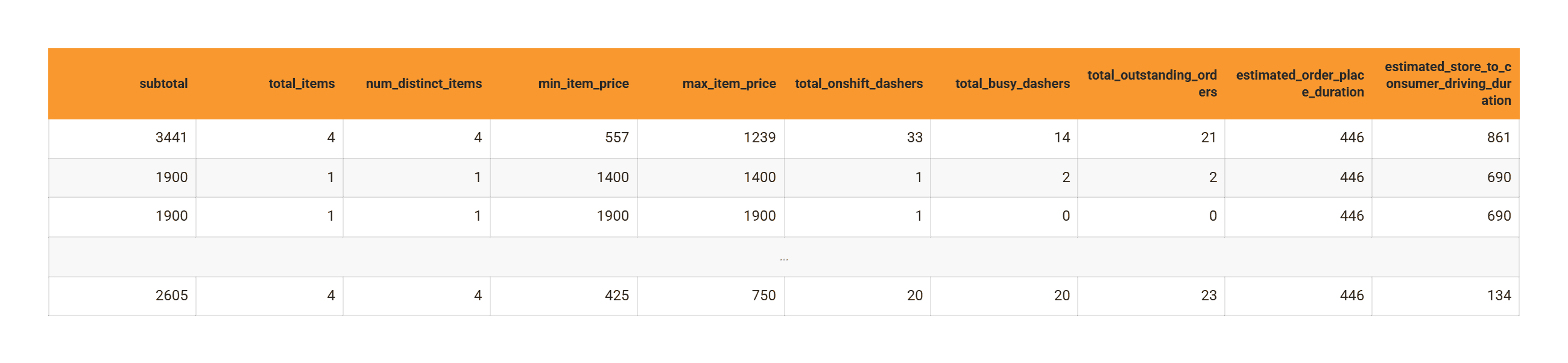
For this case, we analyzed delivery duration for DoorDash. The leak here was twofold. We engineered a store_avg feature using the entire dataset (including test rows) and shuffled the timestamped data before splitting it.
The leaked model reported an RMSE (Root Mean Squared Error) of 862.7 seconds, whereas the honest model reported 949.9 seconds. While the 9% difference seems modest, it represents a fundamental failure in chronological integrity. While all models caught the store_avg issue, only the more advanced models (Sonnet, Opus, and Fable) caught the temporal shuffling error unprompted. Fable’s analysis was particularly sharp, noting that the training set effectively contained "future" information.
Case 3: Structural Leakage
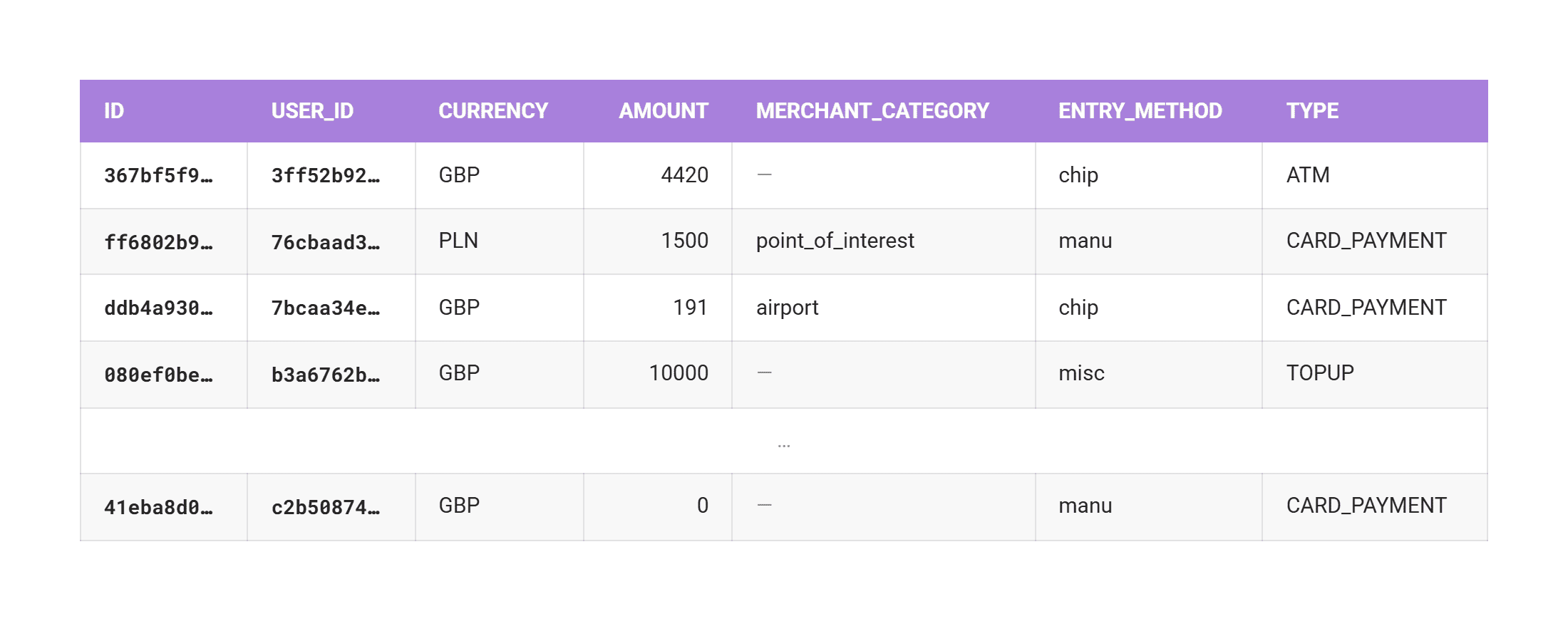
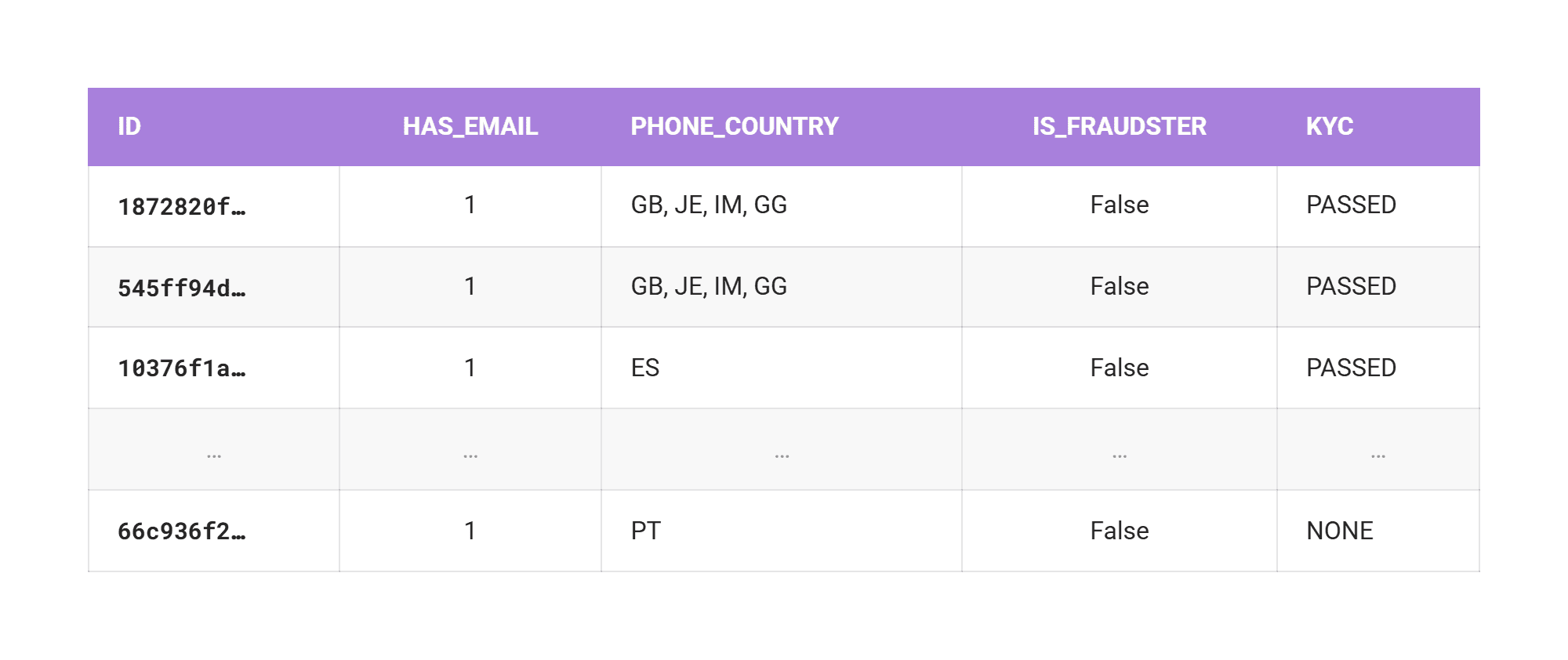
In a fraud detection project for Revolut, we dealt with a one-to-many relationship: one user, many transactions. When we performed a random row-level split, we accidentally allowed the model to see different transactions from the same user in both the training and testing sets.
The result was a fraudulent performance boost, with an AUC of 0.960 compared to the honest 0.898. All four models immediately flagged the mechanism: because the label exists at the user level, a row-level split creates a "memory effect" where the model recognizes the user rather than detecting fraud.
Case 4: The Preprocessing Trap
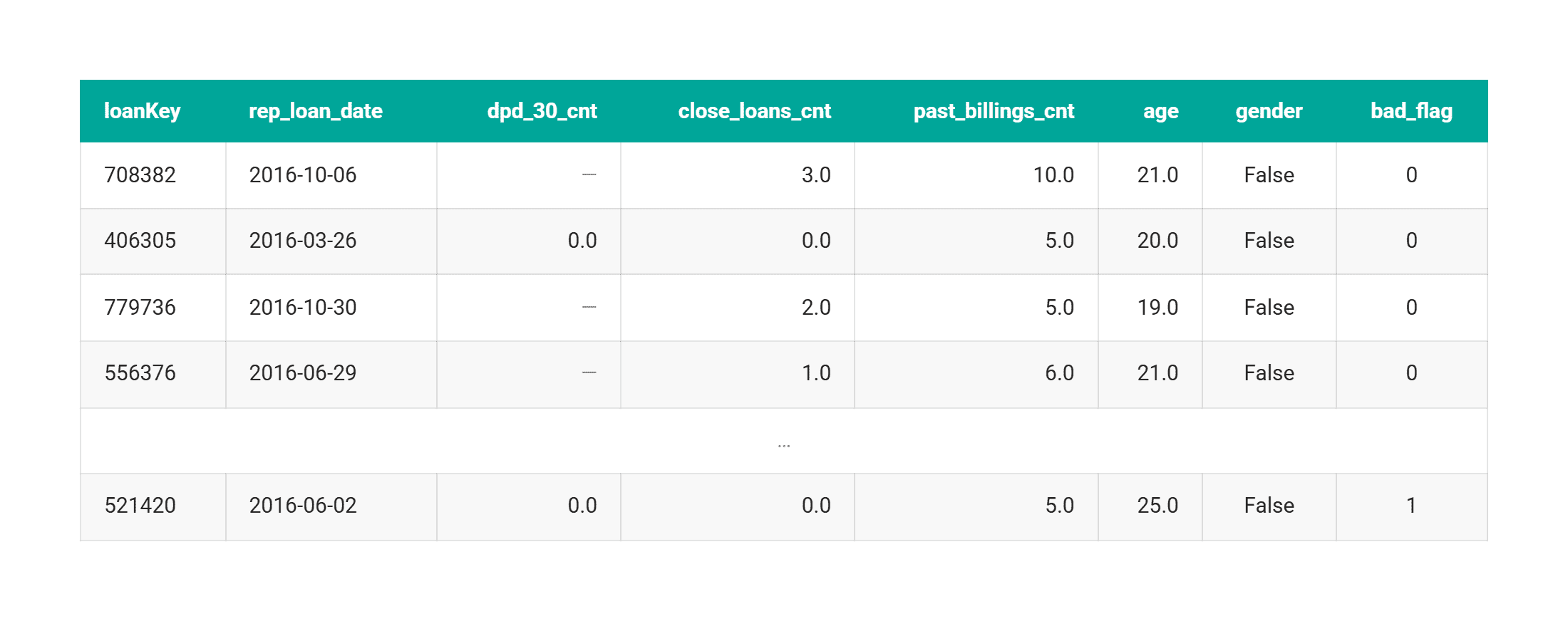
Finally, we examined a loan-flagging project for Chime. The pipeline oversampled the minority class (to handle imbalance) before the train/test split. This led to identical copies of the same loan records appearing in both sets.
This is a classic error. The oversample-then-split approach yielded an AUC of 0.986, while the corrected split-then-oversample method returned a more realistic 0.637. All models flagged this immediately, despite having no access to the data or accuracy metrics, proving that the structural logic of the code was sufficient for the AI to identify the flaw.

Supporting Data and Performance Analysis
The following table summarizes the performance discrepancy between models that rely on "leaky" data versus those that operate on clean, honest data:
| Project | Leakage Type | Leaky Performance | Honest Performance |
|---|---|---|---|
| Amazon Stock | Target Definition | 97.0% Accuracy | 51.6% Accuracy |
| DoorDash | Temporal Foresight | 862.7 RMSE | 949.9 RMSE |
| Revolut Fraud | Relational Split | 0.960 AUC | 0.898 AUC |
| Chime Loans | Preprocessing Order | 0.986 AUC | 0.637 AUC |
The data confirms that the impact of leakage is not uniform. In cases involving direct target definitions, the degradation is catastrophic. In cases involving temporal or structural leakage, the impact is more insidious, creating a "false sense of competence" that can lead to significant real-world failures if the model is deployed.
Official Perspectives and Model Capability
The experiment revealed a clear hierarchy of capability. While all models were proficient at identifying the primary leak, the depth of their critique varied:
- Claude Haiku (Fast/Cost-Efficient): Excelled at identifying the "obvious" leak but occasionally missed secondary, deeper architectural flaws in complex scenarios.
- Claude Sonnet and Fable (Balanced): These models acted as reliable senior auditors. They caught the primary issues and the more complex secondary leaks, such as the temporal split error.
- Claude Opus (High Reasoning): Opus stood out by providing contextual meta-analysis. It didn’t just point out the leak; it offered baseline expectations for performance, suggested alternative validation strategies, and even questioned the underlying logic of the features themselves.
It is important to note that these models were not "trained" on these specific datasets. Their ability to catch these leaks comes from a fundamental understanding of machine learning best practices and the logical flow of data pipelines.
Implications for Data Science Teams
The implications for the industry are profound. Data leakage remains one of the most common reasons for model failure in production. The fact that an AI can, with zero context, look at a written description of a pipeline and identify flaws suggests a shift in how we approach code review.
1. AI as a Mandatory Audit Step
Every data science team should incorporate an AI-assisted "pre-mortem" phase into their model development lifecycle. Before running a training job, the pipeline architecture should be reviewed by an LLM. It is cheap, fast, and serves as a highly effective sanity check.

2. Beyond Human Bias
Human developers often suffer from "tunnel vision." When we write code, we are often too focused on the mechanics—the syntax and the library calls—to see the structural logic errors. An AI, by contrast, evaluates the pipeline as a logical flow, making it naturally inclined to flag "circular" or "future-facing" dependencies that a human might overlook.
3. The Need for "Honest" Benchmarking
The most important takeaway is that accuracy is not a proxy for validity. As this experiment demonstrated, a model with 99% accuracy can be fundamentally broken. Teams must move toward "honest benchmarking," where models are evaluated based on their ability to generalize to unseen, chronologically separated data, rather than their ability to memorize training patterns.
Conclusion
Data leakage is not an exotic or rare occurrence; it is a recurring trap in the lifecycle of any predictive project. Our experiment proves that the tools to prevent these errors are already at our disposal. By using AI as an architectural auditor, we can catch these leaks before they manifest as misleading metrics.
While the fastest models are capable of spotting the most glaring errors, the more advanced models offer the nuance required to catch deeper, more complex structural flaws. Ultimately, whether you are using a junior or senior model to assist you, the practice of asking for an outside perspective—even a digital one—is a fundamental step toward building more reliable, trustworthy, and effective machine learning systems. In the race for higher accuracy, the most important performance metric remains the integrity of the data itself.