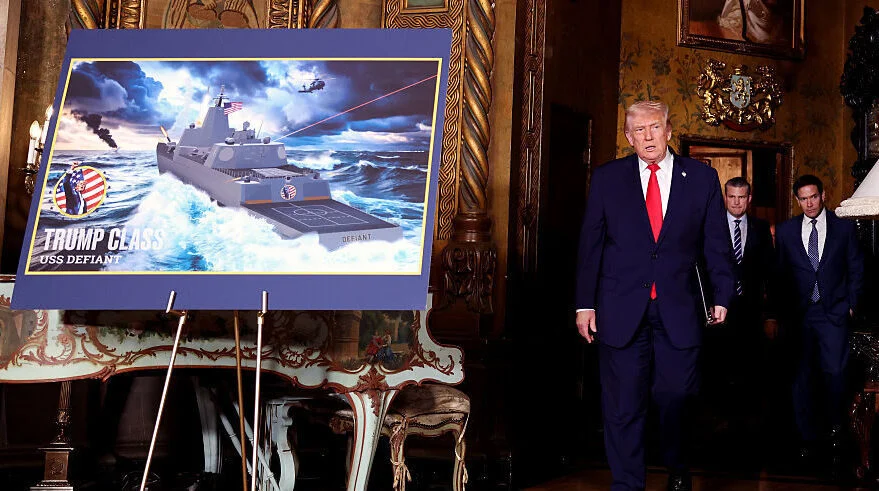
WASHINGTON — The United States Navy is embarking on a monumental shift in maritime doctrine, centered on the construction of the "Trump-class" battleship—a vessel intended to be the cornerstone of the administration’s ambitious "Golden Fleet" initiative. According to a new report released today by the Congressional Budget Office (CBO), the financial commitment required for this program is staggering. The total cost for a fleet of 15 nuclear-powered battleships is projected to reach $275 billion, a figure that has ignited intense debate regarding fiscal responsibility, strategic utility, and the future of surface warfare.
The Cost of Power: A Financial Breakdown
The CBO’s latest assessment provides a sobering look at the economic reality of the Trump-class program. The lead ship, the first of its kind, is expected to carry a price tag of approximately $23.4 billion. While subsequent vessels are projected to benefit from economies of scale, averaging $18 billion each, the aggregate cost remains unprecedented in the history of naval shipbuilding.
These figures represent a significant escalation from earlier estimates. In January, the CBO projected that the lead ship could cost roughly $20.6 billion. The jump to $23.4 billion is attributed largely to the decision to utilize nuclear propulsion, a design choice that adds roughly 13 percent to the total program cost compared to conventional power.
However, the budget may be subject to further volatility. The Navy’s current justification documents suggest that while the initial design sits at 35,000 tons, the final displacement could range up to 41,000 tons. The CBO warns that if the ship reaches the higher end of that spectrum, the cost of the lead vessel could balloon by an additional 16 percent, further straining an already burdened defense budget.
Chronology of a Golden Fleet
The genesis of the Trump-class battleship can be traced back to December 2025, when President Donald Trump formally announced the "Golden Fleet" initiative. The vision was clear: to return to an era of massive, high-impact surface combatants capable of projecting power through sheer scale and advanced weaponry.
- December 2025: President Trump unveils the "Golden Fleet" initiative, placing the Trump-class battleship at the heart of future naval modernization.
- January 2026: The CBO releases initial estimates, placing the cost of the first vessel at $20.6 billion.
- April 2026: Navy budget documents reveal a request for $1 billion in advance procurement and $837 million in research and development for the 2027 fiscal year.
- May 2026: The Navy confirms the battleship will be nuclear-powered, utilizing the same reactor technology found in the Gerald R. Ford-class aircraft carriers. Simultaneously, the House Armed Services Committee pushes the Navy to finalize design specifications.
- Today: The CBO releases its comprehensive report, setting the current program total at $275 billion for 15 ships.
The Navy’s procurement strategy is currently scheduled to span three decades, with the lead ship slated for order in 2028 and the final ship in the 15-vessel class expected to be completed by 2056.
Engineering a Titan: Technical Specifications
At 35,000 to 41,000 tons, the Trump-class battleship would dwarf modern surface combatants. For perspective, these vessels would be approximately three and a half times the size of an Arleigh Burke-class destroyer, the current workhorse of the U.S. Navy.
The integration of the Gerald R. Ford-class nuclear reactor is intended to provide the massive electrical power required for the ship’s primary weapon systems. These systems reportedly include:
- Hypersonic Missiles: Designed for rapid, long-range strikes against time-sensitive targets.
- Electronic Rail Guns: Providing high-velocity kinetic energy strikes without the need for traditional chemical explosives.
- Directed-Energy Weapons: High-powered lasers designed for point defense against drones and missiles.
- SLCM-N: The nuclear-armed sea-launched cruise missile, which adds a layer of strategic nuclear deterrence to the platform.
While the exact number of nuclear-tipped cruise missiles remains classified, analysts suggest the Trump-class will serve as a significant nuclear deterrent, second only to the Ohio-class ballistic missile submarines, which currently carry the bulk of the nation’s sea-based strategic warheads.
Official Responses and Strategic Implications
The Navy’s leadership has defended the battleship as a necessary evolution. Chief of Naval Operations Adm. Daryl Caudle has consistently emphasized the platform’s role in maintaining maritime dominance. During hearings in May, Adm. Caudle argued that the sheer durability and firepower of the Trump-class would force adversaries to rethink their regional strategies.
However, the CBO report highlights a "highly uncertain" environment. The estimate of $23.4 billion is predicated on a specific industrial approach: one shipyard handling final assembly while a distributed network of smaller shipyards constructs individual sections. Should this logistical chain face disruptions—a common occurrence in large-scale defense projects—the cost could spiral even further.
The Trade-off: Operational Costs vs. Procurement
One of the primary arguments in favor of nuclear propulsion is the long-term reduction in operating expenses. By eliminating the need for frequent refueling, the Navy expects to save significant sums over the ship’s 40-to-50-year service life. Yet, the CBO admits that it currently lacks the granular data to calculate these savings, noting that such figures depend entirely on the final design efficiency and the specific propulsion plant architecture.
Implications for Global Security
The decision to field 15 such vessels represents a profound strategic pivot. Historically, the battleship era ended with the rise of the aircraft carrier and the guided-missile destroyer. The return to a "battleship-centric" fleet suggests that the U.S. believes future conflicts in the Pacific or elsewhere will require ships that can sustain significant damage while delivering heavy ordnance in high-intensity combat zones.
However, the move is not without its critics. Budget hawks in Congress have expressed concern that the $275 billion investment could cannibalize funding for other critical areas, such as unmanned surface vessels, cyber-warfare capabilities, and the maintenance of the existing fleet. There is also the question of survivability; in an age of precision long-range anti-ship missiles, some naval theorists argue that concentrating so much firepower—and cost—into a single hull creates a "high-value target" that could be vulnerable to modern saturation attacks.
Conclusion: A Historic Crossroads
As the Navy prepares for the 2028 procurement start date, the Trump-class battleship stands as a polarizing symbol of American naval ambition. Whether it becomes the ultimate instrument of 21st-century deterrence or a case study in fiscal overreach remains to be seen.
For now, the project continues to move forward, backed by the administration’s "Golden Fleet" mandate and the Navy’s insistence that the future of the sea depends on the return of the battleship. With $275 billion on the line, the stakes for the U.S. maritime strategy have never been higher. As the CBO concluded in its summary, the program relies on a complex web of design, industrial capacity, and geopolitical resolve—all of which remain under intense scrutiny as the lead ship moves closer to the drawing board.