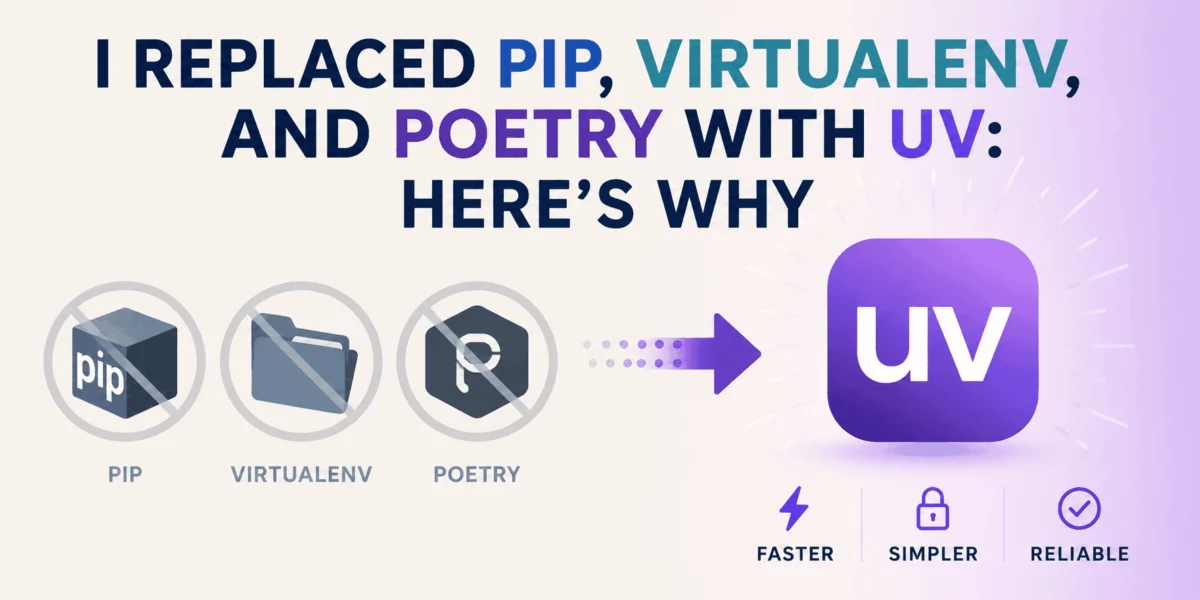
For decades, the Python ecosystem has been defined by a "choose your own adventure" approach to dependency management. Developers have long navigated a fragmented landscape of pip, virtualenv, conda, poetry, pyenv, and pip-tools. While this variety offered flexibility, it also birthed the infamous "Python packaging mess"—a state of affairs characterized by global environment pollution, inconsistent dependency resolution, and sluggish installation times.
However, a paradigm shift is underway. With the rise of uv, a high-performance Python package and project manager developed by Astral, the community is moving toward a unified, high-speed standard. By replacing a dozen disparate tools with a single, Rust-based executable, uv is promising—and delivering—a cleaner, faster, and more professional developer experience.
The State of the Python Ecosystem: A Historical Context
To understand the impact of uv, one must first appreciate the historical friction in Python development. Historically, the standard toolset was built on a series of incremental additions rather than a cohesive design.
The Fragmented Workflow
- The Early Days:
pipbecame the de facto package installer, but it lacked the ability to manage isolated environments, necessitatingvirtualenv. - The Complexity Surge: As projects grew, developers required reproducibility. This led to the adoption of
pip-toolsfor lock files andpyenvfor managing multiple Python versions on a single machine. - The Modern Era: Tools like
Poetryattempted to consolidate these needs by offering a holistic management system. While effective, many foundPoetryto be heavy, resource-intensive, and slow, particularly when performing dependency resolution for complex data science stacks involvingPyTorchorTensorFlow.
This fragmentation led to a common developer headache: managing requirements.txt for simple scripts, pyproject.toml for applications, and a constant, manual toggling of virtual environments. The overhead of context switching between these tools often consumed more time than the actual coding process.
The Arrival of ‘uv’: A Technical Consolidation
uv represents the first major attempt to bring the entire lifecycle of a Python project—from environment creation and Python version management to dependency locking and execution—under a single, ultra-fast roof.
What Makes uv Different?
Developed by Astral, the same team behind the ubiquitous Ruff linter, uv is written in Rust. This architectural choice is not merely a stylistic preference; it is the engine of its performance. By leveraging low-level system optimizations, uv achieves speeds 10 to 100 times faster than pip.
It effectively serves as a drop-in replacement for:
- Package Management:
pip,pip-tools. - Environment Management:
virtualenv,venv. - Project Management:
Poetry,PDM. - Tool Management:
pipx. - Python Versioning:
pyenv.
Chronology of the Adoption Curve
The adoption of uv has followed a swift, exponential trajectory within the developer community, moving from a niche experimental tool to a core component of modern CI/CD pipelines.
- The Announcement: When Astral first introduced
uv, the focus was purely on speed, marketing it as a drop-in, high-speed replacement forpip. - The Expansion: Recognizing that speed alone wouldn’t solve the "workflow mess," Astral quickly expanded
uvto include dependency management and lock files, effectively challenging tools likePoetry. - The Maturity Phase: The current phase is marked by the integration of Python version management, allowing developers to download and manage Python interpreters without needing external tools like
pyenv. - Industry Integration: Today,
uvis being integrated into major platforms and CI environments, where its speed in creating virtual environments drastically reduces the duration of build steps, saving companies thousands in compute costs.
Supporting Data: The Speed Factor
In benchmark tests conducted by Astral and verified by independent developers, the performance gap is stark. While traditional pip installs rely on synchronous, network-bound operations and Python-based resolution, uv utilizes an asynchronous, multi-threaded approach.
For instance, in a clean environment installation of a heavy data science stack (e.g., scikit-learn, pandas, transformers), pip may take upwards of 30 to 60 seconds to resolve and install dependencies. uv consistently completes the same task in under two seconds. This performance isn’t just a "nice-to-have"; it is a critical optimization for modern CI/CD pipelines where container images are built and destroyed dozens of times a day.

Official Stances and Community Consensus
The official stance from the Python Packaging Authority (PyPA) has long been that "there is no single right way" to manage packages. However, the community’s response to uv has been overwhelmingly positive.
Prominent figures in the Python ecosystem have praised the tool for its adherence to PEP standards. Unlike some previous tools that attempted to reinvent the wheel, uv respects existing standards like pyproject.toml, ensuring that it remains interoperable with the rest of the Python ecosystem.
- The Pro-uv Stance: Proponents argue that by reducing the "cognitive load" of managing tools, developers can focus on writing logic. It creates a standardized interface that is easy to teach newcomers.
- The Cautionary Stance: Skeptics, particularly those in the data science community, often point to
conda.condahandles non-Python dependencies (like C++ libraries and CUDA drivers) in a way thatuvis not currently designed to replicate. Therefore, the consensus is thatuvis a "Python-first" tool, whilecondaremains a "system-environment" tool.
Implications for the Future of Python Development
The shift toward uv signals a maturing of the Python ecosystem. It suggests that the community is moving past the phase of "experimentation" and into a phase of "standardization."
Reduced Onboarding Friction
For teams, the implication is significant. New hires no longer need to spend their first day configuring pyenv, installing poetry, and wrestling with global Python paths. A project using uv can be initialized, synced, and run with a single command (uv run), ensuring that every team member is working in an identical, isolated environment.
The "vibe coder" vs. The "Engineer"
While AI-assisted coding tools are currently optimized for standard pip workflows, it is expected that as uv gains market share, these AI models will update their training data to favor uv. Currently, for those relying heavily on AI to generate boilerplate, sticking to traditional pip may avoid some friction, but this is a temporary state of affairs.
The Consolidation of Tools
The long-term implication of uv is the likely obsolescence of several smaller, single-purpose packaging utilities. As developers consolidate their workflows, the "messy" ecosystem of the 2010s will likely be replaced by a streamlined, high-performance set of industry standards.
Final Thoughts: Should You Migrate?
The decision to migrate to uv should be based on your specific use case. If you are a beginner in data science, conda remains an invaluable safety net for handling complex system-level dependencies. However, for the vast majority of Python application developers, web engineers, and library maintainers, uv is no longer just an alternative—it is the new default.
By adopting uv, developers aren’t just saving seconds on installs; they are buying back hours of frustration. In an industry that prioritizes productivity and clean architecture, uv is the most significant leap forward in Python tooling in over a decade. It transforms the Python project lifecycle from a chore into a seamless, high-speed, and reliable process.
For those ready to make the switch, the installation is trivial, and the backward compatibility with existing requirements.txt files means you can start small—using it as a faster pip—before fully committing to the modern uv project workflow.