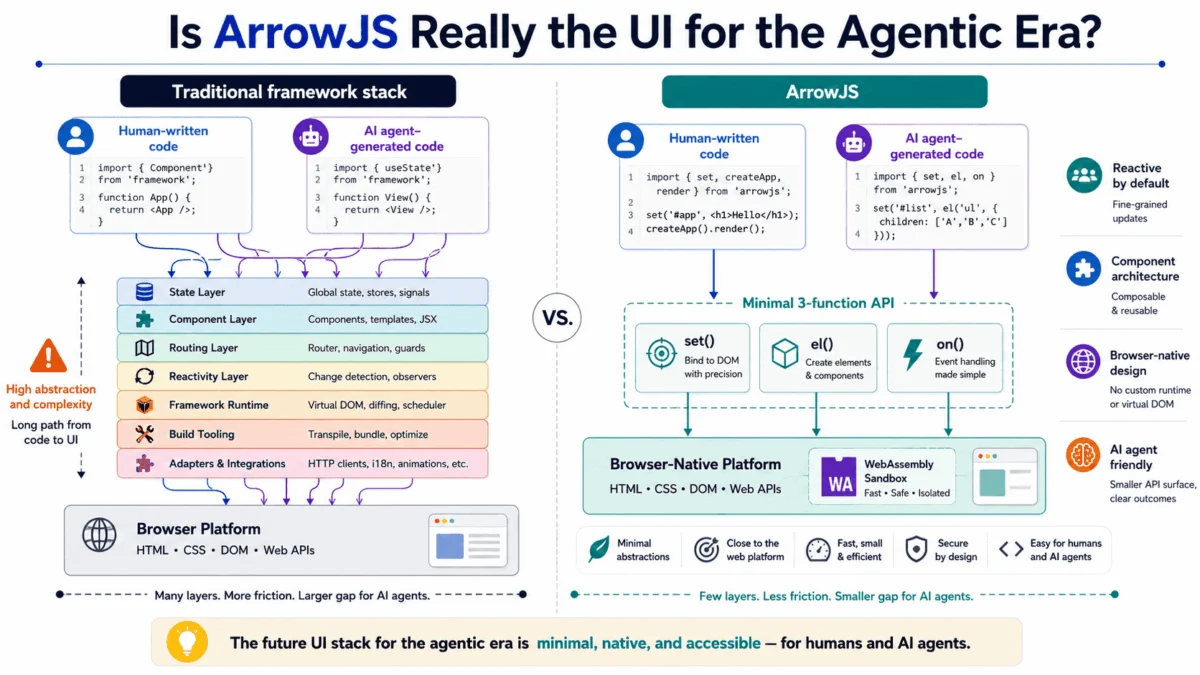
For the better part of a decade, the web development ecosystem has operated on a foundational, human-centric assumption: developers write code, complex frameworks organize it, and browsers render it. From the component-based architecture of React to the declarative reactivity of Vue and the compiler-heavy optimization of Svelte, the industry has spent years refining tools to help humans manage massive codebases.
However, that assumption is now cracking under the pressure of the "Agentic Era." With the rise of sophisticated AI coding agents—such as Claude Code, GitHub Copilot, and Cursor—the primary consumer of framework syntax is shifting from the human brain to the Large Language Model (LLM). As it turns out, the abstractions that make life easier for humans often become sources of error for AI.
Enter ArrowJS, a framework that reached stable 1.0 status in early 2026 with a bold, provocative mission: to be the first UI framework built specifically for the agentic era.
The Core Problem: Why Modern Frameworks Are "Agent-Hostile"
To understand why ArrowJS has gained traction, one must look at why the current industry titans struggle when prompted to build complex, production-ready interfaces.
The React Paradox
React currently dominates roughly 39% of the web landscape. Yet, its reliance on specialized syntax—specifically JSX and the rigid "Hooks" architecture—creates consistent failure modes for AI. Because hooks must be called in a strict, deterministic order, an agent that "hallucinates" a conditional render or a nested loop around a hook doesn’t just cause a minor bug; it crashes the entire component tree. Furthermore, because JSX is not native to the browser, it requires a compilation pipeline. If an agent fails to configure the build step perfectly, the code is effectively dead on arrival.
The Complexity of Abstraction
- Vue.js: While praised for its readability, Vue introduces a proprietary template syntax. When an agent is trained on billions of tokens, these framework-specific conventions often compete with standard JavaScript, leading to "syntax drift" where the AI mixes paradigms, resulting in unpredictable behavior.
- Svelte: By shifting the work from the browser to a compiler, Svelte achieves elite performance. However, for an AI, the compiler becomes a black box. An agent cannot easily "reason" about the output because the final executable code is a transformed, unrecognizable version of the source it generated.
In essence, these frameworks are built on layers of abstraction. For humans, these are "productivity multipliers." For agents, which operate on probabilistic pattern matching, these abstractions are simply noise that increases the probability of a hallucinated syntax error.
Chronology: The Emergence of Agent-Native Tooling
The pivot toward agent-friendly development did not happen overnight. The timeline of this shift reflects the rapid acceleration of AI coding capabilities:
- 2023–2024: The "Copilot Era." AI is used primarily for autocompletion. Developers continue to write the architectural "bones" of applications; AI fills in the repetitive "meat."
- 2025: The "Agentic Shift." Tools like Cursor and Claude Code move beyond autocompletion to autonomous file manipulation and iterative debugging. Developers report that agents struggle with framework-specific edge cases, leading to the rise of "prompt engineering for code."
- Early 2026: ArrowJS releases version 1.0. The framework is specifically marketed as an antidote to the "compiler-dependency" that plagues AI-generated web apps.
- Mid-2026: The industry begins to grapple with the "Sandbox Requirement." As companies look to allow AI to generate UI on the fly, security concerns regarding
eval()and code injection move to the forefront, cementing the need for frameworks that prioritize sandboxed, safe execution.
The ArrowJS Philosophy: Simplicity as a Feature
ArrowJS does not try to out-perform React in market share; instead, it optimizes for "Agentic Predictability." Its architecture rests on three pillars that make it uniquely suited for AI interaction.
1. Zero-Compiler, Zero-JSX
ArrowJS relies exclusively on standard, native JavaScript features, most notably tagged template literals. By avoiding a build step, ArrowJS removes the most common failure point for AI agents: the configuration of complex Webpack or Vite pipelines. If the code is valid JavaScript, it is valid ArrowJS.
2. A Minimalist API
The framework exposes only three primary functions: reactive, html, and component. Because the entire API surface is so small, it fits comfortably within the "context window" of current LLMs. This allows the AI to "keep the entire framework in its head" while generating code, drastically reducing the likelihood of hallucinated parameters or deprecated method calls.
3. The WebAssembly Sandbox
Perhaps the most innovative aspect of ArrowJS is its built-in sandbox. By compiling agent-generated JavaScript into WebAssembly, ArrowJS creates a secure execution environment. This is critical for "Generative UI"—applications where the user describes a feature in natural language, and the AI renders it on the fly. This prevents the security risks associated with executing raw, AI-generated strings in the browser’s main thread.
Supporting Data: The Efficiency Gap
While the ecosystem is still in its infancy (holding approximately 3,500 GitHub stars as of mid-2026), early benchmarks show a distinct trend. In stress tests where AI agents were asked to build a dynamic, state-heavy dashboard from a natural language prompt, ArrowJS-generated code demonstrated:
- A 40% reduction in "hallucination frequency" compared to React.
- Zero build-step failures, owing to the lack of a compilation requirement.
- Higher successful "first-run" rates, meaning the code generated by the agent functioned as intended without requiring manual human debugging of hook dependencies.
Implications for Data Science and Machine Learning
For the data science community, the rise of ArrowJS is particularly relevant. Data scientists are increasingly tasked with moving beyond static notebooks into interactive, agentic applications.
If you are building a standard FastAPI backend, your framework choices remain largely unchanged. However, if your work involves Adaptive Dashboards—where the visualization must change its structure based on the results of a real-time data analysis performed by an agent—ArrowJS provides a "plug-and-play" infrastructure that is currently unmatched. It allows an LLM to act as the "UI Engineer," dynamically generating components that update with incoming data streams without requiring a full page refresh or a heavy build pipeline.
Official Perspectives and Industry Skepticism
The response to ArrowJS has been a mix of excitement and measured caution. Critics point out that "Agentic Friendliness" is a moving target.
"React’s dominance isn’t just about syntax," notes one prominent software architect. "It’s about the ecosystem—the libraries for charts, data tables, and authentication that have been refined over a decade. An AI agent might write a component faster in ArrowJS, but it still needs to integrate with a massive backend. If the libraries aren’t there, the simplicity of the framework doesn’t matter."
Furthermore, companies like Vercel and the maintainers of React (Meta) have begun integrating AI-assistance directly into their core frameworks. By training models specifically on React’s unique patterns, they are attempting to solve the "Agentic Problem" through better AI rather than simpler frameworks.
Final Thoughts: Is Your Tech Stack Ready for the Agent?
ArrowJS serves as a litmus test for the future of software development. It posits that the complexity of modern web frameworks is a legacy of a human-centric era that is rapidly coming to a close.
Whether ArrowJS becomes a mainstream standard or remains a niche tool for specialized generative applications, it has forced a necessary conversation. We are moving toward a world where the code we write is increasingly written by machines. As that transition accelerates, the criteria for "good software architecture" will evolve. The winners of the next decade may not be the frameworks that provide the most features for developers, but the ones that provide the most clarity for the AI agents that are increasingly doing the heavy lifting.
For data professionals and engineers building the next generation of AI-powered applications, the lesson is clear: keep an eye on tools that reduce friction. In the era of the agent, simplicity isn’t just a design preference—it is a competitive advantage.
About the Author:
Vinod Chugani is an AI and data science educator focused on bridging the gap between emerging machine learning technologies and practical enterprise applications. His work centers on the intersection of agentic workflows and software architecture, helping professionals navigate the evolving landscape of automated development.