The commercial space sector is standing on the precipice of a profound paradigm shift. For decades, spacecraft were treated as expendable, single-use assets—launched with a fixed supply of fuel, a predetermined set of instruments, and a finite lifespan. Once a satellite depleted its propellants or suffered a minor component failure, it became expensive space debris, regardless of how advanced its remaining systems were.
This throwaway culture is rapidly drawing to a close. Today, pioneering aerospace companies are actively demonstrating the foundational building blocks of a fully realized orbital logistics network: autonomous rendezvous and proximity operations (RPO), on-orbit refueling, orbital transfer maneuvers, active debris removal (ADR), and complex robotic servicing.
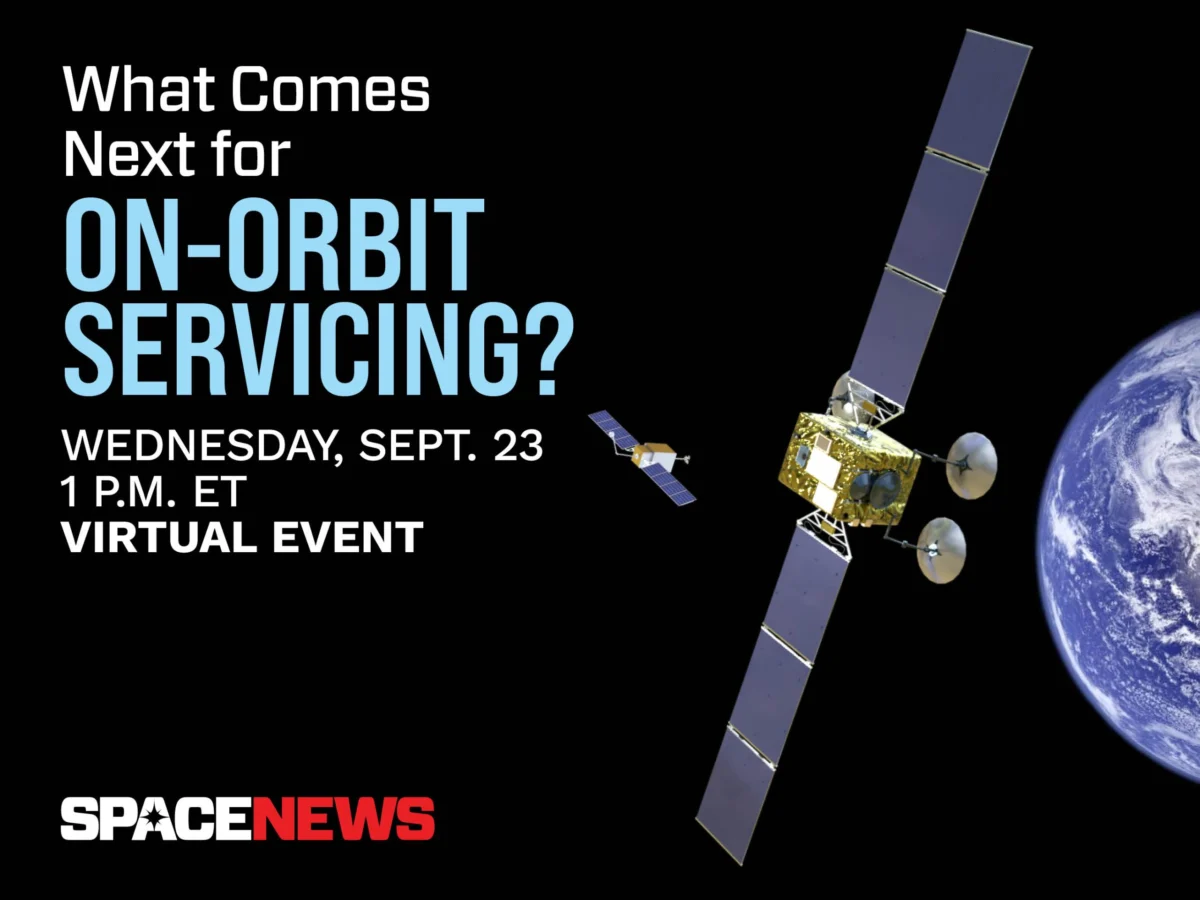
To address the strategic, technical, and regulatory hurdles of this burgeoning sector, SpaceNews will host a highly anticipated virtual panel discussion, "What Comes Next for On-Orbit Servicing?" on Wednesday, September 23, 2026, from 1:00 p.m. to 1:45 p.m. ET. The event will bring together leading minds from across the commercial, civil, and military space sectors to outline the roadmap for a sustainable, resilient, and interconnected in-space economy.
Main Facts: Charting the Next Frontier of Space Logistics
The upcoming SpaceNews virtual event arrives at a critical juncture for the In-space Servicing, Assembly, and Manufacturing (ISAM) industry. While early-stage demonstrations have proven that physical interaction between cooperative spacecraft is technically feasible, the transition from isolated technology demonstrations to a standardized, high-volume commercial market remains incomplete.
The panel will focus on several critical pillars necessary to build a functioning, interoperable orbital ecosystem:
- Market Maturity and Commercial Viability: Identifying which sub-sectors of the ISAM market—such as life extension, active debris removal, in-space manufacturing, or orbital propulsive transfers—will achieve commercial self-sustainability first.
- Technical Standardization: Establishing open-source physical and digital interfaces (such as refueling valves, docking adapters, and communication protocols) to ensure that servicing vehicles from one manufacturer can seamlessly interact with client satellites built by another.
- Government and Regulatory Catalysts: Examining how civil space agencies like NASA and defense organizations like the U.S. Space Force can act as anchor customers, providing the initial demand signals and regulatory frameworks required to de-risk private capital investment.
- Multi-Domain Applications: Exploring how in-orbit logistics will underpin future commercial space stations in Low Earth Orbit (LEO), support sustainable logistics for the Artemis lunar program, and enable "maneuver without regret" capabilities for national security assets.
Chronology: From Experimental Dockings to an Active Orbital Economy (2019–2026)
The realization of on-orbit servicing is the culmination of a decade of accelerating technological milestones, transitioning from highly experimental government-funded research to agile, commercial-led missions.
[2019] SpaceLogistics (Northrop Grumman) launches MEV-1
  │
[2020] MEV-1 historically docks with Intelsat 901 in GEO (First commercial docking)
  │
[2021] MEV-2 docks with active Intelsat 10-02; Astroscale's ELSA-d demonstrates magnetic debris capture
  │
[2023] Orbit Fab launches first operational propellant depot testbeds; US Space Force prioritizes SML
  │
[2024] Astroscale's ADRAS-J successfully inspects non-cooperative rocket upper stage in LEO
  │
[2025] Multiple commercial tugs (Impulse Space, Firefly) enter service; NASA restructures ISAM focus
  │
[2026] Focus shifts to standardization, multi-vehicle interoperability, and commercial scaling- October 2019 – Launch of MEV-1: SpaceLogistics, a wholly-owned subsidiary of Northrop Grumman, launched the Mission Extension Vehicle-1 (MEV-1), the world’s first commercial satellite servicing spacecraft designed to provide life-extension services to satellites in Geostationary Earth Orbit (GEO).
- February 2020 – Historical Docking: MEV-1 successfully docked with the Intelsat 901 satellite, which had been moved to a graveyard orbit. This marked the first time two commercial spacecraft docked in orbit, and the first time servicing was performed on a satellite not originally designed for docking. MEV-1 returned the satellite to active service, extending its operational life by five years.
- April 2021 – Active Servicing Expansion: SpaceLogistics achieved another milestone with MEV-2, which docked with the fully operational Intelsat 10-02 satellite in its active geosynchronous slot, demonstrating the ability to service high-value assets without disrupting their commercial broadcasts.
- August 2021 – Debris Capture Demonstration: Astroscale’s End-of-Life Services by Astroscale-demonstration (ELSA-d) mission successfully demonstrated magnetic capture of a simulated piece of space debris in LEO, showcasing commercial technology designed to mitigate the growing orbital debris crisis.
- 2023 – Refueling Infrastructure and Defense Pivots: Orbit Fab deployed its initial testbeds for the Rapidly Attachable Fluid Transfer Interface (RAFTI), aiming to establish "gas stations in space." Concurrently, the U.S. Space Force formally declared Space Mobility and Logistics (SML) as a core military competency, dedicating significant budget lines to refueling and servicing studies.
- February 2024 – Non-Cooperative Inspection: Astroscale’s Active Debris Removal by Astroscale-Japan (ADRAS-J) spacecraft launched, subsequently maneuvering within meters of an abandoned Japanese H-IIA rocket upper stage. The mission successfully performed fly-around inspections of a non-cooperative, tumbling piece of space debris, proving the precision RPO capabilities needed for future debris removal.
- 2025–2026 – The Proliferation of Orbital Tugs: Commercial orbital transfer vehicles (OTVs) from companies like Impulse Space, Firefly Aerospace, and Launcher (now part of Vast) began offering routine, precise delivery of small satellites to custom orbits, establishing the foundational logistics layer of LEO.
Supporting Data: The Economics of Satellite Life Extension and Debris Mitigation
The transition of the ISAM sector from a novelty to a cornerstone of the space economy is backed by compelling financial and operational data.
Market Size and Growth Projections
According to market intelligence reports from firms like Northern Sky Research (NSR) and Euroconsult, the market for in-orbit servicing, assembly, and manufacturing is projected to generate cumulative revenues exceeding $6.2 billion by 2035.
The primary driver of this growth is satellite life extension in GEO. A typical high-throughput communication satellite in GEO costs between $200 million and $500 million to build and launch, generating upwards of $30 million to $50 million in annual revenue. Extending its operational life by five years using a servicing vehicle costing a fraction of a new build represents an extraordinary return on investment (ROI) for fleet operators.
| Servicing Category | Projected Cumulative Market Share (By 2035) | Primary Drivers |
|---|---|---|
| Life Extension (GEO) | 45% | Propellant replenishment, attitude control takeover, mechanical recovery |
| Last-Mile Delivery (LEO/MEO) | 25% | Constellation deployment, custom orbital insertion by OTVs |
| Active Debris Removal (ADR) | 15% | Regulatory compliance, constellation safety, orbital sustainability |
| Assembly & Manufacturing | 15% | Large aperture antennas, commercial space station modules |
The Orbital Debris Imperative
The physical safety of LEO is rapidly deteriorating. According to the European Space Agency (ESA), there are currently more than 36,500 pieces of space debris larger than 10 centimeters, and over 130 million pieces ranging from 1 millimeter to 1 centimeter in orbit.
As megaconstellations like SpaceX’s Starlink and Amazon’s Project Kuiper continue to populate LEO, the probability of catastrophic collisions increases exponentially. A single collision can generate thousands of high-velocity fragments, triggering a localized Kessler Syndrome. Active debris removal is no longer viewed merely as an environmental ideal, but as an operational necessity to preserve the utility of low Earth orbits.
Stakeholder Perspectives: Government Policy, Military Mandates, and Industry Standardization
For a fully integrated orbital logistics network to succeed, the industry must overcome a complex web of regulatory, geopolitical, and technical hurdles. Stakeholders across the civil, military, and commercial sectors have expressed diverse viewpoints on how the market should be shaped.
Industry Standardization: The CONFERS Initiative
Commercial operators emphasize that widespread adoption of servicing technologies is impossible without standardization. The Consortium for Execution of Rendezvous and Servicing (CONFERS), an industry-led initiative, has been working to establish consensus technical and safety standards for RPO and servicing.

Industry advocates argue that standardizing interfaces, such as Orbit Fab’s RAFTI refueling port, is critical. Without these open-source standards, the market risks fragmenting into proprietary, closed ecosystems, which would stifle innovation and drive up costs for satellite operators.
Military Imperatives: "Maneuver Without Regret"
The United States Space Force (USSF) has emerged as one of the most vocal proponents of on-orbit servicing. Historically, military satellites were designed to conserve fuel, limiting their maneuvers to avoid shortening their operational lifetimes.
Military leadership has expressed a clear desire to transition to a posture of "maneuver without regret." By equipping national security satellites with refueling ports and utilizing commercial refueling tankers, military operators can dynamically maneuver satellites to avoid threats, inspect suspicious objects, and respond to changing tactical situations on the ground without worrying about depleting their non-renewable propellant reserves.
Civil Space Agencies: Enabling Deep Space Exploration
NASA and other civil space agencies view ISAM as a critical enabler for the Artemis program and eventual crewed missions to Mars. Developing the capability to assemble massive structures, manufacture fuel, and repair scientific instruments in the microgravity environment of LEO or lunar orbit is essential.
However, civil agencies also face budgetary constraints and political pressure. NASA’s decision to cancel the long-running OSAM-1 (On-Orbit Servicing, Assembly, and Manufacturing 1) mission in early 2024 highlighted the difficulties of managing complex, state-funded technology development programs, prompting the agency to lean more heavily on commercial partners to lead the technological charge.
Implications: Reshaping Commercial Space Stations, Lunar Architectures, and Defense Operations
The maturation of the in-orbit servicing sector will have profound implications for the future of humanity’s presence in space, fundamentally altering how systems are designed, operated, and sustained.
The Era of Commercial Space Stations
With the planned retirement of the International Space Station (ISS) in the early 2030s, NASA is actively funding the development of Commercial LEO Destinations (CLDs). Consortia led by companies like Axiom Space, Voyager Space, and Vast are designing private space stations.
These modular platforms will rely heavily on an active orbital logistics network. Commercial servicing vehicles will be required to deliver propellants, transport cargo, repair external scientific payloads, and perform routine structural maintenance, replacing the costly, specialized astronaut spacewalks that historically sustained the ISS.
Sustainable Lunar Infrastructure
As the Artemis program moves from initial landing demonstrations to sustained lunar habitation, logistics will become the defining factor of success. The Moon’s gravity well makes launching all necessary consumables directly from Earth incredibly inefficient.
A functioning ISAM ecosystem will enable the transfer of propellants from LEO depots to lunar transfer vehicles, the assembly of large-scale scientific instruments on the lunar gateway, and the recycling of spent rocket stages into orbital habitats or surface shelters.
Redefining Space Warfare and National Security
In the national security domain, the ability to service, refuel, and upgrade satellites in orbit will transform space from a static, vulnerable domain into a highly dynamic environment. Servicing vehicles could be used to upgrade old satellites with state-of-the-art sensors, repair damaged solar arrays, or shield critical assets from directed-energy or kinetic threats.
Conversely, the dual-use nature of these technologies presents a significant diplomatic and defense challenge. A robotic arm capable of repairing a friendly satellite is technically capable of disabling an adversary’s satellite. Establishing clear rules of the road, transparent operational notifications, and international norms of behavior for RPO will be essential to prevent miscalculation and escalation in an increasingly crowded orbital commons.
As the SpaceNews virtual panel on September 23, 2026, approaches, the discussions held will not merely predict the future of space logistics—they will actively help shape the rules, standards, and partnerships that define the next great era of space exploration.