In the rapidly evolving landscape of generative AI, the prevailing development pattern has remained stubbornly inefficient. Most production-grade AI agents, regardless of the complexity of the task at hand, default to the most powerful—and consequently the most expensive and slowest—frontier models available. Whether the system is performing a simple classification, executing a routine tool call, or conducting high-level logical reasoning, the "always-on" use of flagship models like GPT-4o or Claude 3.5 Sonnet is driving up operational costs and latency to unsustainable levels.
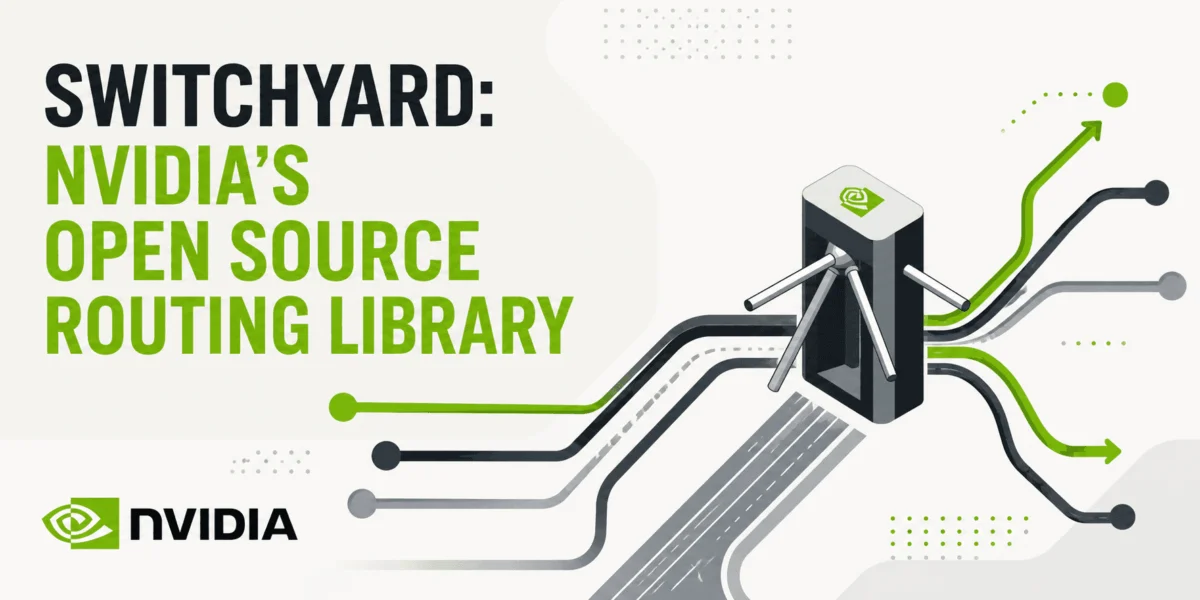
NVIDIA, a leader in the AI infrastructure space, has recognized this bottleneck and introduced NeMo Switchyard, an open-source routing library and proxy layer designed to optimize LLM inference. By abstracting the model selection process away from the application layer, Switchyard allows developers to build intelligent, cost-aware AI agents that dynamically match the model to the task.
The Architecture of Intelligence: What is Switchyard?
At its core, Switchyard serves as a sophisticated intermediary—a "smart traffic controller"—that sits between the application and the upstream model providers. In a standard LLM application architecture, the flow is linear: the application sends a prompt, and the model returns a response. Switchyard disrupts this linearity by injecting a routing layer that can analyze the incoming request, evaluate the state of the conversation, or predict the necessary model tier required to achieve a successful outcome.
The architectural shift is profound. By decoupling the application logic from the specific model endpoint, developers can define "tiers" of models—ranging from high-efficiency, low-cost models (such as GPT-4o-mini or Llama 3 8B) to high-capability, "reasoning" models. Switchyard then selects the appropriate target dynamically, ensuring that resources are allocated based on the complexity of the prompt.
Chronology of Implementation: From Randomness to Reason
Transitioning an existing AI agent to a dynamic routing model requires a methodical approach. The development cycle for integrating Switchyard typically follows a well-defined path from validation to sophisticated, context-aware decision-making.
Phase 1: Installation and Infrastructure Setup
The project leverages the uv package manager, favoring efficiency and speed. Installing the Switchyard server is a straightforward process:
uv tool install "nemo-switchyard[cli,server]"Following verification, developers export their API keys—typically through platforms like OpenRouter, which aggregates multiple model providers into a single interface. The primary objective in this phase is to ensure the routing layer acts as a transparent pass-through, maintaining system health without introducing latency.
Phase 2: A/B Testing with Random Routing
Before implementing complex logic, developers are encouraged to utilize "random routing." By creating a YAML configuration file, one can assign probabilities to different model tiers. For example, routing 30% of traffic to a "strong" model and 70% to a "weak" model allows teams to validate their proxy infrastructure and observe latency profiles without the risk of logic errors. This stage acts as a "smoke test" for the entire pipeline.
Phase 3: Deterministic Capability Routing
Once the infrastructure is stable, the focus shifts to "smart" routing. By utilizing a classifier—often a smaller, faster model—Switchyard can estimate the probability that a weak model can successfully fulfill a request. If the probability score (p_solve) falls below a predefined threshold, the request is automatically escalated to a stronger model. This eliminates the guesswork for the developer, automating the cost-benefit analysis in real-time.
Phase 4: Advanced Agentic Routing
For long-running agents that maintain state over dozens of turns, Switchyard introduces "stage routing" and "escalation routing." These methods consider the history of the conversation, the frequency of errors, and the progress made toward a goal. If an agent is stuck in a loop or encounters a complex edge case, the system escalates; if the agent is performing standard tasks, it remains on the low-cost tier.
Supporting Data: Measuring the Quality-Cost Trade-off
The true value of Switchyard lies in its ability to generate empirical evidence for architectural decisions. The library provides built-in support for Prometheus metrics, allowing developers to monitor latency, token usage, and error rates in real-time.
To quantify the success of a routing implementation, developers are advised to compare three distinct baselines:
- The "Always Strong" Baseline: Represents the quality ceiling but sets the maximum cost.
- The "Always Weak" Baseline: Represents the absolute minimum cost but serves as the quality floor.
- The Switchyard Router: The experimental target, designed to capture 90%+ of the "Strong" quality at significantly reduced cost.
By examining the delta between these three, teams can calculate their "Cost-per-Success." For example, if an "Always Strong" configuration costs $20 with a 92% success rate, and an "Always Weak" configuration costs $5 with a 71% success rate, a well-tuned Switchyard configuration might achieve a 90% success rate at a cost of only $9. This data is critical for organizations attempting to scale AI agents across millions of requests.
Official Perspectives and Industry Implications
NVIDIA’s contribution of Switchyard to the open-source community signals a strategic shift in the AI industry. As LLM-based applications move from prototypes to production-grade enterprise software, the focus is shifting from "how to build the bot" to "how to operate the bot efficiently."
Industry analysts observe that this "model-agnosticism" is a major step toward preventing vendor lock-in. Because Switchyard acts as a unified proxy, switching from an OpenAI-hosted model to a self-hosted local model or a different provider becomes a matter of updating a YAML configuration file rather than refactoring the entire codebase.
Furthermore, the introduction of "escalation routing"—where the system only uses expensive resources when the cheap ones fail—mirrors traditional software engineering patterns where we utilize cache layers, content delivery networks (CDNs), and load balancers to protect the core application server. By treating LLM inference as a tier-based resource, NVIDIA is helping to professionalize the "LLM Ops" discipline.
Broader Implications for AI Agents
The implications of this technology extend far beyond simple cost savings. There is a profound impact on the "Agentic Workflow":
- Sustainability: Reducing the total number of parameters processed for routine tasks directly correlates to lower energy consumption, a growing concern as AI data centers consume massive amounts of power.
- Latency-Sensitivity: By offloading simple requests to smaller models, the overall system response time improves. A user asking "What is the status of my order?" does not need the reasoning capabilities of a trillion-parameter model; they need speed.
- Workflow Resilience: As agents become more autonomous, they will inevitably encounter scenarios where their initial logic fails. An escalation-based routing system allows an agent to "self-correct" by upgrading its reasoning capability mid-session, providing a level of robustness that static systems lack.
Conclusion: The Path Forward
The transition from "Which model should I use?" to "Which model should I use for this specific turn, under this cost budget?" marks the maturation of the AI development lifecycle. Switchyard is not merely a routing library; it is a framework for economic and operational efficiency in the age of generative AI.
For developers and organizations looking to integrate Switchyard, the recommendation is clear: start small. Validate your infrastructure, gather data on your existing model performance, and use that data to build your routing rules. By iteratively introducing capability-based and escalation-based routing, you can build a system that is not only smarter but significantly more economical. As the ecosystem continues to grow, tools like Switchyard will be the essential infrastructure that makes large-scale, agentic AI not just possible, but profitable.