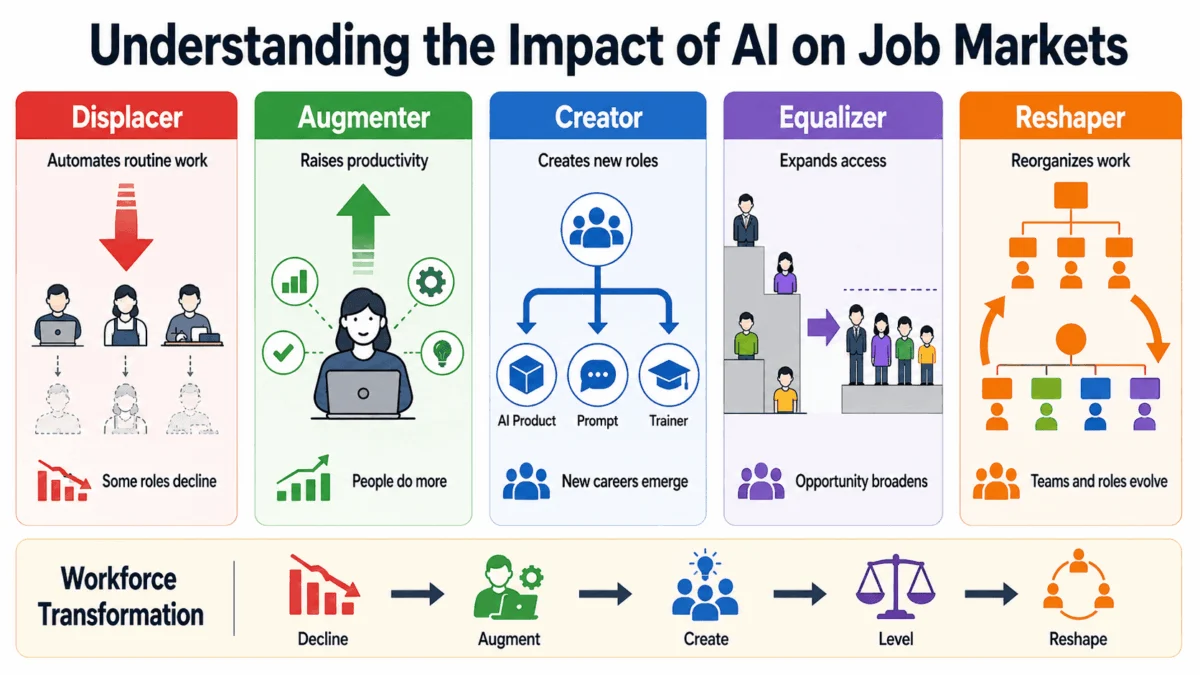
For years, the public discourse surrounding artificial intelligence has been dominated by a singular, paralyzing question: "Will a machine take my job?" While this query captures the existential anxiety of the digital age, it is fundamentally flawed. It treats AI as a monolithic, binary force—either a savior of productivity or an agent of obsolescence. In reality, AI is a multifaceted phenomenon, exerting simultaneous, often contradictory pressures on the global labor market.
To understand the future of work, we must move beyond the binary. We must dissect AI into its five primary operating forces: The Displacer, The Augmenter, The Creator, The Equalizer, and The Reshaper. By mapping these forces, we can move from passive anxiety to proactive career management.
The Chronology of the AI Shift
The current transformation is not an overnight event but a trajectory spanning several distinct phases.
- 2015–2020: The Predictive Era. Early AI adoption focused on machine learning models used for predictive analytics—optimizing supply chains, refining recommendation engines, and automating basic classification tasks.
- 2022–2024: The Generative Explosion. The public release of Large Language Models (LLMs) shifted the paradigm. AI moved from "predicting" to "creating." This period saw the rapid integration of AI into creative and knowledge-based workflows, moving the impact from back-office clerical tasks to front-office strategy and design.
- 2025–Present: The Integration and Structural Phase. We are now entering a period where AI is being baked into organizational infrastructure. This stage is characterized by the "Reshaper" effect, where companies are fundamentally redesigning hiring pipelines, training protocols, and organizational hierarchies to accommodate a hybrid human-AI workforce.
The Five Forces: A Detailed Analysis
1. The Displacer: Automating the Routine
The most visible and feared aspect of AI is its ability to perform high-volume, structured tasks. AI excels at pattern recognition, data ingestion, and repetitive cognitive processing.
According to the World Economic Forum’s Future of Jobs Report 2025, the labor market is currently navigating a period of intense churn. Projections suggest that 92 million roles face displacement by 2030 due to the convergence of technological advancement, shifting demographics, and economic pressures. Approximately 41% of employers surveyed have indicated plans to reduce headcount specifically as AI automates routine components of existing workflows.
2. The Augmenter: Amplifying Knowledge Work
While displacement grabs headlines, augmentation represents the dominant reality for the majority of the professional class. Here, AI acts as a "co-pilot," stripping away the "drudge work"—such as summarizing transcripts, drafting boilerplate code, or generating marketing copy—to allow humans to focus on high-level synthesis and decision-making.
Goldman Sachs estimates that 300 million jobs globally are "exposed" to AI automation. However, the firm clarifies that for most of these, the result is not total job loss but a massive productivity dividend. They project that generative AI could elevate global GDP by 7% over the next decade. In this paradigm, the professional’s role shifts from "creator" to "curator" and "editor."
3. The Creator: The Birth of New Occupations
Technological revolutions inevitably destroy old roles while simultaneously minting new ones. Just as the internet birthed the role of the "Social Media Manager" or "Cloud Architect," AI is catalyzing entirely new career paths.
The Future of Jobs Report 2025 forecasts the creation of 170 million new roles by 2030, representing a net gain of 78 million jobs even after accounting for displacement. We are witnessing an explosion in demand for AI Ethicists, Prompt Engineers, Data Governance Specialists, and the physical infrastructure roles—electricians, HVAC technicians, and data center construction crews—necessary to house the massive compute power driving this revolution.
4. The Equalizer: Compressing the Skill Gap
Perhaps the most surprising finding in recent labor research is AI’s role as an equalizer. A seminal study by economists Erik Brynjolfsson, Danielle Li, and Lindsey Raymond tracked 5,000 customer support agents, discovering that AI tools increased overall productivity by 14%.
Crucially, the gains were non-linear: novice agents saw a 34% improvement, while experienced veterans saw minimal change. The AI effectively democratized the "institutional knowledge" of top performers, bringing the bottom of the talent pool closer to the top. This phenomenon is fundamentally changing how companies approach hiring; if a junior employee can perform like a senior one with the right tool, the premium on "years of experience" may begin to deflate.
5. The Reshaper: Redrawing the Career Ladder
This is the most unsettling dimension of the current shift. If AI allows a junior worker to perform like a veteran, what happens to the junior worker? A Stanford University study (2025) titled "Canaries in the Coal Mine" found that workers aged 22–25 in AI-exposed fields experienced a 13% relative decline in employment.
The data suggests that firms are increasingly routing junior-level tasks—the very tasks that traditionally served as the "apprenticeship" for new employees—directly to AI. This creates a structural risk: if the entry-level rung of the corporate ladder is removed, how will organizations cultivate the senior experts of tomorrow?
Official Responses and Economic Outlook
Regulatory bodies and financial institutions are beginning to respond to these tremors. The Federal Reserve Bank of New York recently highlighted that underemployment among recent college graduates has climbed to 42.5%. This is being viewed by policymakers as a signal that the "skill-to-job" transition is breaking.
Governments are now pivoting toward "reskilling mandates." The focus is shifting from protecting old jobs to fostering "AI-resilient" labor markets. The emphasis is on digital literacy, regulatory compliance, and a renewed interest in vocational trades that remain beyond the reach of current automation.
Strategic Implications: How to Adapt
For the individual, the path forward is not found in panic, but in strategic alignment. Workers must categorize their daily tasks into the "Five Forces" framework to understand their exposure.
| Force | Strategic Response |
|---|---|
| Displacer | Pivot toward complex, high-judgment, or interpersonal roles. |
| Augmenter | Master the art of "AI orchestration"—directing, editing, and auditing AI. |
| Creator | Remain technically agile; keep an eye on emerging industry verticals. |
| Equalizer | Embrace AI early to bridge skill gaps and increase personal output. |
| Reshaper | Focus on building "human-only" competencies like ethical judgment and complex problem-solving. |
Conclusion: Reading the Shift
The labor market is undergoing its most significant reconfiguration since the Industrial Revolution. We are not moving toward a world without jobs, but a world of fundamentally different ones. The worker who can identify which of these five forces is acting upon their specific role is the worker who will survive the transition.
As the entry-level ladder shifts and the nature of expertise is redefined, the most valuable skill a professional can possess is adaptive intelligence. The future belongs to those who view AI not as an adversary to be feared, but as an environment to be navigated. By mapping your professional trajectory against these forces, you can transform the uncertainty of the AI era into an opportunity for strategic growth.
Vinod Chugani is an AI and data science educator who bridges the gap between emerging AI technologies and practical application for working professionals. His work focuses on agentic AI, machine learning workflows, and helping professionals navigate career transitions in a changing landscape.