While modern conflicts in Ukraine and the Middle East have provided a grim masterclass in the evolution of drone warfare and the interplay between offensive and defensive systems, they leave a critical void in our understanding of future high-intensity warfare. Specifically, these conflicts lack the scale of high-end, near-peer aerial combat that would define a potential war between the United States and China in the Western Pacific.
In a theater dominated by vast distances and sophisticated, long-range anti-access/area-denial (A2/AD) capabilities, the U.S. Air Force faces a looming crisis: a "firepower-versus-protection" paradox. To win, the Air Force must secure temporary air superiority, but the very assets required to achieve this—airborne early warning (AEW) and aerial refueling aircraft—are increasingly vulnerable. The solution may not lie in building more expensive manned fighters, but in the rapid development of specialized, autonomous Collaborative Combat Aircraft (CCA).
Main Facts: The Vulnerability of High-Value Assets
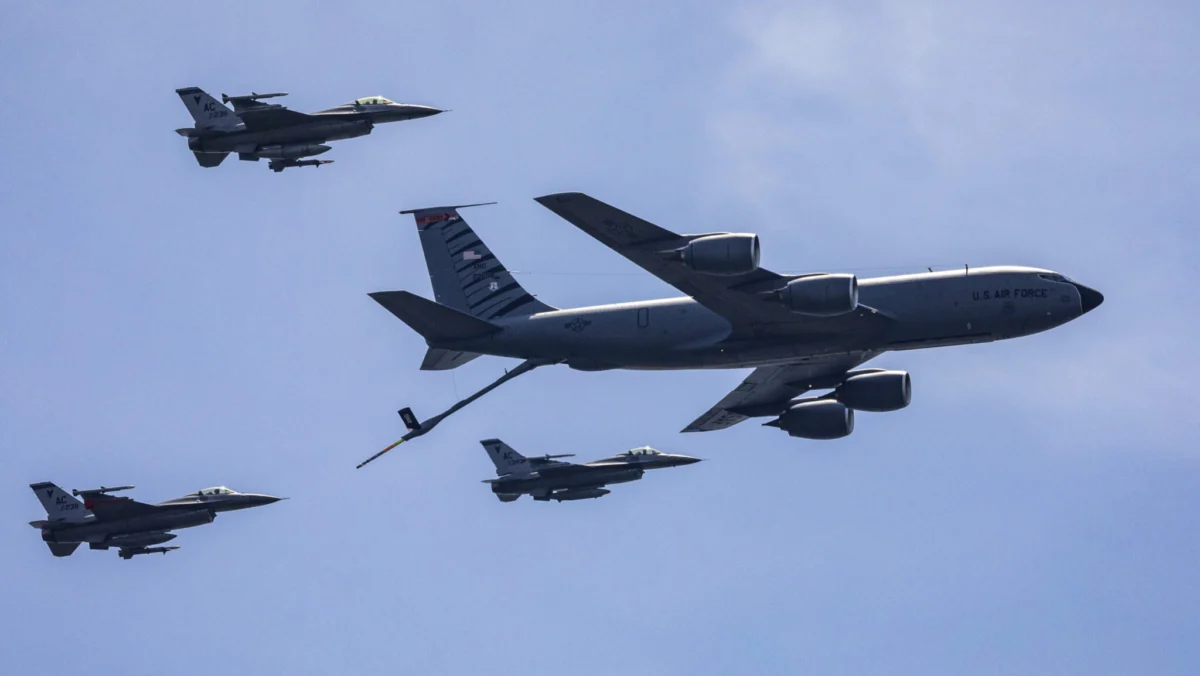
Modern air-to-air combat is no longer a matter of dogfighting in the traditional sense; it is a battle of "kill chains." Success relies on High-Value Airborne Assets (HVAA), such as E-3 AWACS and KC-46 tankers, which provide the situational awareness and logistical fuel necessary for fighters to engage effectively.
The People’s Liberation Army Air Force (PLAAF) has recognized this dependency. Rather than attempting to match the U.S. head-on in every tactical arena, the PLAAF has invested heavily in "systems destruction warfare" (SDW). This doctrine focuses on blinding the U.S. military by targeting its HVAA. The deployment of extended-range, air-to-air missiles like the Chinese PL-17, capable of striking targets at extreme distances, poses an existential threat to the U.S. ability to project power in the Indo-Pacific.
The current Air Force strategy—relying on sixth-generation fighters like the forthcoming F-47—is a necessary, but insufficient, response. Even with superior pilots and stealth technology, the U.S. faces a quantitative disadvantage. With the PLAAF fielding hundreds of J-20 Mighty Dragons and developing next-generation J-36 and J-50 platforms, the U.S. cannot afford to "tax" its precious manned fighter fleet by tethering them to defensive escort missions for vulnerable support aircraft.
Chronology: The Evolution of Air Superiority
- Pre-2020s: The U.S. Air Force relies on qualitative superiority, utilizing the F-22 and F-35 as the primary pillars of air dominance, assuming uncontested access to the skies over any theater.
- 2023–2025: The rapid proliferation of one-way attack drones and sophisticated missile systems in Ukraine and Iran forces a reassessment of air defense, highlighting the fragility of large, slow-moving support aircraft.
- 2026: The Air Force accelerates the Collaborative Combat Aircraft (CCA) program, moving toward a second increment of development that seeks to transition from simple "loyal wingman" drones to more specialized autonomous platforms.
- 2027 and Beyond: As the PLAAF’s J-20 fleet approaches 300+ units and advanced prototypes emerge, the "protection tax" on U.S. fighters reaches a critical tipping point, where the demand for defensive escorts threatens to neutralize the offensive potential of the entire fighter force.
Supporting Data: The Arithmetic of the "Protection Tax"
The mathematical reality of a modern Pacific air war is sobering. According to data from the 2026 Military Balance, the U.S. maintains approximately 1,780 fighter aircraft, while China possesses roughly 1,650.
If the Air Force commits to a defensive posture where 100 HVAA orbits must be maintained—each requiring a four-fighter escort—the "protection tax" consumes 400 fighters. This leaves only 787 fighters available for offensive counter-air missions. Conversely, if the PLAAF can achieve its objectives with a lower defensive requirement, they could potentially field upwards of 1,300 fighters for offensive operations.
This creates a nearly 2:1 numerical disadvantage for the U.S. force. If the Air Force continues to prioritize manned fighters for these defensive duties, they risk losing the ability to project force before the first shot is fired. The deployment of 150–400 specialized CCAs, however, could eliminate this tax entirely. By offloading defensive duties to drones carrying four-to-six missiles each, the Air Force could inject up to 900 additional missile rails into the theater, effectively restoring quantitative parity and allowing manned fighters to hunt the enemy rather than hide from them.
Official Responses and Strategic Pivot
The Department of the Air Force has begun acknowledging that the "Increment One" CCA model—which focuses on relatively inexpensive, expendable drones—is only the beginning. The shift toward "Increment Two" represents a strategic pivot toward multi-role autonomy.
Defense planners, including voices from the Office of Net Assessment, have increasingly emphasized that the future of air superiority will be decided by terminal missile defense. If a CCA can be designed not just to escort, but to actively intercept incoming PL-17 or HQ-9 missiles, it would fundamentally negate billions of dollars of Chinese investment in A2/AD technology.
While the Air Force has yet to officially finalize the requirements for Increment Two, the focus is shifting away from speed and stealth—which drive up unit costs—toward endurance, large-capacity payload bays, and resilient, secure datalinks. This "defensive CCA" concept aims to create a protective "bubble" around high-value assets, enabling them to operate closer to the front lines than previously thought possible.
Implications for Future Warfare
The implications of adopting specialized, defensive CCAs are profound. First, it breaks the firepower-versus-protection paradox. By decoupling the need for manned fighter escorts, the Air Force regains the operational freedom to mass its offensive power.
Second, it changes the economics of the battlefield. CCAs can be built with minimal signature reduction and modular payloads, making them cheaper to replace than a sixth-generation F-47. If the U.S. can successfully deploy a fleet of these drones, it effectively forces the PLAAF into a war of attrition that they are ill-equipped to win.
Finally, the technology behind defensive CCAs—specifically active terminal missile defense—has applications far beyond HVAA protection. Such systems could escort strike aircraft and electronic warfare platforms into the heart of contested airspace, rendering integrated air defense systems significantly less effective.
Conclusion: A Shift in Strategic Thinking
The wars in Ukraine and Iran have taught us that the battlefield is increasingly lethal and that technology is changing the nature of air engagement. However, the U.S. Air Force must look beyond the immediate lessons of today to the structural challenges of tomorrow.
The integration of specialized Collaborative Combat Aircraft is not merely a technological upgrade; it is a strategic necessity. By investing in drones that can serve as the primary guardians of our airborne infrastructure, the U.S. can protect its critical information networks, sustain its offensive momentum, and ensure that in any future clash in the Western Pacific, the skies remain under the control of the United States and its allies. The era of the lone fighter pilot is not over, but the era of the autonomous, loyal, and highly lethal guardian has only just begun.