By Anne-Françoise Pelé, Editor-in-Chief, EE Times
As we move toward the latter half of the decade, the convergence of artificial intelligence, advanced semiconductor manufacturing, and environmental intelligence is reshaping the technological landscape. The September 2026 edition of EE Times dives deep into three critical pillars defining the current industry trajectory: the evolution of the “intelligent building,” the rapid maturation of India’s semiconductor ecosystem, and the urgent necessity of system-level integration to overcome the physical limits of AI hardware.
I. The Intelligent Building: Balancing Utility and Privacy
The modern building is no longer a static shell; it is becoming a living, breathing network of sensors and data-processing nodes. From energy-efficient climate control to predictive maintenance, the deployment of "ambient intelligence" is promising a future of unprecedented operational efficiency.
The Shift Toward Edge Intelligence
The primary driver behind this transformation is the transition from cloud-centric data processing to edge AI. By shifting the processing of sensor and camera data directly to the device—the "edge"—architects of smart buildings can reduce latency and significantly improve privacy. When video or thermal data is analyzed locally, the raw, identifiable footage never needs to leave the premises, mitigating the risks associated with centralized data storage.
Energy Harvesting and Sustainability
A critical component of this revolution is the rise of ambient energy harvesting. By utilizing power generated from light, vibration, or thermal gradients, sensors can operate autonomously for years without battery replacement. This reduces the logistical burden of maintenance and aligns with global sustainability goals. Companies such as e-peas S.A. are at the forefront of this, providing the power management integrated circuits (PMICs) necessary to run IoT devices on harvested energy, effectively closing the loop on a self-sustaining building ecosystem.
The Privacy and Cybersecurity Paradox
While the benefits are clear, the proliferation of connected devices introduces a massive attack surface. Cybersecurity remains the "Achilles’ heel" of the smart building. Industry leaders, including Axis Communications and Wireless Logic, are now emphasizing "secure by design" principles. This involves hard-coding encryption at the silicon level and ensuring that data anonymization—a field where firms like Pimloc are making significant strides—is baked into the image processing pipeline before data is ever transmitted.
II. India’s Semiconductor Renaissance: A Strategic Blueprint
India’s emergence as a global semiconductor hub is no longer a speculative trend; it is a tangible, building-block reality. The government’s strategic expansion of the India Semiconductor Mission (ISM) is creating a fertile ground for both domestic startups and multinational giants.

Chronology of Expansion
- 2023–2024: Initial investments focus on assembly, testing, marking, and packaging (ATMP) facilities.
- 2025: Significant influx of foreign direct investment (FDI) leads to the construction of high-end semiconductor manufacturing plants.
- 2026: Focus shifts toward the vertical integration of the supply chain, with local startups developing advanced materials and high-efficiency motor controllers.
The Role of Research and Quantum Computing
IBM’s recent entry into the Indian market with advanced quantum computing infrastructure is a pivotal moment for the nation’s R&D ecosystem. By integrating quantum research with local neuromorphic architecture efforts, Indian researchers are moving beyond traditional fabrication to focus on the next generation of computing paradigms. This holistic approach ensures that India is not just a "factory" for chips but a center for architectural innovation.
III. Breaking the AI Hardware Ceiling: The Post-Moore Era
For years, the semiconductor industry relied on the simple mantra: "make transistors smaller and faster." However, at the 2026 Leti Innovation Days, the consensus was clear: the AI hardware crisis cannot be solved by lithography alone. We have hit a wall where data movement, not raw compute, is the primary bottleneck.
System-Level Integration as the New North Star
To sustain the growth of AI, the industry is pivoting toward system-level integration. This includes:
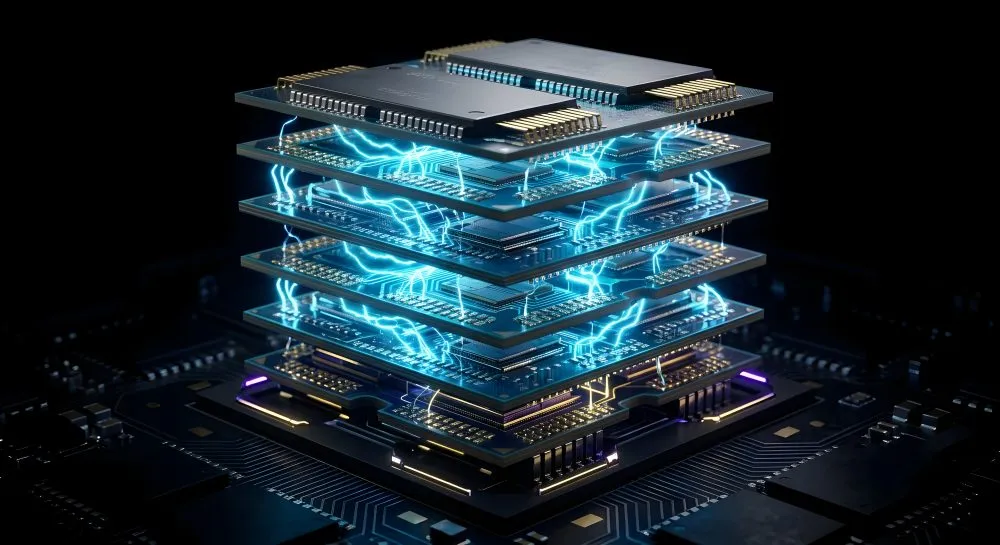
- 3D Stacking: Moving from 2D layouts to vertical stacking, which reduces the physical distance electrons must travel, lowering power consumption and latency.
- Chiplets: Breaking monolithic processors into modular chiplets allows for heterogeneous integration—combining a high-performance logic chip with an optimized memory module on the same package.
- Silicon Photonics and Co-Packaged Optics: As data speeds climb into the terabit-per-second range, copper interconnects are becoming thermal and signal-integrity nightmares. Replacing them with optical interconnects allows data to move at the speed of light, with significantly lower heat dissipation.
Official Industry Responses
During the discussions at CEA-Leti, representatives from Infineon and other industry heavyweights emphasized that the "industrialization" of these technologies is the next hurdle. It is one thing to demonstrate a 3D-stacked AI accelerator in a lab; it is quite another to produce it at scale with acceptable yields. The industry is now focusing on standardizing chiplet interconnects, a move that will allow a broader range of companies to participate in the high-performance AI market without needing to own a massive, multi-billion-dollar fabrication facility.
IV. Implications for the Future of Electronics
The convergence of these three narratives—Smart Buildings, Indian Semiconductor Growth, and AI Hardware Integration—paints a picture of a more complex, but more capable, technological world.
The Implications for Policy and Ethics
As smart buildings become more autonomous, regulators will need to grapple with the "right to privacy" versus the "right to efficiency." We are moving toward a world where buildings might detect a medical emergency through non-invasive sensors and alert services automatically. While life-saving, this requires robust legal frameworks to ensure such data is used strictly for safety and never for surveillance or commercial profiling.
The Economic Shift
The geographic shift of semiconductor manufacturing to regions like India signals a de-risking of the global supply chain. By spreading production across different geopolitical zones, the industry is creating a "multi-polar" supply chain that is inherently more resilient to localized shocks—be they natural disasters or geopolitical conflicts.

Technological Sustainability
Finally, the push for system-level integration in AI hardware is not just about speed; it is about energy. Training a single large language model today consumes enough electricity to power a small town. By moving toward photonics and optimized chiplet architectures, the industry is making a concerted effort to decouple AI performance from its massive carbon footprint.
V. Concluding Thoughts: A New Era of Engineering
The trends explored in our September 2026 report underscore a transition from "innovation for innovation’s sake" to "innovation with intent."
Whether it is the sensor on a ceiling tile harvesting energy from ambient light, a cleanroom in India producing the next generation of neuromorphic processors, or a researcher at a Leti facility perfecting the light-based interconnects that will power future AI, the theme is consistent: integration.
We are leaving the era of the isolated component and entering the era of the integrated system. In this new landscape, success will not be defined by who has the fastest transistor, but by who can most effectively orchestrate these complex, disparate technologies into a cohesive, secure, and sustainable whole.
As we look toward the remainder of the decade, the collaboration between academia, government policy, and industry leaders will be the defining factor. The technologies are ready; the challenge now lies in the scale, the security, and the stewardship of the data that these systems will generate.
For more in-depth coverage, technical white papers, and expert analysis on the topics discussed above, please visit the EE Times Special Report portal.
Keywords: #AmbientIoT #Cameras #Cybersecurity #DataPrivacy #EdgeAI #EnergyEfficiency #Semiconductors #Sensors #SmartBuildings #IndiaSemiconductorMission #AIHardware #Chiplets #SiliconPhotonics #CEA-Leti #IBM #Infineon #InsightSiP #Pimloc #VimagLabs #WirelessLogic