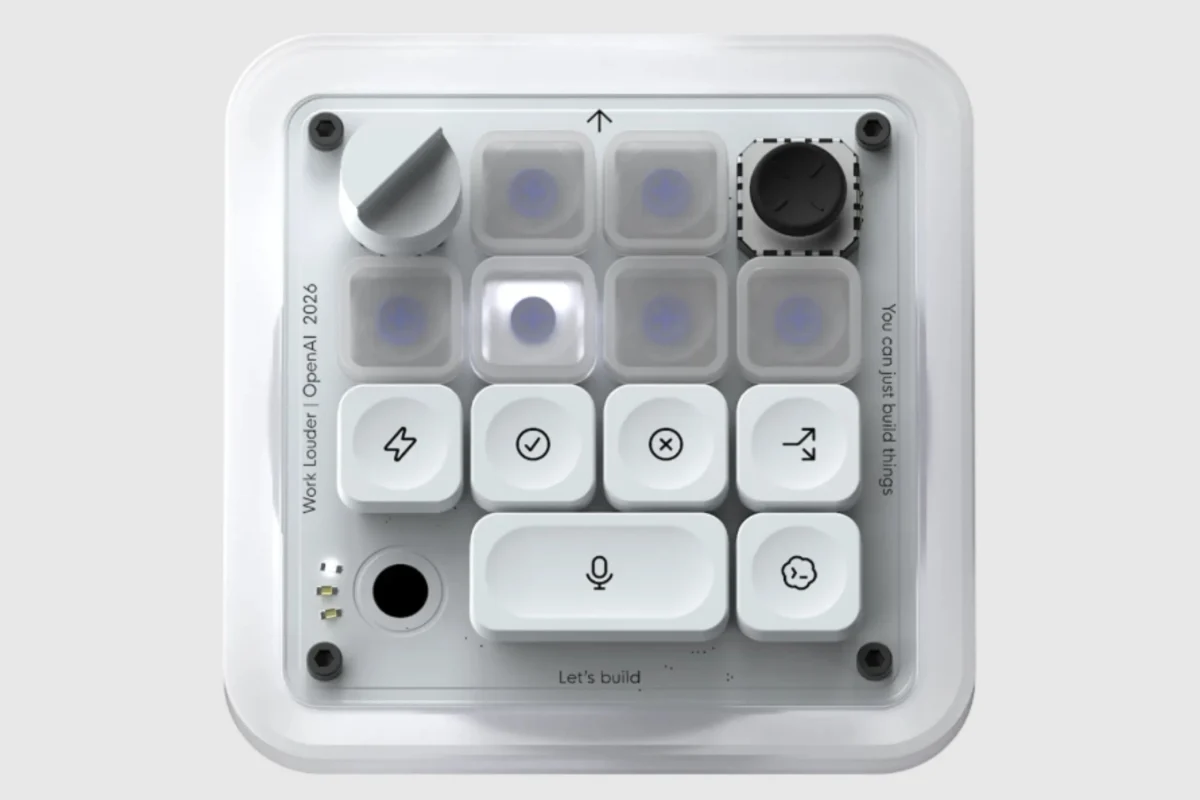
OpenAI, the industry titan that redefined the landscape of generative artificial intelligence, has officially stepped beyond the screen. Last week, the company launched its inaugural piece of hardware: the "Micro," a tactile, customizable keypad designed specifically to interface with ChatGPT and the company’s agentic coding tool, Codex. Developed in collaboration with boutique keyboard manufacturer Work Louder, the device is an exercise in minimalist design—a physical bridge between the ephemeral nature of AI models and the grounded reality of the desktop workstation.
However, the launch has been met with a mixture of bewilderment, skepticism, and intense scrutiny. In an era where AI is synonymous with intangible, cloud-based software, the Micro stands as a polarizing artifact: a $230 premium peripheral that some herald as a workflow revolution and others dismiss as a glorified, overpriced desk ornament.
A Chronology of Hardware Ambition
The arrival of the Micro does not occur in a vacuum; it is the latest development in a high-stakes, multi-front expansion for OpenAI. The company’s trajectory over the past few months has been defined by both rapid innovation and significant legal friction.
- July 2026 (Early): Apple initiates a high-profile lawsuit against OpenAI, alleging the theft of critical trade secrets. This legal battle, which centers on proprietary technology and talent acquisition, has cast a long shadow over OpenAI’s recent corporate maneuvers.
- July 2026 (Mid): Reports emerge that OpenAI is developing a second, more ambitious piece of hardware: a screenless smart-home speaker. Industry insiders have noted that this project is being led by a team of former Apple engineers, further heightening the tension between the two Silicon Valley giants.
- July 2026 (Late): The official release of the Micro keypad. Designed as a "macro pad," the device aims to provide a tactile interface for AI interactions, signaling OpenAI’s desire to control the user experience from the software layer down to the physical desk space.
The Hardware: Anatomy of the Micro
The Micro is, at its core, a sturdy, well-engineered macropad. Physically, it exudes a "premium" aesthetic—so much so that its clean lines, immaculate white packaging, and industrial design have drawn immediate, pointed comparisons to Apple’s signature hardware philosophy.
The device features a layout comprising six frosted "agent" keys at the top, which are designed to be mapped to specific tasks within the ChatGPT ecosystem. Below these sit six command keys, intended to manage workflow navigation and program control. Connectivity is handled via Bluetooth or USB-C, ensuring compatibility with modern workstation setups.
Functional Utility and the Learning Curve
The most practical feature of the Micro is its dedicated voice-dictation button. By holding the button and speaking, users can issue complex instructions to ChatGPT, which then processes and executes these requests. A "send" button facilitates the final submission, streamlining the friction often associated with typing out lengthy prompts.
However, the device demands a significant investment of cognitive labor. The keys are color-coded to provide visual feedback:
- White: The agent is idle.
- Blue: The AI is actively processing or "thinking."
- Green: The task has been successfully completed.
- Red: A system error has occurred.
Users must not only internalize this color-coded language but also map their specific projects to individual keys. For the average user, this introduces a steep learning curve that must be managed within a dedicated "Micro" tab inside the ChatGPT interface.
Supporting Data: The Backlash from the Tech Community
While OpenAI likely envisioned the Micro as a must-have tool for developers, the response from the target demographic has been decidedly frosty. On forums like Reddit, the consensus has been overwhelmingly negative. Critics have characterized the device as a "prank" or a "gimmick," arguing that the $230 price point is difficult to justify in a market saturated with cheaper, programmable DIY macropads.
Independent tech outlet Aftermath offered a scathing critique, noting that the device felt "engineered to piss me off specifically." The core argument from critics is simple: Why replace a keyboard and mouse—tools that are already highly efficient—with a secondary, proprietary device that requires weeks of training to master? For many, the Micro represents a solution in search of a problem.

Official Stances and Corporate Strategy
OpenAI has maintained that the Micro is intended to "delight" the tech community and provide a more intuitive, agentic way to interact with AI. By allowing users to toggle between specific ChatGPT sessions using physical keys, the company claims it is creating a more "efficient and enjoyable" user experience.
Yet, the strategic implications of this launch are broader. By venturing into hardware, OpenAI is attempting to cultivate a "walled garden" ecosystem. If a user becomes accustomed to using the Micro to manage their workflow, they are effectively tethering their productivity to OpenAI’s software stack. This is a classic platform strategy: hardware provides the anchor, and software provides the utility.
Implications for the Future of AI Integration
The existence of the Micro raises profound questions about the future of human-computer interaction (HCI). Are we moving toward a future where our desks are cluttered with specialized, AI-dedicated hardware? Or is this merely a transitional phase?
The "Apple-Coded" Aesthetic
The physical design of the Micro, particularly its packaging, is a deliberate aesthetic choice. It is sleek, minimalist, and undeniably reminiscent of the Cupertino-based giant currently suing the company. This mimicry is not lost on observers; it suggests that OpenAI is not just competing on intelligence, but on lifestyle and hardware prestige. Whether this is a strategic move to position itself as the next Apple, or merely a derivative design choice, it invites intense scrutiny from both the market and the courts.
The Value Proposition
Ultimately, the Micro’s success will hinge on its "power user" base. For a casual user, the device is likely an unnecessary expense. However, for a developer who lives inside ChatGPT, the ability to offload complex tasks via a physical macro pad may offer a genuine, if niche, productivity boost.
The divide here is between the potential of the device and its execution. If OpenAI can improve the integration and lower the barrier to entry, the Micro could become a staple of the modern AI-assisted desk. If it fails to do so, it will remain a historical footnote—a "funky" paperweight that serves as a reminder of a period when the lines between AI and hardware began to blur.
Conclusion: A Gamble on Hardware
As the legal storm with Apple continues to brew and rumors of a "smart speaker" circulate, the Micro serves as a litmus test for OpenAI’s hardware ambitions. It is an expensive, ambitious, and fundamentally experimental product.
For the tech enthusiast, the Micro is a piece of hardware that can brighten a workspace and offer a tactile connection to the abstract world of LLMs. For the skeptic, it is a sign of a company potentially losing focus, prioritizing physical gimmicks over the core software improvements that made them a household name.
Whether the Micro is the start of a revolution or a costly misstep, one thing is clear: OpenAI is no longer content to simply be an AI provider. They want to be the hardware, the software, and the desktop companion—whether the industry is ready for it or not.