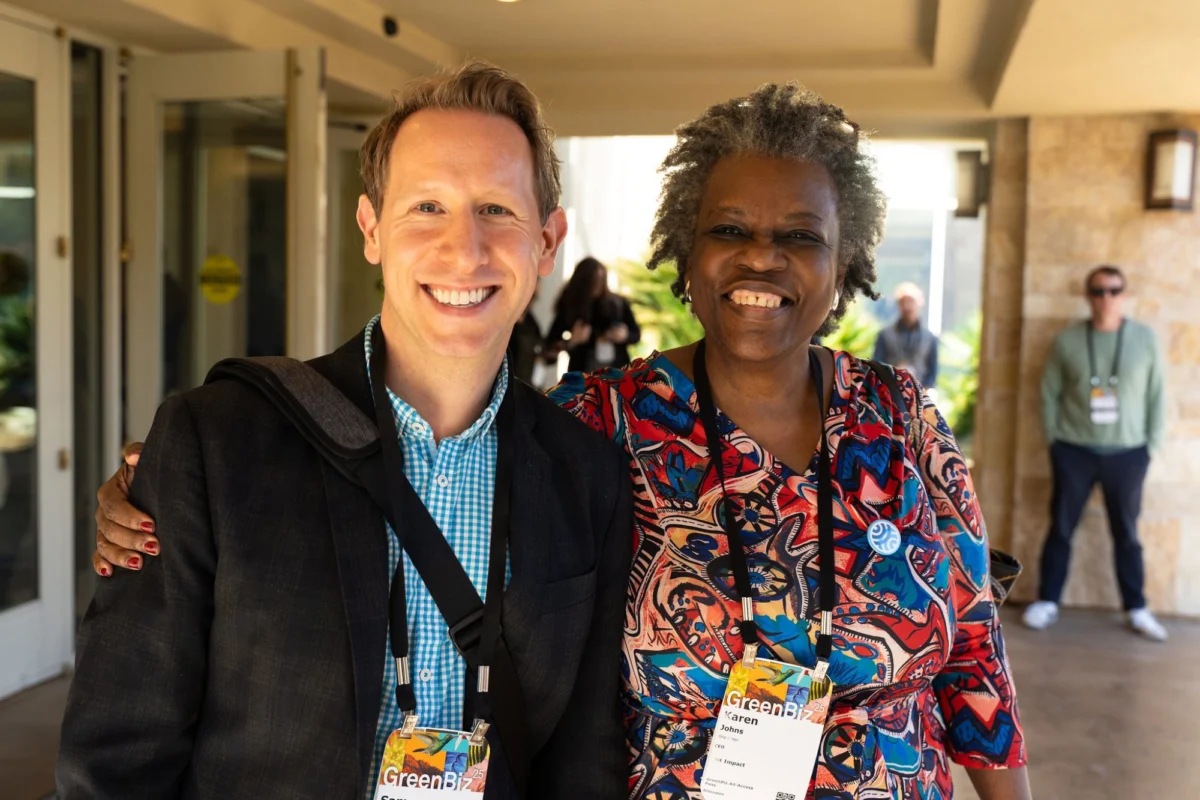
In the high-stakes world of corporate sustainability, the professional calendar has become a grueling gauntlet. For those who frequent the global circuit—from the bustling halls of Climate Week in New York to the sprawling, logistically fraught venues of the UN COP summits—the experience is defined by a sharp dichotomy. On one side lies the "soft" promise of these gatherings: the spark of inspiration, the strengthening of professional networks, and the intangible energy that defines a community. On the other lies the "hard" reality: exorbitant travel costs, debilitating jet lag, time away from family, and the ever-mounting anxiety of an overflowing inbox.
This friction between what sustainability events promise and the steep price they exact served as the focal point for a recent installment of the Two Steps Forward podcast. As co-hosts, we found ourselves dissecting an industry that is currently at a crossroads. The conclusion was striking: the intangible elements of these gatherings—the hallway conversations, the serendipitous meetings, and the shared human experience—are not merely "add-ons" to the business case. In a digital-first, AI-driven world, these connections are increasingly the primary reason for the event’s existence.
The Shift: From Passive Consumption to Active Connection
For decades, the event industry has operated on a traditional model: hire experts, book a stage, print a sleek agenda, and hope the audience absorbs the content. However, data suggests that this model is rapidly losing its appeal.
A seminal report released by Encore and Boldpush, 2026 Experience Design: Shaping What Drives Value in Live Corporate Events, confirms a paradigm shift that many seasoned attendees have long suspected. The report’s findings are clear: peer connection is now the top driver of event value. It consistently ranks higher than keynote speakers, panel discussions, or proprietary research presentations—the very items that consume the vast majority of programming budgets.
The implications for event organizers are profound. Participants are signaling a fatigue with the "talking head" format. They are moving toward participatory formats where the value is generated horizontally, between attendees, rather than vertically, from the stage to the audience. Trust, it seems, is no longer built through polished slide decks; it is built through face-to-face, unscripted human interaction.
Chronology of an Evolving Landscape
To understand why the sustainability event sector is struggling with its value proposition, one must look at how the calendar has transformed over the past decade.
The Era of Proliferation (Pre-2015)
Historically, the sustainability calendar was a manageable, albeit fragmented, list of events. Organizations like GreenBiz, BSR, and Ceres held distinct, annual gatherings that served as the industry’s touchstones. These events were complemented by regional business media conferences from outlets like Fortune, Bloomberg, and The Wall Street Journal.
The Era of Concentration and Expansion (2015–Present)
Following the adoption of the Paris Agreement, the urgency of climate action triggered a dual shift. First, the calendar "compressed." Major events began to cluster around high-profile moments, most notably the annual UN COP summits and the increasingly influential regional "Climate Weeks." Second, the footprint of these events expanded geographically. What was once a Western-centric cycle now includes significant programming in India, Southeast Asia, Latin America, and emerging markets in Africa.
This leaves the modern sustainability professional with a paradox: there are more places to be than ever before, but less time to spend in each. The result is a rushed, transactional experience that often undermines the very community-building these events claim to foster.
Supporting Data: The Cost of the "Gathering"
The logistical challenges associated with this growth are not merely inconveniences; they are existential threats to the sustainability industry’s credibility. When a professional flies halfway around the world to attend a series of panels that could have been viewed on a webinar, the carbon footprint of that journey is scrutinized with increasing rigor.
Consider the logistics of the COP summits. COP31, scheduled for November in Antalya, Turkey, represents the extreme end of this spectrum. The barriers to entry are immense:
- Logistical Complexity: Navigating mass-transit bottlenecks and high-density security zones.
- Infrastructure Stress: In previous years, such as the COP30 summits, we have seen reports of inadequate food access, water shortages, and even safety concerns, such as fire hazards in temporary structures.
- The "Negotiator’s Burden": For those involved in the high-stakes, late-night climate negotiations, the tangible benefits are often outweighed by the exhaustion of the process.
Yet, despite these hurdles, attendance at such events continues to climb. Why? Because the "intangibles" provide a return on investment that no digital platform can replicate.
Official Responses and Industry Reflections
Industry leaders and event organizers are beginning to pivot. At Trellis, we have spent significant time developing a philosophy we call "intimacy at scale." The objective is not to abandon the large-scale conference model, but to re-engineer it.
"Building great programming is obviously important," notes the discourse among event designers today. "But creating the conditions for ‘collisions’—those unplanned, serendipitous meetings—is what keeps people coming back."
This shift in strategy acknowledges that the modern professional is calculating their time with extreme precision. They are asking: Will I meet my next partner here? Will I find a mentor for my career? Will I gain a reality check that helps me navigate the shifting regulatory landscape?
When asked about the future of corporate events, event strategy consultants emphasize that the "agenda" is merely the bait. The "hook" is the community. As one organizer put it, "If you want to create a successful event in 2025, you need to spend less time worrying about the quality of your keynote microphones and more time worrying about the quality of the coffee break space."
Implications: The Future of Sustainability Networking
The conclusion of our investigation leads to a sober realization: the era of the "one-size-fits-all" mega-conference is likely coming to an end. We are moving toward a bifurcated model.
1. The Death of the Passive Panel
The traditional panel discussion, where four people talk at a silent audience for 60 minutes, is becoming a liability. Future programming will emphasize the "workshop" and "roundtable" models, where knowledge is crowdsourced and problems are solved in real-time.
2. The Rise of the "Micro-Event"
As travel costs and carbon budgets come under closer scrutiny, we will see a rise in smaller, hyper-local gatherings. These events offer the intimacy of a dinner party with the professional utility of a conference.
3. The Value of the "Accidental Encounter"
The most enduring business relationships in sustainability are rarely forged during a keynote presentation. They are forged in the "snaking line" for security or while sharing a meal at a local eatery. Organizers who prioritize these spaces—and who accept that their role is to facilitate connection rather than control content—will thrive.
Conclusion
The tangible costs of global sustainability events are real and worthy of regular interrogation. Every expense report represents a sacrifice of time, capital, and environmental impact. However, the intangibles—the connections that turn into enduring business partnerships and personal relationships—are equally real.
While these human connections may never appear on a balance sheet, they are the lifeblood of the sustainability movement. In an industry defined by the need to solve complex, global challenges, the ability to find one’s "people" in a crowd of thousands is not a luxury. It is the most critical tool for progress. The goal for the future of our events is to stop pretending that the slide presentation is the destination. The destination has always been the person sitting in the chair next to you.