Introduction
The narrative surrounding generative AI has undergone a seismic shift as we move deeper into 2026. For the past several years, the industry’s attention was dominated by the "frontier model" arms race—a quest to scale parameters into the trillions in search of artificial general intelligence. However, the reality of enterprise AI deployment has revealed a different set of priorities.
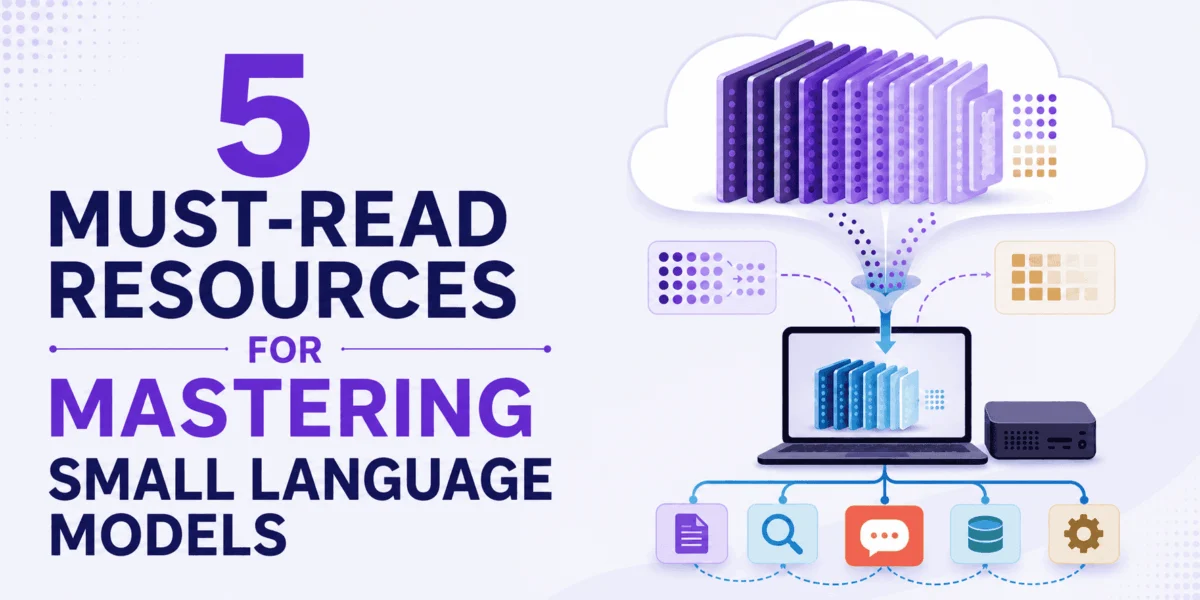
For the vast majority of businesses, the challenges of latency, exorbitant cloud costs, and stringent data sovereignty requirements have rendered monolithic models impractical. Consequently, engineering teams are pivoting toward Small Language Models (SLMs). Ranging from 1 billion to 10 billion parameters, these compact models offer a "Goldilocks" solution: they are lightweight enough to run on local edge hardware or affordable private cloud infrastructure, yet powerful enough to execute complex reasoning and data extraction tasks.
For the modern data professional, mastery of SLMs is no longer a peripheral skill—it is a core engineering requirement. Moving away from expensive API calls toward self-hosted, optimized SLMs is the defining trend of this year. To help navigate this transition, we have curated five essential resources that cover the full spectrum of SLM development, from foundational architecture to production-grade deployment.
The Architectural Foundation: From Scratch to Theory
To truly leverage SLMs, one must understand how they differ from their massive counterparts. The following resources provide both a hands-on mechanical understanding and a high-level academic perspective on how these compact systems are constructed.
1. Building from the Ground Up: The Mechanical Perspective
Understanding the "black box" of an AI model is best achieved through direct implementation. ChaitanyaK77’s GitHub repository, Building a Small Language Model (SLM), serves as an indispensable guide for engineers looking to demystify the training process.
Unlike massive frontier models that require supercomputer clusters, this project demonstrates that functional, high-quality SLMs can be trained on a single consumer-grade GPU. By utilizing the TinyStories dataset, the repository strips away the bloated abstractions found in standard enterprise frameworks. It forces the developer to engage with the raw mechanics of the transformer architecture, weight initialization, and gradient descent. This is more than a tutorial; it is a weekend project that transforms a developer from a model user into a model architect.
2. The Science of Compression: The arXiv Survey
Once the basic mechanics are understood, the practitioner must confront the reality of how modern, industry-standard SLMs are actually created. Few production-grade models are trained entirely from scratch. Instead, they are the products of sophisticated distillation, pruning, and quantization.
"A Comprehensive Survey of Small Language Models in the Era of Large Language Models" (available on arXiv) provides the rigorous, peer-reviewed literature necessary to understand these techniques. The paper highlights that the future of AI is not just about making models smaller, but about retaining intelligence through advanced training regimes. It explains the nuances of "knowledge distillation," where a compact student model learns to mimic the outputs of a larger teacher model. For engineers, this survey is the foundational text for choosing between pre-trained variants or building a custom-distilled pipeline.
Strategy and Agentic Workflows: Moving Beyond Chatbots
Building a model is only half the battle. The true value of an SLM lies in its integration into complex, agentic workflows where speed and accuracy are paramount.
3. The Future of Agentic AI: The NVIDIA Research Position
A common industry myth suggests that autonomous AI agents—those capable of planning, browsing, and executing tasks—require massive models to function reliably. A pivotal position paper from NVIDIA Research, Small Language Models Are the Future of Agentic AI, effectively dismantles this misconception.
NVIDIA’s research posits that SLMs are not just "good enough" for agents; they are often superior. When specialized for a specific domain, a 3B parameter model can outperform a generalized 100B model by reducing inference latency and error rates. By narrowing the scope of the model’s responsibility, engineers can create agents that are faster, more reliable, and significantly cheaper to operate. This paper is essential reading for any team tasked with building autonomous workflows that must perform in real-time.
4. Practical Implementation: The Pioneer AI Roadmap
Bridging the gap between theoretical potential and a production-ready application is where many projects fail. Fastino Labs’ A Guide to Small Language Models, hosted on the Pioneer AI blog, provides the tactical roadmap that many developers lack.
This guide moves past the "why" and focuses entirely on the "how." It provides a clear framework for when to initiate a fine-tuning run, how to curate datasets for specialized tasks, and how to evaluate model performance against business-specific KPIs. Before provisioning a cloud GPU cluster, engineers should consult this guide to ensure they are optimizing their resource allocation effectively. It is the definitive playbook for moving an SLM from a sandbox experiment to a reliable business asset.
Ecosystem Overview: Navigating the Model Jungle
The rapid pace of open-source development means that new, efficient models are released on a weekly basis. Navigating this landscape requires a central hub for information.
5. The Hugging Face Compendium
Hugging Face remains the heartbeat of the open-source AI community. Their resource, Small Language Models (SLM): A Comprehensive Overview, is the primary dashboard for developers looking to identify their next base model.
The overview provides necessary categorization, helping developers distinguish between models optimized for multilingual support, those fine-tuned for code generation, and those designed specifically for extreme low-latency environments. As the ecosystem becomes more fragmented, having a reliable guide to the state-of-the-art becomes critical. It allows teams to avoid "reinventing the wheel" and instead focus on fine-tuning existing, high-performing architectures to their specific needs.
Implications for the Industry
The shift toward compact, specialized models represents a fundamental change in the economics of AI. We are seeing a transition from a "centralized utility" model, where companies rely on a few massive API providers, to a "distributed intelligence" model.
Economic Implications:
- Cost Reduction: By deploying SLMs on local hardware or private cloud instances, enterprises eliminate the variable costs associated with token-based pricing.
- Data Privacy: Local deployment ensures that sensitive corporate data never leaves the internal perimeter, solving the primary barrier to AI adoption in regulated industries like healthcare and finance.
- Latency: Edge devices can now run high-performance AI, enabling real-time applications that were previously impossible due to network round-trip delays.
Engineering Shifts:
The role of the AI engineer is evolving. In 2026, the competitive advantage no longer belongs to those who can prompt a giant model the best, but to those who can prune, quantize, and fine-tune a model to perform a specific task with surgical precision.
Where to Go From Here
The trajectory for a professional looking to master SLMs is clear. Start by demystifying the architecture through the ChaitanyaK77 GitHub notebook, then build a conceptual foundation with the arXiv survey. Once you understand the mechanics, apply them to agentic systems using the NVIDIA research insights, and solidify your deployment strategy with the Pioneer AI guide. Finally, keep your finger on the pulse of the industry using the Hugging Face SLM overview.
Whether you are an architect looking to optimize infrastructure costs or a developer building the next generation of autonomous agents, these five resources offer the roadmap required to succeed. The frontier era is not over, but it is being joined by a new, more efficient, and highly specialized era of compact intelligence. The teams that embrace this shift today will be the ones that define the enterprise AI landscape of tomorrow.
About the Author
Vinod Chugani is an AI and data science educator specializing in bridging the gap between emerging AI technologies and practical business applications. With a background in quantitative finance and a focus on agentic AI, Vinod provides technical mentorship to professionals navigating the rapidly changing landscape of machine learning. His work emphasizes actionable, high-impact strategies for engineers looking to move beyond theory and into scalable, real-world deployment.