In a landmark development for the future of military and government communications, satellite technology provider ALL.SPACE and software orchestration leader Aalyria have announced a strategic partnership to integrate the former’s Hydra MAX terminals with the latter’s Spacetime software platform. Announced on August 10, the collaboration marks a significant shift in how the U.S. Government (USG) intends to manage complex, multi-orbit data transport in contested environments.
By combining ALL.SPACE’s high-performance hardware—specifically designed for communications-on-the-move (COTM)—with Aalyria’s AI-driven, temporospatial orchestration software, the two firms are positioning themselves as the backbone for next-generation Joint All-Domain Command and Control (JADC2) initiatives.
The Core Technology: A Synergy of Hardware and Intelligence
The alliance hinges on the integration of two sophisticated, industry-leading technologies. To understand the gravity of this deployment, one must examine the individual capabilities of both the Hydra MAX terminal and the Spacetime orchestration suite.
The Hydra MAX: A New Paradigm in Terminal Design
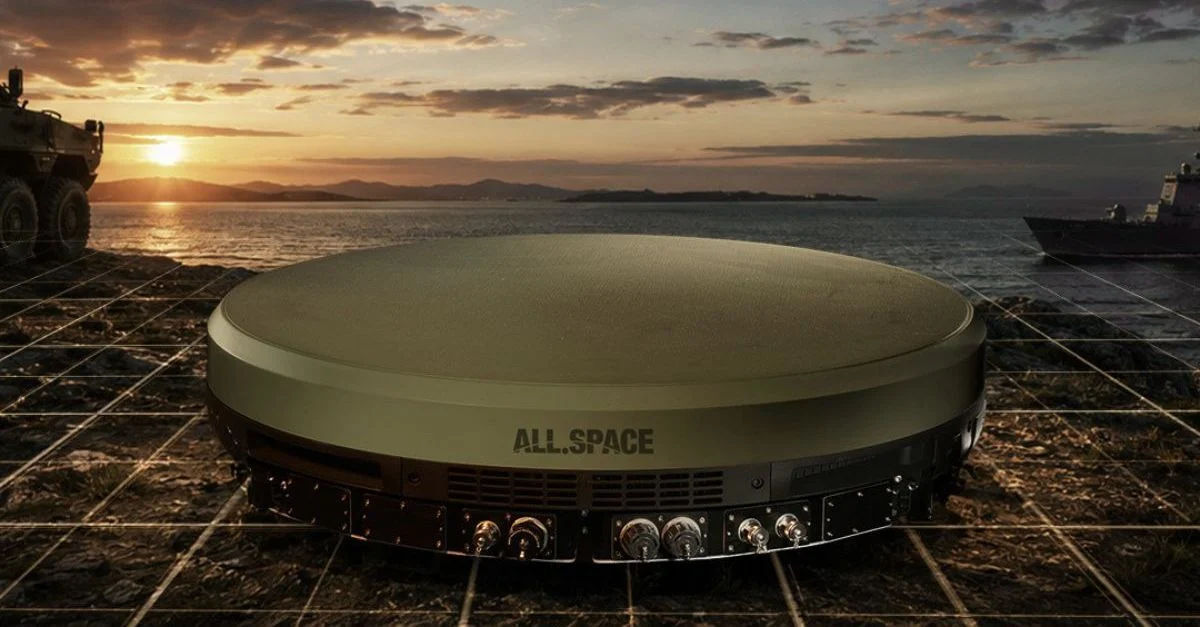
The Hydra MAX represents the flagship iteration of ALL.SPACE’s next-generation SATCOM platform. Unlike traditional antennas, which often struggle with the limitations of single-beam tracking, the Hydra MAX is a dual-beam, full-duplex, 500 MHz-per-beam Ka-band terminal.
Key technical specifications include:
- Aggregate Bandwidth: It delivers up to 1 GHz of aggregate instantaneous bandwidth, providing massive throughput capacity for high-demand mission data.
- Multi-Orbit Flexibility: The platform is software-defined, allowing it to maintain simultaneous connectivity across various satellite constellations—including LEO, MEO, and GEO architectures.
- Versatility: Engineered specifically for communications-on-the-move, the terminal is built to handle the mechanical and electronic rigors of land, sea, and air platforms, ensuring connectivity remains stable even during high-speed transit.
Spacetime: The "Brain" of the Network
If the Hydra MAX is the "eyes and ears" of the link, Aalyria’s Spacetime is the "brain." Spacetime is a sophisticated temporospatial orchestration platform. Its primary function is to continuously optimize routing, network topology, and resource allocation across highly dynamic, heterogeneous terrestrial and non-terrestrial networks.
Spacetime maintains a "digital twin" of the entire network—a live, planet-scale model of every platform, link, and orbital slot currently in play. By using this model, the software can compute the most efficient data path for any given connection in milliseconds. This enables the network to "self-heal" and reconfigure in real-time, bypassing congested or jammed nodes without human intervention.
Chronology of the Partnership
The announcement on August 10 did not emerge in a vacuum. It is the culmination of a broader industry shift toward modular, software-defined, and hardware-agnostic defense architectures.
- Phase 1: Research and Development: Over the past several years, both companies have operated within the defense innovation ecosystem, focusing on the need for "multi-vendor resilience." This phase involved independent testing of both the Hydra MAX and Spacetime by various government stakeholders.
- Phase 2: Strategic Collaboration: Before this operational contract, the two companies engaged in preliminary technical integration tests. The goal was to ensure that the hardware-agnostic nature of Spacetime could effectively command the software-defined capabilities of the Hydra MAX without latency-induced performance degradation.
- Phase 3: The August 10 Agreement: The formal announcement marks the transition from conceptual testing to actual operational demonstration within USG environments. This phase is intended to validate the technology in realistic, high-stakes military scenarios.
- Phase 4: Future Rollout: With the contract in place, the companies are now moving toward deploying these integrated systems into specific U.S. missile defense and joint-force data-transport architectures, setting the stage for wide-scale adoption.
Supporting Data: Why Multi-Orbit Matters
The current geopolitical landscape demands a departure from the "single-vendor, single-orbit" model of the past. As U.S. adversaries develop sophisticated electronic warfare (EW) capabilities—specifically anti-satellite (ASAT) jamming and cyber-attacks—the reliance on a single satellite provider has become a strategic liability.
Resilience Through Diversity
Data from the Department of Defense (DoD) suggests that future connectivity requirements will require a "mesh" architecture. In this scenario, a single terminal must be able to switch between commercial LEO providers (like Starlink or Kuiper) and military-owned MEO/GEO satellites instantaneously.
The Hydra MAX’s ability to support simultaneous beams allows a single platform to aggregate bandwidth from different sources. If one satellite is obscured by terrain or targeted by jamming, Spacetime can reroute data packets to another orbital layer without dropping the connection. This "seamless handoff" is the "holy grail" of modern military communications, and the integration of these two products provides a concrete path to achieving it.
Official Perspectives: Bridging the Gap
The significance of this partnership lies in its potential to turn disparate military assets into a single, cohesive network. Ian Eishen, the Senior Vice President of Government at Aalyria, articulated the strategic necessity behind the deal in a recent statement:
"Every domain we work in, sea, land, air, and space, is trying to solve the same problem: turning scattered sensors, shooters, and platforms into a network that behaves as one, even as the mission keeps changing shape underneath it. Spacetime was built to solve exactly that, and integrating with the Hydra MAX lets that network reconfigure itself in real-time instead of waiting on the next requirements cycle. It’s a real step toward the kind of connectivity government users are going to depend on for years to come."
From the perspective of ALL.SPACE, the partnership validates their move toward becoming a critical hardware supplier for the defense sector. By aligning with a software-agnostic orchestrator like Aalyria, ALL.SPACE avoids being pigeonholed into a proprietary ecosystem, making their terminals more attractive to government procurement officers tasked with avoiding "vendor lock-in."
Implications for Defense and Commercial Sectors
The implications of this deal extend far beyond the immediate technical deployment. It signals a shift in the procurement culture of the U.S. Government.
1. The Death of Vendor Lock-In
For years, the military has struggled with proprietary systems that cannot communicate with one another. Aalyria’s commitment to being "hardware-agnostic" combined with ALL.SPACE’s multi-beam capabilities creates a "plug-and-play" ecosystem. This will likely pressure other defense contractors to adopt open-architecture standards, as the military increasingly mandates interoperability as a requirement for new contracts.
2. JADC2 Realization
The Joint All-Domain Command and Control (JADC2) initiative is the DoD’s top priority for modernizing communications. The ALL.SPACE/Aalyria combination provides the literal "pipes" (Hydra MAX) and the "traffic control" (Spacetime) required to connect sensors on the ground to shooters in the air and satellites in orbit. This integration makes the vision of JADC2—where a soldier in the field has the same situational awareness as a commander at a remote base—substantially more feasible.
3. Implications for Missile Defense
The specific mention of missile defense architectures is telling. Missile defense requires ultra-low latency and absolute reliability. A system that can maintain a persistent link despite jamming, atmospheric interference, or satellite failure is a critical component of the "kill chain." By automating the selection of the best data path, Spacetime ensures that time-sensitive telemetry data reaches the interceptor systems without delay.
4. Commercial Spillovers
While the initial focus is on the USG, the technology has obvious implications for the commercial sector. Industries such as maritime shipping, commercial aviation, and remote emergency response require the same level of connectivity. If the system proves successful in the grueling environment of military operations, it will likely see rapid adoption in the private sector for high-availability communication needs.
Conclusion: A New Standard for Connectivity
The partnership between ALL.SPACE and Aalyria is more than a simple supply agreement; it is a fundamental reconfiguration of the network architecture that will define the next decade of defense communications. By addressing the critical need for resilient, multi-orbit, and software-defined connectivity, these two companies are providing the U.S. military with the agility required to maintain information dominance in an increasingly complex and contested world.
As the operational demonstrations progress, the industry will be watching closely. If the Hydra MAX and Spacetime can deliver on their promise of real-time, automated network reconfiguration, it will set a new gold standard for the industry—one where the hardware and the software finally work in perfect concert to keep the mission moving forward, regardless of the challenges presented by the environment.