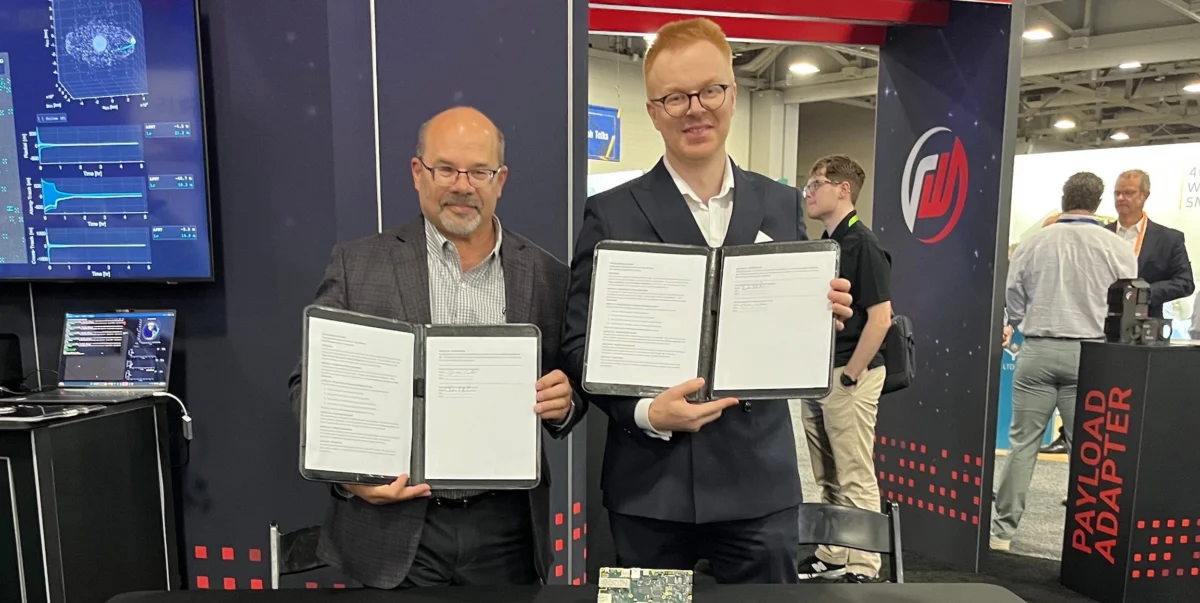
SALT LAKE CITY, Utah — In a move designed to address the tightening bottleneck of space-grade hardware production, Luxembourg-based Edge Aerospace and U.S.-based space infrastructure leader Redwire Corporation have officially entered into a strategic licensing agreement. The partnership, formalized during the annual Small Satellite Conference (SmallSat) in Utah, authorizes Redwire to manufacture Edge Aerospace’s advanced data processing units (DPUs) and high-speed network switches domestically within the United States.
This collaboration marks a significant pivot in the industrial strategy for both firms. By localizing production, the companies aim to bypass the notorious 18-to-24-month lead times that have plagued the satellite manufacturing sector, effectively creating a high-velocity supply chain for critical space-bound hardware.
The Core Agreement: Localizing Production for a Global Market
The licensing agreement, signed on August 25 by Redwire Defense Tech Senior Vice President Don Wesson and Edge Aerospace CEO JJ Jaworski, is a multi-faceted arrangement. Under the terms, Redwire will utilize its state-of-the-art manufacturing facility in Marlborough, Massachusetts, to produce Edge’s specialized computing hardware.
For Edge Aerospace, a company that has gained significant industry traction since its inception just two years ago, the deal solves a classic "scaling dilemma." While Edge maintains strong engineering and manufacturing ties in Europe to serve its non-U.S. customer base, the sheer volume of demand from American satellite integrators required a more localized approach.
"Since Edge Aerospace is two years old, bumping up towards such a large production is a challenge," said CEO JJ Jaworski during the signing ceremony. "We have collaborated with Redwire since almost the beginning of the company. Considering that Redwire is capable of manufacturing hundreds of units per year, this is a great collaboration to increase this distribution in the U.S."
For Redwire, the agreement serves a dual purpose: it provides them with the ability to integrate cutting-edge Edge Aerospace processors directly into their own product lines, while simultaneously acting as a manufacturing partner that can offer these high-performance units to their broader customer base.
Chronology: A Partnership Built on Long-Term Synergy
The road to this week’s announcement was not an overnight development, but rather the result of a two-year period of iterative collaboration between the two firms.
- 2023–2024 (The Inception Phase): Edge Aerospace establishes its presence in the market, focusing on low-latency, high-performance data processing for orbital assets. During this period, the company begins early-stage testing and design integration with Redwire, identifying key technical synergies between their processing architecture and Redwire’s space infrastructure platforms.
- Early 2025 (Supply Chain Realization): As the U.S. space sector begins an aggressive push toward increased orbital data processing, the lead times for specialized semiconductors and network hardware reach critical levels. Leadership at both companies recognizes that relying on trans-Atlantic logistics for high-volume U.S. demand is unsustainable.
- Mid-2025 (Negotiation): Formal discussions begin regarding a licensing model that would allow Redwire to leverage its Marlborough facility for domestic production. The goal is defined: create a "Made in the USA" pathway for Edge technology.
- August 25, 2026 (Formalization): During the Small Satellite Conference in Salt Lake City, the agreement is officially signed, setting the stage for the first units to roll off the Massachusetts production line by Q1 2027.
Supporting Data: Why In-Orbit Processing is the Next Frontier
The demand for the hardware produced under this agreement is driven by a fundamental shift in satellite architecture. Historically, satellites were designed primarily as "bent-pipe" relays, sending raw data back to Earth stations for processing. However, the rise of Space Domain Awareness (SDA) and the proliferation of high-resolution imaging sensors have rendered that model obsolete.
The "Data Tsunami"
Satellite integrators are currently managing a "data tsunami." A single imaging constellation can generate terabytes of data per day. Transmitting this raw data to the ground via limited bandwidth links is costly, slow, and operationally inefficient.
The Shift to Edge Computing
By moving the compute power to the "edge"—directly onto the satellite—integrators can:
- Filter and Analyze: Only transmit the critical insights or metadata to the ground, significantly reducing bandwidth requirements.
- Increase Autonomy: Enable satellites to make real-time decisions, such as maneuvering to avoid debris or re-tasking sensors based on autonomous anomaly detection.
- Reduce Latency: Decrease the time-to-insight from hours to seconds, a requirement for modern national security and commercial applications.
According to Jaworski, the demand for this specific capability in the U.S. market is "surprisingly fast." The Edge Aerospace DPU is designed to handle this workload, and Redwire’s manufacturing scale will be the catalyst that allows the industry to move from prototype-heavy development to mass-production constellations.
Official Responses: Addressing the Supply Chain Crisis
Don Wesson, senior vice president of Redwire Defense Tech, emphasized the strategic necessity of the agreement from the perspective of a manufacturer and system integrator.
"Anyone that tries to buy processing at this point notices that there’s an 18-month to two-year lead time," Wesson noted. "Now I can control our supply chain, and we can get our deliveries much faster."
By bringing the manufacturing of these components to Massachusetts, Redwire is insulating its programs from the global semiconductor volatility that has plagued the aerospace and defense sectors for the past half-decade. Wesson confirmed that the facility is currently preparing for the integration process, with expectations for the first commercial deliveries to reach customers in the first quarter of 2027.
For Redwire’s customers, this means they no longer need to source processors as a separate line item from a foreign supplier with uncertain shipping timelines. Instead, the DPU becomes a standard, readily available component in the Redwire ecosystem.
Implications for the Future of the Space Industry
The Redwire-Edge Aerospace agreement serves as a bellwether for the future of the "SmallSat" industry. Several key implications arise from this development:
1. The Rise of "Off-the-Shelf" Space Hardware
The industry is moving away from bespoke, one-off satellite components. By licensing technology for domestic mass production, companies are moving toward a modular, "off-the-shelf" economy. This reduces costs for the end-user and lowers the barrier to entry for new players in the space domain.
2. Domesticating the Defense Supply Chain
For the U.S. Department of Defense and intelligence community customers, domestic production is a top-tier priority. By shifting manufacturing to Marlborough, Redwire ensures that the critical processing hardware powering U.S. space assets remains within the domestic security perimeter, mitigating risks associated with international logistics and geopolitical instability.
3. Scaling for Constellations
The current trend toward mega-constellations requires hardware that can be manufactured in the hundreds or thousands. Traditional aerospace manufacturing—often characterized by slow, manual assembly—is being replaced by higher-throughput, semi-automated processes. Redwire’s capacity to manufacture "hundreds of units per year" is a direct response to this requirement.
4. Continued International Cooperation
Despite the push for domestic production, the agreement does not signal a total retreat from global markets. Edge Aerospace will continue its manufacturing operations in Europe, ensuring that their non-U.S. clients remain supported. This hybrid model—localizing production to the largest market while maintaining global reach—could become the blueprint for future aerospace startups looking to expand their footprint.
Conclusion
The partnership between Redwire and Edge Aerospace represents a mature step in the lifecycle of the modern space industry. By solving the dual challenges of lead-time volatility and production scalability, the two companies are positioning themselves at the center of the next generation of space infrastructure. As satellite integrators continue to shift toward data-heavy missions, the ability to rapidly source high-performance processing hardware will likely become the primary differentiator between market leaders and those left behind in the queue.
With production set to ramp up in the coming months, the space industry will be watching closely to see if this domestic manufacturing model can truly clear the backlog and set a new standard for the speed of space development.