Introduction: Moving Beyond the Terminal "Hello World"
Running a small language model (SLM) on a local machine has evolved from a niche hobby for hardware enthusiasts into a cornerstone of professional software engineering. In 2026, the question is no longer whether a developer can run a model locally, but rather how to integrate these powerful, open-weight systems into a high-performance development workflow.
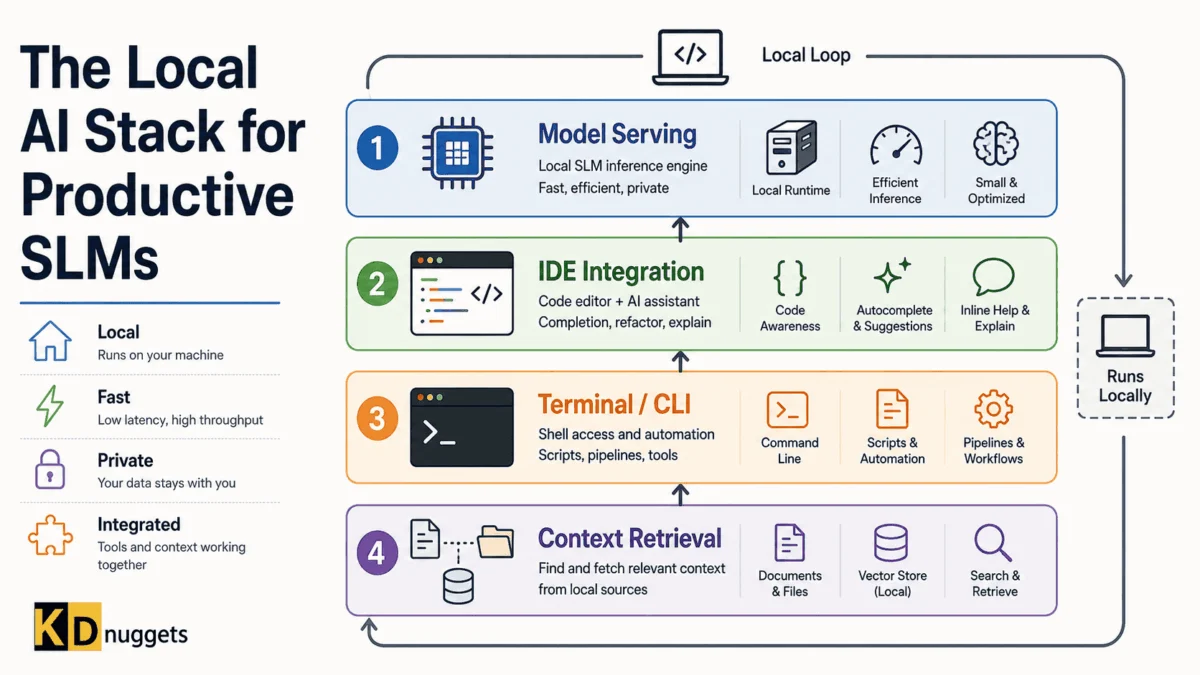
The gap between a terminal-based chatbot and a productive, context-aware AI assistant is defined by architecture. To move from novelty to utility, developers must treat their local AI environment as a multi-layered software stack. By decomposing the system into four distinct domains—Serving, Editing, Automation, and Retrieval—developers can construct a robust, private, and cost-effective infrastructure that rivals cloud-based alternatives.
The Four Layers of the Local AI Ecosystem
Layer 1: The Engine Room (Local Model Serving)
The serving layer acts as the foundation, bridging the gap between raw hardware—whether high-end NVIDIA GPUs or unified memory Apple Silicon—and the software that consumes the model’s intelligence.
- Ollama: Currently the industry standard for individual developers. It abstracts the complexity of quantization and memory management, providing a REST API that acts as a universal adapter for IDEs and CLI tools.
- LM Studio: A GUI-centric alternative that prioritizes model discovery and testing. It is the preferred tool for developers who require a visual interface to evaluate multiple model variants before committing them to a pipeline.
- Performance Engines (llama.cpp & vLLM): At the higher end of the spectrum, these engines cater to advanced use cases.
llama.cppoffers granular control over quantization, essential for edge deployment. Conversely,vLLMutilizes PagedAttention to enable high-throughput, concurrent request handling, making it the superior choice for engineering teams serving local models across multiple workstations.
Layer 2: The Editor Interface (Integrating Code and Context)
The IDE is where the rubber meets the road. Integrating an AI directly into the development environment requires a tool capable of balancing autonomous agency with developer oversight.
- Cline: Standing as the most prominent open-source coding agent for VS Code, Cline has eclipsed older plugins in popularity. Its "Plan/Act" paradigm ensures that the AI proposes a logical path before executing code edits or terminal commands. Its compatibility with the Model Context Protocol (MCP) allows it to reach beyond the local codebase to interact with databases and external APIs.
- The Cursor Shift: Following the June 2026 acquisition of the open-source stalwart
Continue.dev, the landscape has shifted. Cursor has emerged as a dominant, albeit commercial, platform. For developers seeking to remain strictly within the open-source ecosystem, community-maintained alternatives like Kilo Code have stepped in to fill the void left by the discontinuation of standalone Continue releases.
Layer 3: The Terminal Layer (Repo-Wide Automation)
While IDEs handle file-level edits, the terminal is the natural home for complex, multi-file refactoring and CI/CD integration.
- Aider: This tool is favored for its deep Git integration. By automating commit messages and tracking multi-file edits, it provides a structured, version-controlled experience that is difficult to replicate inside a GUI.
- OpenCode: With over 165,000 GitHub stars, this Go-based CLI harness has become the standard for headless AI automation. Its architecture is specifically designed for integration into automated pipelines, allowing developers to trigger AI-driven code reviews or refactors directly from the shell.
- Claude Code: While highly capable, it is important to note the distinction: Claude Code requires an internet connection for authentication. For developers prioritizing a "100% offline" air-gapped security posture, Aider or OpenCode remain the superior choices.
Layer 4: The Context Layer (Local Memory and Retrieval)
A model is only as intelligent as the data it can access. Without a robust Retrieval-Augmented Generation (RAG) system, an AI remains blind to project-specific documentation and legacy codebases.
- Embedded Databases: Tools like LanceDB and Chroma allow developers to implement vector search without setting up external servers. They are ideal for individual projects where simplicity and speed are prioritized.
- Standalone Vector Databases: For teams, Qdrant and pgvector offer the persistence and scalability required for enterprise environments.
pgvectoris particularly compelling for teams already relying on PostgreSQL, as it enables vector search without the burden of adding a new, specialized infrastructure component.
Chronology: The Evolution of the Local Stack
The maturation of local AI can be tracked through several key milestones over the last 24 months:
- Early 2025: The rise of Ollama simplified the "Getting Started" phase, turning local LLM deployment into a one-command process for millions of users.
- Mid 2026: The acquisition of Continue.dev by Cursor marked a consolidation phase, forcing the open-source community to pivot toward agentic tools like Cline and Kilo Code.
- Late 2026: The stabilization of the Model Context Protocol (MCP) has allowed for a standardized way to connect local models to external tools, finally enabling a truly "plug-and-play" agentic experience.
Supporting Data: Why Small Language Models (SLMs)?
The shift toward 1B to 14B parameter models is driven by hardware realities.
| Hardware Class | Recommended Model Range | Primary Use Case |
|---|---|---|
| Consumer (8-16GB VRAM) | 1B – 7B | Real-time autocomplete, refactoring |
| Enthusiast (24GB VRAM) | 7B – 14B | Agentic reasoning, RAG query processing |
| Server-Grade/Multi-GPU | 14B+ | High-throughput API serving, complex logic |
The efficiency gains of these SLMs are not just in VRAM usage; they also offer lower latency, which is critical for maintaining "flow state" during active coding sessions.
Official Responses and Industry Outlook
"The ecosystem is no longer experimental," says Vinod Chugani, an AI educator and technical mentor. "We have moved past the era where a developer needed to be a machine learning engineer to run a model. The current challenge is no longer deployment—it is architectural discipline."
Industry leaders suggest that the next frontier is not larger models, but rather "smarter context." By improving how the retrieval layer feeds data to the model, developers can achieve performance parity with massive, cloud-only models while maintaining absolute data privacy.
Implications: The Privacy and Cost Paradigm
The shift to a local stack has profound implications for corporate and individual security.
- Data Sovereignty: In a local stack, sensitive proprietary code never leaves the developer’s machine. This eliminates the risk of data leakage during model training or API processing, a critical concern for sectors like finance and healthcare.
- Cost Decoupling: By removing the reliance on per-token API pricing, developers can experiment freely without financial penalty. This encourages a "fail-fast" development culture.
- Dependency Resilience: As seen with the discontinuation of Continue.dev, cloud-dependent AI tools can disappear overnight. A local stack, built on modular, open-source components, offers long-term stability that third-party vendors cannot guarantee.
Conclusion: Building Your Own Path
The optimal local AI stack is not the one with the most tools, but the one with the most coherence. For most, starting with Ollama for serving, Cline for IDE integration, and Chroma for local retrieval provides a balanced, high-performance foundation.
As the industry moves into 2027, the barrier to entry will continue to drop. Developers who invest the time to master these layers now will find themselves with a significant competitive advantage: the ability to leverage state-of-the-art AI while maintaining full control over their code, their data, and their workflow. The era of the autonomous, private, local developer is not coming—it is already here.