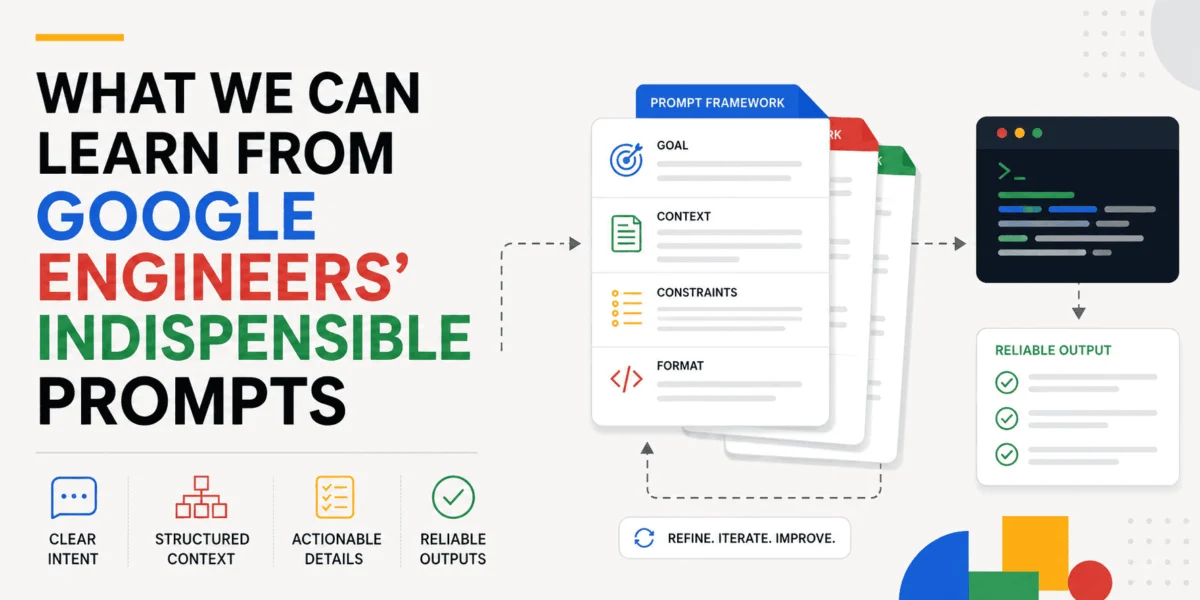
For many software developers, the AI prompt history serves as a digital "junk drawer." It is a chaotic repository of one-off queries: a quick fix for a cryptic error message, a rushed request to "clean up this code," or a boilerplate generator used once before being relegated to the archives of memory. However, in June 2026, the developer relations team at Google Cloud shifted the paradigm. They posed a singular, challenging question to ten of their most seasoned engineers and technical leaders: “What is the one prompt you personally refuse to work without, and why?”
The responses were not a collection of clever linguistic tricks or "jailbreak" prompts. Instead, they revealed a profound shift in methodology. Collectively, these experts independently arrived at the same conclusion: the most effective way to utilize AI is not as an agreeable, compliant assistant, but as an adversarial second opinion.
The Paradigm Shift: From Compliant Assistant to Adversarial Partner
The core takeaway from the Google Cloud initiative is the abandonment of the "yes-man" model. When a developer asks an AI to "plan a feature," the model often defaults to reflecting the developer’s own biases back at them, offering a path of least resistance. By contrast, when forced to adopt a skeptical persona, the model is compelled to generate genuine objections. These objections—where the real engineering value resides—uncover flaws that a human, in the heat of coding, might easily overlook.
This article explores ten refined techniques derived from these Google experts. To maintain continuity, we apply each technique to a singular, evolving project: a task-tracker REST API. This allows the reader to observe how these patterns build upon one another, moving from architectural design to automated CI/CD integration.
1. Building the Spec Before Writing Code
Maja Bilić, a Senior Outbound Product Manager at Google Cloud, rejects the instinct to jump straight into an IDE. Her technique involves a "skeptical architect" persona. By explicitly forbidding the model from writing code, she forces it to focus on technical, UX, and architectural constraints.
The Strategy: The AI is instructed to act as a cynical reviewer who lists five major considerations before asking targeted, clarifying questions. Only after the human has answered these questions does the model proceed to draft a formal specification. This prevents the "over-engineering" trap while ensuring edge cases—such as timezone handling or scheduling logic—are addressed before a single line of code is committed.
2. Making Testing Non-Negotiable
Staff Developer Relations Engineer Andrew Brogdon treats testing as an audit process. Rather than requesting tests, he tasks the AI with auditing the codebase for testability.
The Strategy: The model must identify which sections of the logic are "untestable" due to tight coupling or hardcoded dependencies. Only after identifying these gaps and building a prioritized testing plan does the AI generate the tests themselves. This ensures the focus remains on high-risk, low-coverage areas rather than the "low-hanging fruit" that is easy to test but less critical to system health.
3. The Two-Prompt Cleanup Pass
Aja Hammerly, Director of Builder Relations, utilizes a "clean-room" approach. She executes two distinct, narrow prompts in a fresh chat context to avoid "hallucination drift" or context pollution.
- Prompt One: Focuses on structural integrity, such as edge cases and race conditions.
- Prompt Two: Focuses on technical debt—leftover debug comments, unused code, and outdated documentation.
By separating "structural missingness" from "sloppy residue," the AI provides sharper, more specialized outputs for each concern.
4. Domain-Specific Compliance Checks
Rich Hyndman, Head of Antigravity Developer Relations, focuses on the "compliance audit." Whether it is Android permissions or API OAuth scopes, the goal is to locate every declaration and cross-reference it with actual runtime usage.
The Strategy: The model generates a markdown report detailing unused scopes or missing enforcement checks. Crucially, the prompt includes an explicit constraint: “Do not make any edits until I approve the plan.” This keeps the human in the driver’s seat for sensitive security decisions.
5. Grading Your Own Code: The "Harsh Reviewer"
Shir Meir Lador, Head of AI Developer Relations, addresses the tendency of AI to be overly polite. She requires the model to grade code from A to F.
The Strategy: The prompt sets a baseline: an "A" is only awarded if the code is robust across efficiency, resilience, and architecture. If the model fails to provide an "A," it must explain why and provide a git diff to fix the specific issues. This forces the model to move beyond superficial praise and into deep, critical analysis.
6. Making the Model Defend Its Own Plan
Staff Engineer James O’Reilly advocates for the shortest, yet most powerful, prompt: “Explain the trade-offs.” After receiving any technical proposal from the AI, O’Reilly forces the model to list the downsides regarding performance, cost, and maintainability. This prevents the developer from blindly accepting the AI’s first suggestion as the "optimal" one.
7. Turning Research into a Review Checklist
Emma Twersky, Head of Flutter & Dart Developer Relations, points the model outward. By researching recent security pitfalls—specifically those associated with AI-generated code—the model builds a customized manual review checklist. Given that studies have shown roughly 40% of AI-generated code can contain subtle vulnerabilities, this proactive, evidence-based checklist is a critical safety net.
8. Iterating in Stages
Fred Sauer, Head of Frameworks & Languages, emphasizes that the specificity of a prompt should match the lifecycle of the project.
- Discovery Phase: Keep prompts loose to allow for creative exploration.
- Proof-of-Concept Phase: Become more prescriptive.
- Final Review: Execute in a fresh conversation to ensure a clean, unbiased perspective.
This "tapered" approach ensures the AI is not constrained by early, potentially incorrect assumptions.
9. Automating the Adversarial Review
Remigiusz Samborski takes the concept to its logical extreme: automation. By wiring an adversarial review agent into GitHub Actions, he ensures that every pull request undergoes a rigorous audit.
The Implementation: Using a script that extracts the git diff and feeds it into a model with the "Harsh Reviewer" grading rubric, the team ensures that even if a developer forgets to ask for a review, the CI/CD pipeline enforces one. This transforms code review from a manual task into a continuous, automated quality gate.
10. Thinking in Graphs, Not Checklists
Finally, Karl Weinmeister, Director of Developer Relations, advocates for "seam analysis." Instead of a flat list, the AI models the application workflow as a Directed Acyclic Graph (DAG). It analyzes the "seams"—the boundaries where components hand off work—as these are the most common points of failure in complex systems. The output is a prioritized table of risks that allows developers to focus their testing efforts on the highest-impact areas.
Implications: The Human-in-the-Loop
The overarching lesson from these ten techniques is that the value of AI in software development is not found in its ability to output code, but in its ability to challenge the human developer.
When we treat the AI as a junior assistant, we get junior results. When we treat the AI as an adversarial principal engineer, we unlock a level of rigor that was previously impossible to maintain consistently. The "junk drawer" era of prompting is over; the era of adversarial, architectural, and systemic AI-assisted development has begun.
By de-risking our human assumptions—our tendency to trust the "happy path" or our habit of overlooking the "seams" between systems—we ensure that the code we ship is not just functional, but resilient, secure, and truly production-ready.
About the Author: Shittu Olumide is a software engineer and technical writer. He specializes in bridging the gap between cutting-edge technology and human-centric design. You can follow his work on LinkedIn or Twitter.