
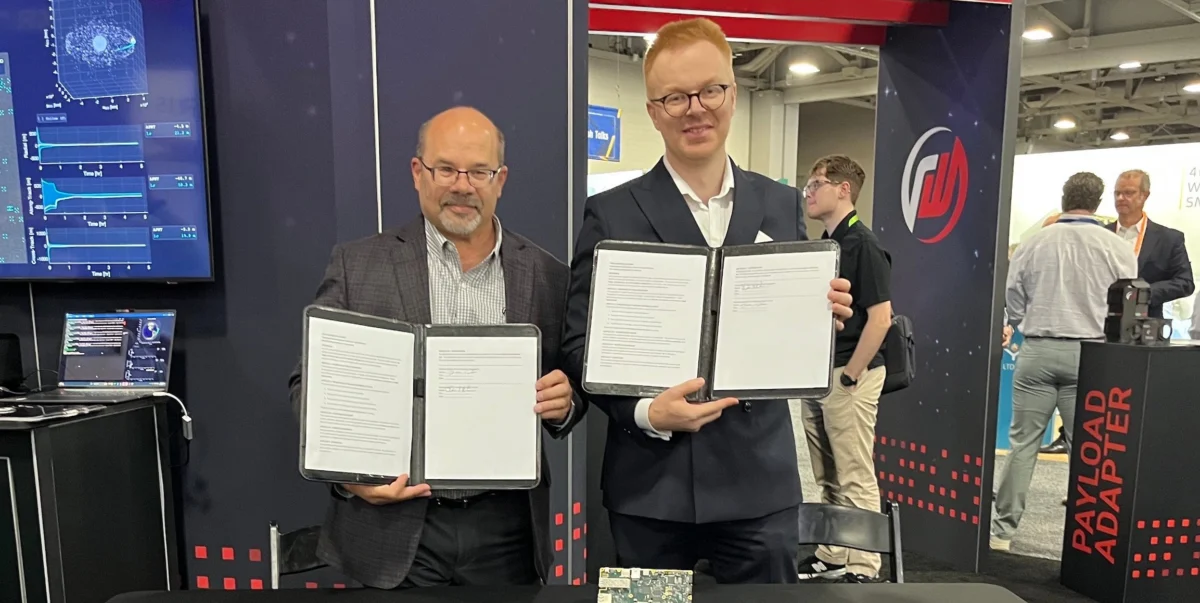
SALT LAKE CITY, UTAH — In a move poised to reshape the supply chain for orbital data processing, Edge Aerospace and Redwire Corporation have officially entered into a strategic manufacturing licensing agreement. Announced during the industry-leading Small Satellite Conference (SmallSat) in Utah, the partnership grants Redwire the authority to produce Edge Aerospace’s advanced data processing units (DPUs) and network switches domestically within the United States.
For the burgeoning commercial space sector, this collaboration represents a critical shift in how high-performance computing hardware is delivered to the front lines of space domain awareness (SDA) and satellite communications.
Main Facts: A New Backbone for Orbital Intelligence
The agreement, formalized on August 25, establishes a manufacturing pipeline that bridges the gap between Luxembourg-based innovation and American production capacity. Under the terms of the deal, Redwire Defense Tech will leverage its established manufacturing infrastructure in Marlborough, Massachusetts, to fabricate, assemble, and test Edge Aerospace’s specialized hardware.
Key highlights of the agreement include:
- Domestic Production: Redwire will manufacture Edge’s proprietary DPUs and network switches in the United States, effectively mitigating geopolitical and logistics risks associated with international shipping.
- Capacity Scaling: Redwire possesses the industrial throughput to produce hundreds of units annually, a significant upgrade for the two-year-old startup, Edge Aerospace.
- Product Integration: Beyond acting as a contract manufacturer, Redwire will integrate Edge’s processors into its own suite of space-ready hardware, making this technology immediately available to Redwire’s extensive existing client base.
- Timeline: Initial deliveries are projected to commence as early as the first quarter of the coming year, providing a rapid injection of hardware into a market currently starved for supply.
Chronology: From Concept to Commercialization
The trajectory of this partnership mirrors the rapid evolution of the "NewSpace" economy.
Early Genesis (2022–2023): Edge Aerospace was founded with the mission to solve the bottleneck of onboard data processing—the "last mile" problem of space-based intelligence. Since the company’s inception, it has maintained a close technical dialogue with Redwire, testing the integration of its units with Redwire’s modular satellite systems.
The Scaling Challenge (Early 2024): As demand for Edge’s high-performance computing modules surged, CEO JJ Jaworski identified a critical hurdle: his startup, while technologically superior, lacked the massive industrial footprint required to satisfy the voracious appetite of the U.S. government and commercial prime contractors.
The SmallSat Signing (August 25, 2026): During the Small Satellite Conference in Salt Lake City, Don Wesson (Senior Vice President, Redwire Defense Tech) and JJ Jaworski signed the formal agreement. This event served as the public launch of a supply chain strategy intended to bypass the industry’s notorious 18-to-24-month hardware lead times.
Supporting Data: The Processing Bottleneck
To understand the gravity of this partnership, one must examine the state of the semiconductor and hardware market in the aerospace sector. In recent years, the industry has been plagued by "lead time inflation." As satellite integrators transition from simple data relays to complex, edge-computing platforms, the requirement for high-reliability, radiation-hardened processing has skyrocketed.
The "Data Explosion" Factor
Modern satellites are no longer just mirrors in the sky; they are mobile data centers. SDA companies are now deploying sensors that generate terabytes of raw data. Downloading this raw data to Earth via traditional radio frequency (RF) links is increasingly inefficient due to bandwidth limitations. Edge Aerospace’s DPUs solve this by filtering, compressing, and analyzing data in situ, allowing for actionable intelligence to be transmitted rather than raw telemetry.
Supply Chain Realities
According to industry benchmarks, purchasing high-end space-grade processors currently involves wait times of up to two years. By localizing production in Marlborough, Massachusetts, Redwire and Edge are effectively reclaiming control over their supply chain. This move reduces the "uncertainty tax" that has plagued satellite integrators, allowing them to finalize spacecraft designs with the confidence that their core processing units will arrive on schedule.
Official Responses: Aligning Strategy and Execution
The leadership teams from both organizations emphasized that this is not merely a contract, but a symbiotic technical evolution.
JJ Jaworski, CEO of Edge Aerospace:
"Since Edge Aerospace is two years old, bumping up toward such a large production volume is a daunting challenge. We have collaborated with Redwire since almost the beginning of the company. Considering that Redwire is capable of manufacturing hundreds of units per year, this is the ideal collaboration to increase our distribution in the U.S. market. The demand we are seeing right now is unprecedented; we have never seen such a hunger for these systems, and Redwire is the engine that will allow us to satisfy it."
Don Wesson, SVP of Redwire Defense Tech:
"Anyone that tries to buy high-end processing at this point notices the 18-month to two-year lead time. By bringing this manufacturing into our own facilities, I can control our supply chain, and we can get our deliveries out the door much faster. It’s about responsiveness. When our customers need to build a resilient satellite constellation, they cannot afford to wait two years for a central processor. We are closing that gap."
Implications: A Shift in the Space Domain Awareness Landscape
The implications of this agreement extend far beyond the two companies involved. It signals a shift in how the U.S. space industry views the "Build vs. Buy" dilemma.
1. Strengthening the Domestic Industrial Base
By manufacturing these units in Massachusetts, the partnership aligns with the growing push for "Made in America" space hardware. This is particularly crucial for defense-related contracts where security of the supply chain and provenance of hardware components are of paramount importance to the Department of Defense (DoD) and the Intelligence Community.
2. The Rise of the "Integrated Satellite"
With Redwire integrating Edge’s processors into its broader product portfolio, satellite integrators will increasingly be able to purchase a "pre-validated" stack. This reduces the risk for integrators who previously had to purchase disparate components and gamble on their interoperability. The ability to pull a pre-integrated, edge-computing-capable satellite bus off the shelf (or close to it) will accelerate the development cycle of the next generation of SDA constellations.
3. Economic Resilience
The partnership provides a blueprint for other international startups. By licensing their technology to established U.S. manufacturers, foreign firms can tap into the massive American space market without the massive capital expenditure of building their own domestic factories from scratch. Conversely, U.S. companies gain access to cutting-edge technology that might otherwise take years to develop in-house.
4. Future Outlook
As the industry moves toward 2027 and beyond, the success of this collaboration will likely be measured by the speed at which it can scale. If Redwire can successfully hit the projected Q1 delivery milestones, it will set a new industry standard for responsiveness. For Edge Aerospace, the focus will remain on continuous innovation, knowing their manufacturing and distribution requirements are handled by a partner with a proven track record.
In conclusion, the collaboration between Redwire and Edge Aerospace is a landmark moment for the SmallSat sector. It addresses the most critical pain point in the industry—hardware availability—and provides the infrastructure necessary to support the next era of high-speed, space-based data processing. As satellite constellations grow in complexity and size, the importance of these "intelligent nodes" in orbit will only increase, making this partnership a foundational element of the future space economy.