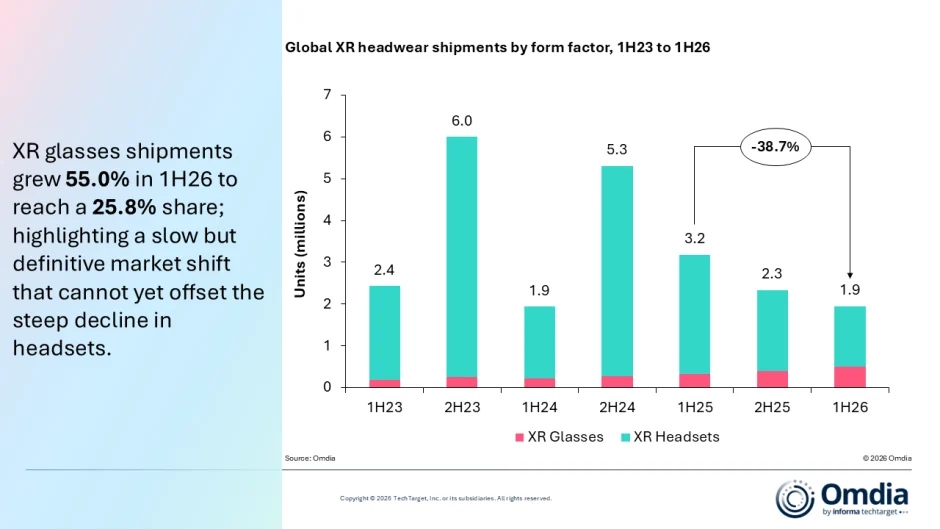
The Extended Reality (XR) headwear market experienced a significant downturn in the first half of 2026, with global shipments plummeting by 38.7% year-on-year to just 1.9 million units. This sharp contraction, as detailed in Omdia’s latest market research, signals a profound transformation within the industry. While traditional virtual reality (VR) headsets are grappling with weakening demand, a burgeoning category of XR glasses is rapidly gaining traction, hinting at a future where immersive experiences might take a backseat to more integrated, everyday wearable technology.
The decline in overall shipments is not an isolated event but rather the continuation of a trend that has seen the XR headwear market contract for the fourth consecutive year. This follows the peak in shipments observed in 2021, largely driven by pandemic-induced demand for immersive entertainment and remote collaboration tools. However, beneath the headline figures lies a crucial narrative of evolving consumer preferences. The market is witnessing a discernible migration away from the bulky, often isolating nature of VR headsets towards sleeker, more versatile XR glasses. These new devices are being engineered not just for deep immersion but also for a wider array of applications, including enhanced video consumption, sophisticated gaming, seamless integration with artificial intelligence, and a host of everyday functionalities.
A Dramatic Shift in Device Preference: XR Glasses Ascend
The most striking revelation from Omdia’s research is the dramatic rise of XR glasses within the overall XR headwear landscape. In the first half of 2026, XR glasses captured an impressive 25.8% of global shipments, a substantial leap from their 10.2% share in the same period of the previous year. This burgeoning segment is largely propelled by the growth of tethered display glasses, devices that connect to smartphones or other computing sources to provide augmented and virtual experiences.
Leading this charge are prominent brands such as RayNeo, VITURE, and XREAL, which collectively dominate the tethered display glasses market, holding a commanding 93.1% share. Products like the RayNeo Air 4 and the VITURE Beast series have been instrumental in propelling these companies to new heights. RayNeo has emerged as the second-largest XR headwear vendor overall, securing 9.9% of the global market, while VITURE follows closely in third place with an 8.6% market share. This remarkable performance underscores a fundamental shift in consumer priorities: a willingness to trade some degree of immersive functionality for lighter, more accessible devices that can be seamlessly integrated into daily routines for entertainment, gaming, and potentially a host of other daily tasks.
Meta’s Declining Dominance and the Rise of New Ecosystems
While Meta has historically been the undisputed titan of the XR headwear market, its once-unshakeable dominance has significantly eroded. In the first half of 2026, Meta’s global market share plummeted from a commanding 71.3% in 1H25 to 48.2%. This sharp decline is attributed to softer demand for its flagship Meta Quest 3 and Quest 3S devices. Despite advancements in specifications and more attractive pricing, these VR headsets have apparently failed to ignite a significant replacement cycle among existing users or attract a substantial new audience.
This weakening of Meta’s position opens the door for alternative ecosystems to flourish. The trend suggests a potential pivot in industry investment towards lighter devices that intelligently combine AI capabilities, advanced cameras, sophisticated displays, and robust connectivity. These are precisely the technologies that are increasingly converging with the broader 5G and telecom technology market, indicating a future where XR devices are not just standalone entertainment platforms but integral components of a connected digital life.
Reinforcing the Trend: Intelligent Eyewear Surges
Further corroborating this shift, independent research from Counterpoint Research highlights the explosive growth in the "intelligent eyewear" segment. In the first quarter of 2026, global intelligent eyewear shipments witnessed a remarkable 83% year-on-year increase. Within this category, AR glasses experienced an astounding 136% surge, while display-less smart glasses saw an even more dramatic rise of 210%. In stark contrast, VR headset shipments within the broader XR landscape declined by 17%.
The competitive landscape for AR glasses, particularly in the "Birdbath/Flat Prism" form factor, is intensifying. RayNeo leads this segment with a 41% market share, followed by VITURE, which has captured 34% after an impressive 281% year-on-year shipment growth. The burgeoning field of waveguide-based AR also showcases fierce competition, with Rokid taking the lead, followed by Meta at 38%, Even Realities with 9%, and Alibaba with 5%. These figures underscore a market that is rapidly fragmenting, with specialized eyewear vendors challenging the long-standing dominance of traditional VR headset manufacturers.
The AI Revolution and the Reshaping of XR Competition
Artificial intelligence is emerging as a pivotal catalyst in the evolution of XR devices. Google is at the forefront of this movement, actively developing Android XR in collaboration with industry giants Samsung and Qualcomm. The company is also integrating its advanced Gemini AI capabilities into XR products, signaling a future where AI is a core component of the XR experience. Google has publicly highlighted eyewear partners such as Gentle Monster and Warby Parker as key players within its expanding Android XR ecosystem.
This strategic alignment of Android XR, Gemini AI, Samsung’s hardware expertise, and Qualcomm’s chipsets presents a compelling alternative ecosystem to Meta’s current vertically integrated XR strategy. Simultaneously, Apple continues to pursue its vision of spatial computing with the Vision Pro, while companies like RayNeo, VITURE, XREAL, and Rokid are capitalizing on the growing consumer appetite for lighter, more accessible smart glasses.
Geographic Market Dynamics and Future Projections
North America continues to hold its position as the world’s largest market for XR headwear, accounting for 43.9% of global shipments in 1H26. Western Europe follows with 23.8%. A noteworthy development is the significant increase in Greater China’s market share, which rose from 11.9% in 2025 to 16.3% in 1H26. This growth has propelled China to become the third-largest XR headwear market, surpassing the Rest of Asia-Pacific, driven primarily by strong domestic demand for tethered display glasses.
Looking further ahead, projections indicate that smart glasses are poised to become a primary growth engine for the entire XR industry. IDC reports that shipments of display-less smart glasses surged by an astonishing 167% year-on-year in Q1 2026, reaching approximately 2.25 million units. IDC forecasts that these shipments will escalate to 13.6 million units in 2026 and are projected to hit 27.3 million units by 2030, demonstrating a robust compound annual growth rate (CAGR) of 18.9%. Display glasses are expected to expand even more rapidly, with shipments projected to grow from 3 million units in 2026 to a substantial 12.2 million units by 2030, reflecting an impressive CAGR of 41.9%. These long-term forecasts strongly suggest that the future growth opportunities for XR are increasingly shifting away from devices optimized for extended, immersive sessions and towards glasses designed for more frequent, everyday use.
The Dawn of a New XR Era: Beyond VR Headsets
The stark 38.7% decline in overall XR headwear shipments to 1.9 million units in the first half of 2026 should not be interpreted as a sign of waning consumer interest in the broader XR space. Instead, it points to a fundamental and rapid evolution in device preferences. While Meta remains a significant player, its market share has now dipped below the crucial 50% threshold, a testament to the growing influence of companies like RayNeo, VITURE, and XREAL, which are carving out substantial niches in the display glasses segment.
Concurrently, tech giants such as Google and Samsung, alongside a host of other innovators, are strategically positioning artificial intelligence as the central pillar of the next generation of wearable computing. With XR glasses already commanding 25.8% of the market – a significant jump from just 10.2% a year prior – it is evident that lighter, more accessible devices are rapidly becoming the industry’s primary growth narrative.
The ensuing competitive arena is unlikely to be solely defined by incremental improvements in virtual reality experiences. Instead, the next wave of innovation and market success will likely be driven by a synergistic combination of advanced AI, lightweight and aesthetically pleasing display technologies, seamless mobile connectivity, and practical, everyday wearable applications. This marks the dawn of a new era for XR, one that promises to integrate immersive and augmented experiences more seamlessly into the fabric of our daily lives.
FASNA SHABEER