In the rapidly evolving landscape of Large Language Model (LLM) deployment, the "inference bottleneck" remains the primary obstacle for developers and enterprises alike. As models grow more sophisticated, the demand for computational resources increases, often leading to prohibitive hardware costs and latency issues. While techniques such as model quantization, kernel optimization, and specialized inference engines have become industry standards, a new, highly efficient strategy is gaining traction: Speculative Decoding.
Among the emerging architectures in this field, DSpark—a method introduced by DeepSeek—stands out as a sophisticated evolution of parallel drafting. By bridging the gap between high-speed parallel generation and the nuanced accuracy of sequential processing, DSpark promises significant throughput gains without the need for additional GPU clusters. This article explores the mechanics of DSpark, provides a hands-on implementation guide using llama.cpp and Qwen3-8B, and analyzes the implications for the future of local AI deployment.
The Core Challenge: The Inference Bottleneck
To understand why DSpark is a breakthrough, one must first recognize the fundamental nature of autoregressive generation. LLMs generate text one token at a time; each generated token depends on all previously generated tokens. This sequential dependency is computationally expensive, as it prevents the parallelization that modern GPUs are designed to handle.
Speculative decoding attempts to solve this by using a smaller, faster "draft" model to predict a sequence of future tokens. The main "target" model then verifies these tokens in parallel. If the target model accepts them, the inference engine skips the latency of multiple sequential passes. However, traditional speculative methods often struggle with accuracy; if the draft model is too simple, the target model rejects the tokens, wasting the compute spent on drafting.
The DSpark Advantage: Blending Speed and Precision
DeepSeek’s DSpark introduces a novel architectural twist to the drafting process. Traditional parallel draft models generate entire blocks of tokens simultaneously, which is lightning-fast but often inaccurate because the draft tokens are generated independently of one another.
DSpark optimizes this by integrating a parallel backbone with a lightweight sequential component. This hybrid design allows draft tokens at later positions to incorporate information from earlier predictions within the same block. By maintaining contextual awareness during the drafting phase, DSpark achieves a higher "acceptance rate"—the frequency at which the target model confirms the draft tokens as correct.
Furthermore, DSpark incorporates a confidence-estimation mechanism. The system evaluates the likelihood of draft tokens surviving the verification process; if the model identifies low-confidence segments, it can abort the drafting process early to save precious GPU cycles. This intelligent gating is a significant step forward in efficiency, moving beyond brute-force parallelization toward a more resource-aware paradigm.
Chronology of the Implementation: Benchmarking DSpark
To evaluate the efficacy of DSpark, we performed a controlled benchmark using the Qwen3-8B model on a standard GPU setup. By comparing the baseline performance against a DSpark-accelerated environment, we can quantify the tangible speed gains.
Phase 1: Preparation and Environment Setup
The experiment utilized the latest llama.cpp repository, which offers native support for DSpark via CUDA acceleration. The following technical workflow was executed:
- Environment Initialization: We updated the Ubuntu system and installed essential build tools (
git,cmake,build-essential). - Compilation:
llama.cppwas built from source with CUDA support enabled to ensure full hardware utilization:cmake llama.cpp -B llama.cpp/build -DBUILD_SHARED_LIBS=OFF -DGGML_CUDA=ON cmake --build llama.cpp/build --config Release -j --clean-first --target llama-cli - Model Acquisition: We sourced the Qwen3-8B Q4_K_M GGUF model as our primary target and the corresponding DSpark Q8_0 draft model from Hugging Face.
Phase 2: Establishing the Baseline
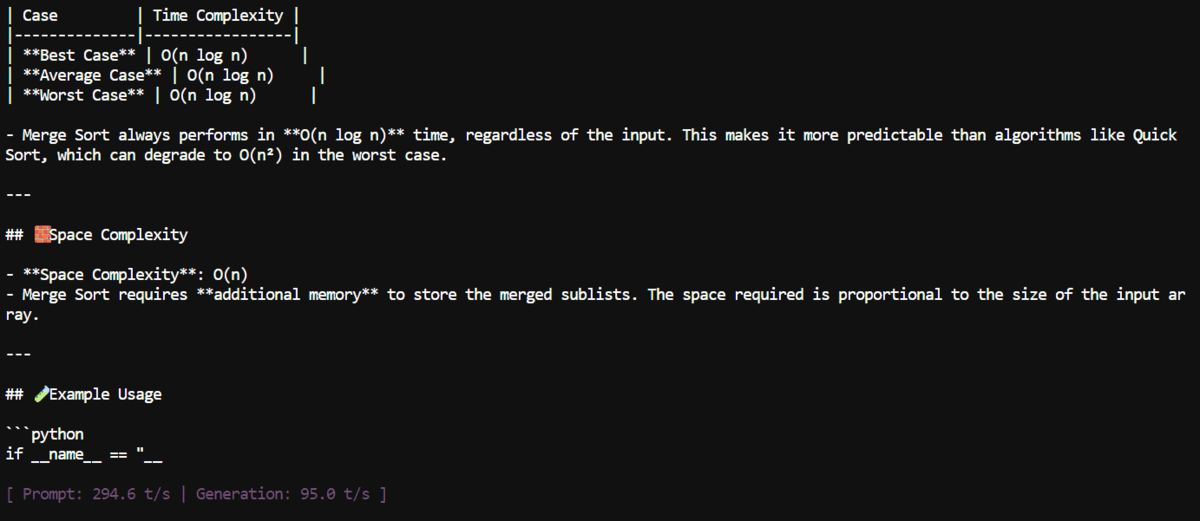
To ensure an accurate "apples-to-apples" comparison, we first ran the target model without speculative decoding. Using a fixed prompt—a request for a Python implementation of merge sort—and deterministic settings (--temp 0, --top-k 1), we established a baseline performance. The generation speed clocked in at 95.0 tokens per second (t/s).

Phase 3: Activating DSpark
With the baseline established, we initiated the second run using the DSpark draft model (-md) and the draft-dspark flag. We limited the draft to three tokens (--spec-draft-n-max 3) to balance speed against memory overhead. Upon execution, the generation speed rose to 124.9 t/s.
Supporting Data: Comparative Performance Metrics
The results of our benchmarking demonstrate a clear performance benefit. As illustrated in the table below, the integration of DSpark resulted in a ~31.5% improvement in generation throughput.
| Configuration | Prompt Speed (t/s) | Generation Speed (t/s) |
|---|---|---|
| Qwen3-8B Baseline | 294.6 | 95.0 |
| Qwen3-8B + DSpark | 88.0 | 124.9 |
Note: While the prompt-processing speed (the initial phase of LLM inference) showed a slight decrease due to the overhead of loading the draft model, the autoregressive generation speed saw a significant uplift. For long-form text generation, where the bulk of inference time is spent, the 31.5% speedup represents a major gain in user-perceived performance.
Implications for the AI Ecosystem
The findings from our test carry several implications for developers and AI researchers:
1. Optimization Without Hardware Upgrades
The primary takeaway is that architectural innovation can substitute for hardware investment. For developers running models on consumer-grade GPUs, a 30% increase in throughput essentially provides a "free" upgrade, allowing for more concurrent users or more complex prompt chains without purchasing additional VRAM or compute power.
2. The Trade-off of Complexity
While DSpark is highly effective, it introduces complexity. Unlike standard inference, DSpark requires a compatible draft model, which is not yet available for every LLM in existence. Furthermore, the llama.cpp implementation is still maturing. Developers must weigh the performance gains against the stability requirements of their production environment.
3. The Future of Multi-Token Prediction (MTP)
While DSpark represents a sophisticated approach to speculative decoding, Multi-Token Prediction (MTP) remains a strong contender due to its broader model compatibility and simpler integration. However, as the ecosystem for DSpark-compatible models grows, its ability to provide high-confidence drafts may make it the preferred method for latency-sensitive applications like real-time coding assistants or interactive AI agents.
Final Thoughts: Is DSpark the New Standard?
DSpark is a compelling addition to the toolset of any AI engineer looking to push the boundaries of local model performance. By intelligently combining parallel drafting with sequential dependencies, it offers a robust solution to the inherent limitations of standard autoregressive generation.
However, the technology is currently in a state of rapid evolution. While we achieved a ~31% speed increase in our testing, the "best" approach—whether it be MTP, DSpark, or future techniques—will depend heavily on the specific model and the nature of the workload. For now, we recommend that developers treat DSpark as a high-performance, experimental tool. As support broadens and documentation stabilizes, it is highly likely that DSpark-like mechanisms will become a standard feature in high-efficiency inference engines, marking another chapter in the ongoing effort to make powerful AI accessible, fast, and local.
About the Author: Abid Ali Awan is a certified data scientist and machine learning enthusiast. With a background in telecommunications and technology management, he focuses on democratizing AI through accessible technical content and research into graph neural networks.